
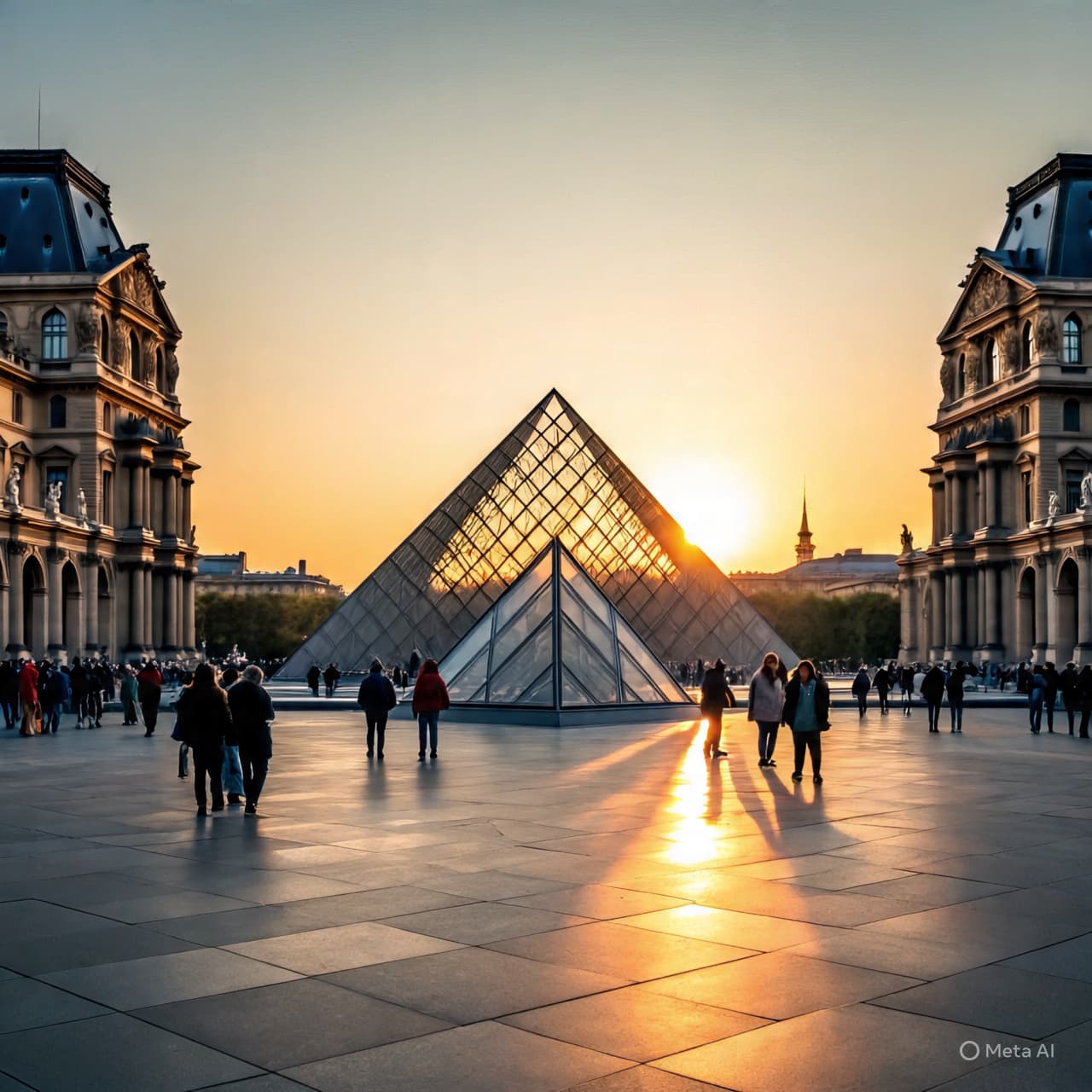
At dusk, the glass pyramid of the Louvre gathers the last light of Paris and returns it in fragments—triangles of amber and blue shimmering against the stone of centuries. Tourists drift across the courtyard in slow currents, their footsteps echoing faintly beneath the archways of the old palace. The museum has long been a sanctuary of stillness, where history is arranged in careful sequence and silence feels curated. Yet recently, that stillness has been unsettled.
A sudden wave of disruptions—staff walkouts, security alerts, and logistical strain—has thrown the Louvre into a moment of visible disorder. Galleries have closed without warning. Visitors have been ushered out into the courtyard, puzzled beneath the vast Parisian sky. Union representatives have cited understaffing and mounting pressure on employees, while officials have pointed to security protocols tightened amid broader national concerns. What unfolds inside the museum’s corridors reflects tensions that extend beyond its walls.
For President Emmanuel Macron, the turbulence carries symbolic weight. Since taking office, he has framed culture as both inheritance and instrument—an emblem of France’s global presence and a pillar of national cohesion. Investments in heritage restoration, from Notre-Dame’s reconstruction to regional arts initiatives, have been part of a broader narrative about renewal. The Louvre, as the world’s most visited museum, stands at the center of that story.
The pressures are layered. France has faced waves of protest in recent years over pension reforms, cost-of-living strains, and public sector budgets. Cultural institutions, often dependent on a blend of state support and ticket revenue, feel the tremors of fiscal recalibration. At the Louvre, employees have warned that surging visitor numbers—returning strongly after pandemic closures—have not been matched by staffing levels or infrastructure upgrades. The result is a friction between spectacle and sustainability.
Security adds another dimension. France remains on heightened alert following past attacks, and major cultural sites operate within intricate protective frameworks. Temporary evacuations, even when precautionary, ripple quickly through social media and international headlines. The image of tourists waiting outside the pyramid, uncertain and subdued, contrasts with the museum’s usual choreography of orderly queues and timed entries.
Within the Élysée Palace, such scenes resonate politically. Macron’s presidency has often balanced reformist ambition with public resistance. His legacy—still in motion—includes efforts to modernize the economy and reposition France within Europe. Yet the health of national institutions, especially those that embody French identity, shapes public perception as powerfully as legislation. When the Louvre falters, even briefly, it feels less like an isolated incident and more like a metaphor.
Cultural leaders have called for dialogue and renewed investment, emphasizing that the museum’s global stature depends not only on masterpieces but on the people who safeguard them. The Mona Lisa’s small, watchful smile draws millions each year, but behind the canvas stand guards, conservators, ticketing agents—an ecosystem of labor that rarely commands headlines. Their concerns, voiced through strikes and statements, suggest a desire to reconcile grandeur with practical care.
As evening settles, the courtyard gradually empties. The pyramid’s reflection steadies in the shallow pools, and Paris resumes its familiar rhythm. The Louvre will reopen its galleries; visitors will again cluster before paintings that have endured revolutions and restorations alike. Yet the recent chaos lingers as a quiet reminder that even the most enduring institutions depend on contemporary stewardship.
For Macron, the moment underscores a broader truth: legacy is not carved solely in stone façades or policy documents, but in the daily functioning of the institutions that define a nation’s cultural life. The Louvre’s temporary disorder may pass quickly, absorbed into the museum’s long chronology. Still, it casts a brief, telling light on the delicate balance between ambition and administration, spectacle and stability—an equilibrium upon which both art and politics quietly rest.
AI Image Disclaimer Illustrations were created using AI tools and are not real photographs.
Sources Reuters Le Monde BBC News France 24 The Guardian
Published by Banx Network. This article is part of the Banx decentralized media programme, powered by the BXE token on the XRP Ledger.


