There is a calm in the night sky that belies the restless motions hidden within it. When we look upward, stars often seem like fixed beacons — gentle, unwavering, distant. But the cosmos is not still. In the immense tapestry of galaxies and gas, even the largest stars carry stories of transformation, of births and endings written in light.
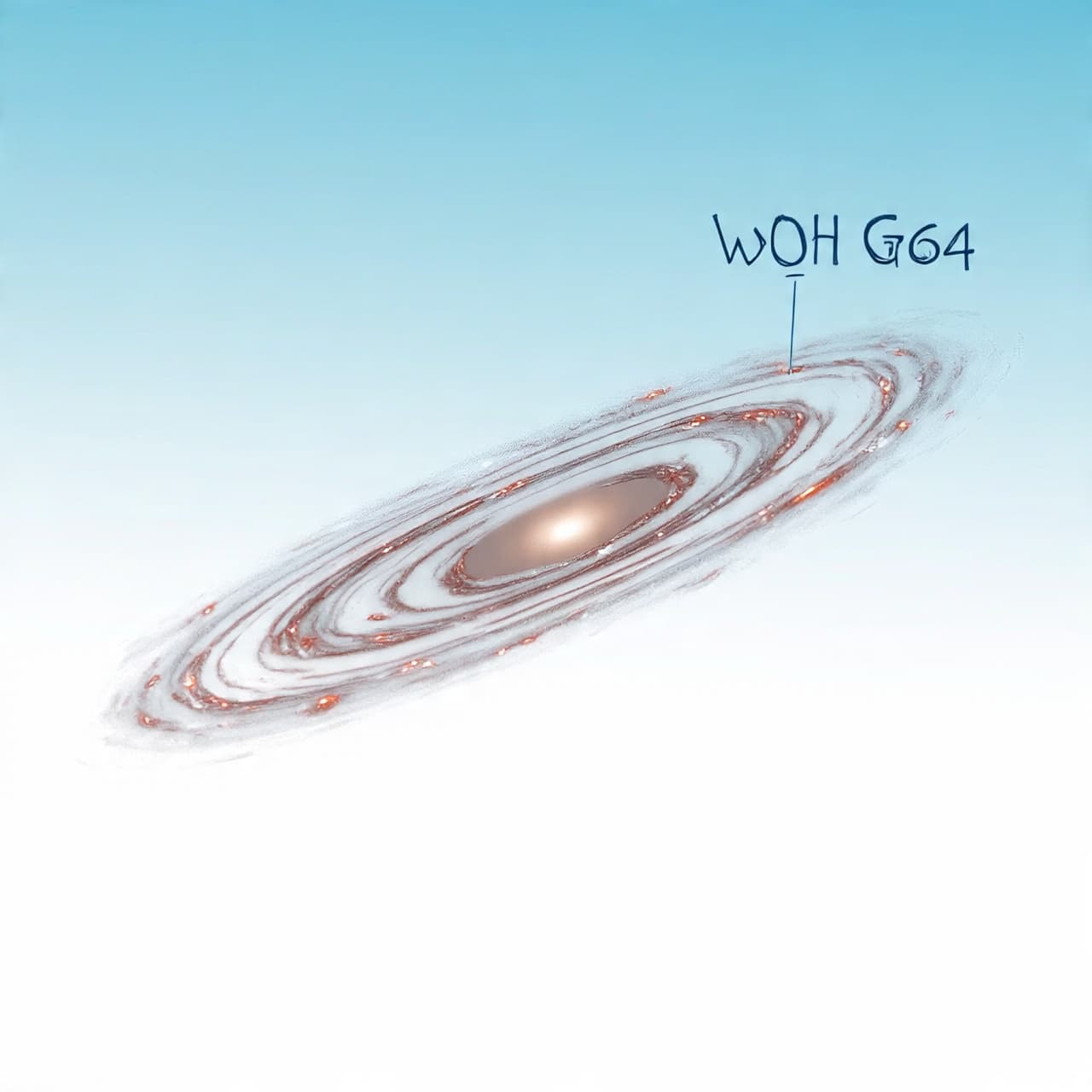
A star called WOH G64, tucked away in the Large Magellanic Cloud some 160,000 light‑years from Earth, has long captivated astronomers for its sheer scale. It dwarfs our own Sun in ways that almost stretch belief: roughly 28 times the Sun’s mass and up to 1,500 times its diameter, its surface spans a distance that, if it replaced the Sun, would extend past the orbit of Jupiter. This enormous star has been under observation for decades, its light collected across generations of telescopes and surveys.
What scientists have now found is that WOH G64 has not been content to remain the same. Over the span of several decades, the star’s surface has warmed and shifted in color. Once classified as an extreme red supergiant — a bloated, cool, and luminous phase near the end of a massive star’s life — it has taken on the characteristics of a much rarer yellow hypergiant. In cosmic terms this transformation is swift, a change in temperature and hue unfolding in what feels like an eye blink compared to billions of years of stellar evolution.
The transition from red to yellow suggests a rise in surface temperature and a subtle contraction, refashioning the star’s outward glow. Yet there is no dramatic eruption or explosive event attached to it, no sudden flash or burst of matter hurled into space. Instead, the change is measured in light and spectral features, a quiet re‑balancing of the star’s outer layers that challenges the models astronomers use to understand how the most massive stars live and die.
This unusual behavior touches on a lingering question in astrophysics: what happens to stars of this size as they approach the end of their lives? Stars between about eight and 23 times the mass of the Sun are generally expected to evolve into red supergiants and later explode as supernovae. But WOH G64, at nearly 30 solar masses, occupies a boundary where fate is less certain. Some may explode, some may collapse directly into black holes, and others, perhaps like this one, may pass through intermediate states that have been seldom observed.
Adding another layer of complexity is the fact that WOH G64 appears to be part of a binary system, bound in a delicate waltz with a companion star. This relationship could influence how the star loses mass, how its outer layers shift and shimmer, and even how its deep interior marches toward eventual collapse. Binary interactions are known to shape stellar evolution in ways that single‑star models do not fully capture, leaving scientists to ponder whether the observed changes are intrinsic to the star itself or sculpted by a celestial partner.
The journey of WOH G64 invites reflection on the rhythms of the heavens. In its slow, observable evolution we glimpse processes that space scientists once thought would unfold on timescales far beyond human observation. Instead, here is a star that changes within the span of decades, offering a rare window into the final chapters of stellar life before ultimate fates — explosive or otherwise — play out.
The observations of WOH G64’s transformation were detailed in a study published in Nature Astronomy. Astronomers continue to monitor this star using telescopes that capture both its brightness and spectral shifts, seeking to refine their understanding of massive star evolution and the interplay of physics that governs the largest suns in the cosmos.
Illustrations were created using AI tools and serve as conceptual representations.
Sources (Media Names Only)
Reuters ScienceAlert Space.com Channel NewsAsia Sky & Telescope
Published by Banx Network. This article is part of the Banx decentralized media programme, powered by the BXE token on the XRP Ledger.