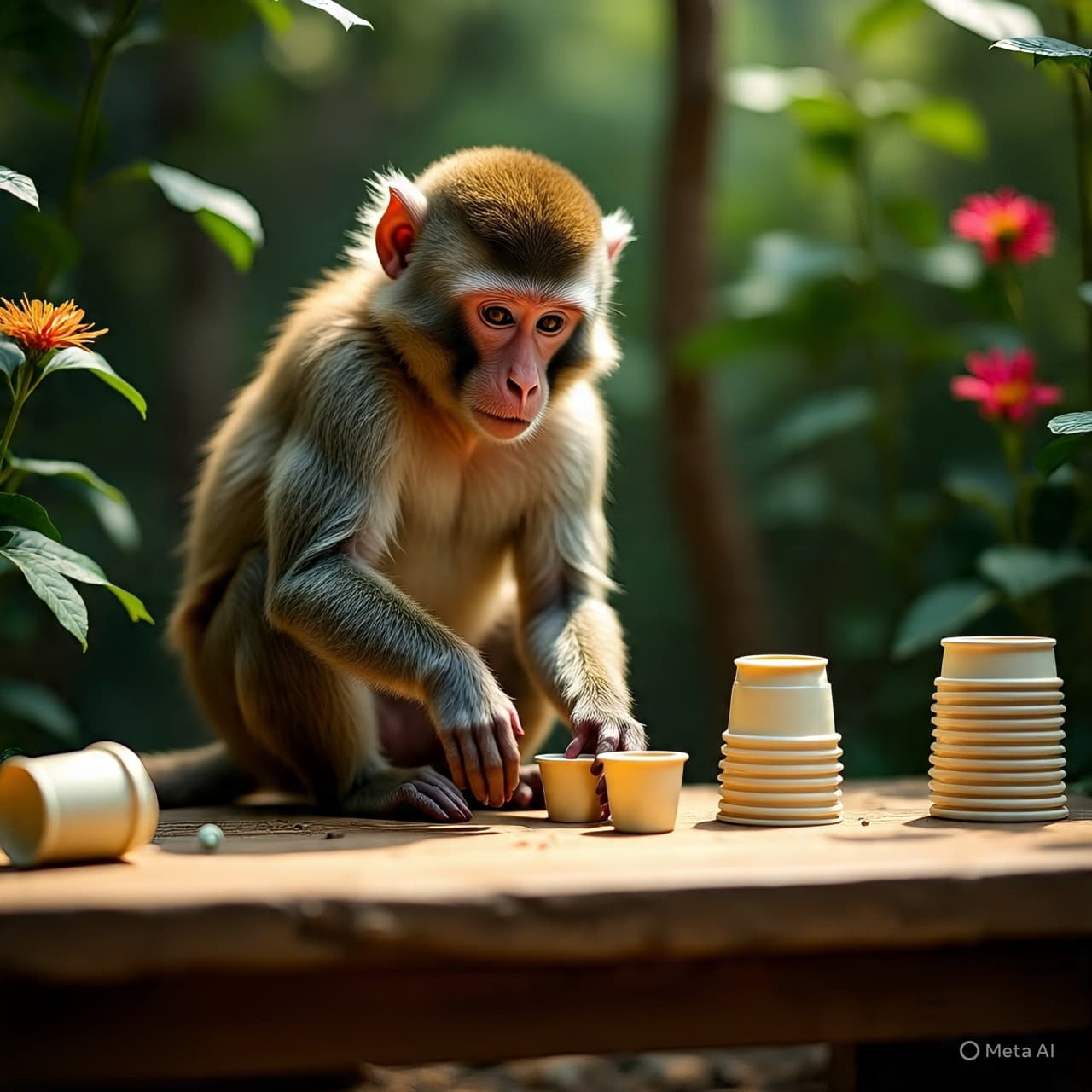
In the filtered light of a research enclosure, where branches cast shifting patterns across the ground, a small table is set. Cups—light, unbreakable, deliberately plain—rest within reach. There is no ceremony in the human sense, no spoken invitation. And yet, what unfolds around such objects may quietly reshape long-held assumptions about primate intelligence.
In a recent study, researchers introduced a simple “tea party” scenario to nonhuman primates, offering them toy cups and familiar social partners. The experiment was designed not as spectacle but as inquiry: to observe whether primates would engage in forms of pretend play, an ability often associated with advanced cognitive flexibility and, historically, considered largely human.
Pretend play has long been treated as a marker of symbolic thought—the capacity to treat one object as if it were another, to suspend literal reality in favor of imagined meaning. In children, it emerges early and is linked to language development, social reasoning, and abstract thinking. Among nonhuman primates, however, evidence of such behavior has been debated. Some studies have suggested limited forms of pretense, while others have interpreted similar actions as exploratory rather than symbolic.
In the tea party experiment, researchers observed instances in which primates appeared to “serve” or “drink” from empty cups, engaging with objects in ways that resembled representational play. The gestures were subtle: lifting a cup to the mouth, offering it toward a companion, repeating the action without immediate tangible reward. Scientists were careful in their interpretation, noting that behavior must be distinguished from simple manipulation or imitation.
Still, the implications ripple outward. If primates demonstrate even rudimentary forms of pretend play, it suggests that the roots of symbolic cognition may extend deeper into evolutionary history than previously thought. Cognitive scientists have long sought to understand where the line between human and nonhuman intelligence is drawn. Increasingly, that line appears less like a boundary and more like a gradient.
The study does not claim equivalence between human imagination and primate behavior. Rather, it invites reconsideration of how intelligence is measured. Traditional assessments often rely on problem-solving tasks or tool use, areas where certain primates have already demonstrated sophistication. Play, however, reveals something more nuanced: flexibility, social awareness, and perhaps the beginnings of shared imaginative space.
Such findings also intersect with broader conversations in animal cognition research. Over the past decades, studies have expanded understanding of primate memory, empathy, communication, and cooperation. Each new observation adds texture to a portrait once drawn in simpler lines. Intelligence, it seems, may not reside solely in calculation or utility, but also in the capacity to treat the world as if it could be otherwise.
A tea party is, by design, an exercise in imagination. It transforms empty vessels into containers of meaning. In a forest enclosure or research center, when a primate lifts a cup without liquid and pauses as though drinking, the action carries no practical necessity. Yet it may carry cognitive significance.
The cups remain light in the hand. The gestures are brief. But within them, researchers glimpse a possibility: that the architecture of imagination did not arise abruptly, but developed gradually, shared in quieter forms among our closest evolutionary relatives. Sometimes, the smallest stage—a table set with toy cups—is enough to widen the frame of understanding.
Published by Banx Network. This article is part of the Banx decentralized media programme, powered by the BXE token on the XRP Ledger.