Mars has long captivated the human imagination, a red neighbor that seems both familiar and alien. Beneath its dusty, cratered surface lies a history written in rock and ice, waiting to be deciphered. Recent discoveries have revealed a massive "thermal anomaly" deep within the Martian crust, a finding that reshapes our understanding of the planet’s internal heat and geological evolution. This hidden warmth suggests that Mars is not as dormant as it once appeared, hinting at dynamic processes that continue to shape its interior.
The discovery is a testament to the power of remote sensing and scientific inference. Without drilling into the planet, researchers have used seismic data and thermal models to peer beneath the surface, uncovering secrets that have been buried for billions of years. It is a reminder that even in the silence of space, there is movement and energy, waiting for the right tools and questions to reveal them.
The thermal anomaly was identified through data collected by NASA’s InSight lander, which monitored marsquakes and heat flow. The anomaly appears to be a region of unusually high temperature located in the upper mantle, possibly caused by residual heat from the planet’s formation or recent volcanic activity. This finding challenges previous assumptions that Mars had cooled significantly and become geologically inactive.
Understanding the internal heat of Mars is crucial for reconstructing its history. Heat drives plate tectonics, volcanic eruptions, and the generation of magnetic fields. On Earth, these processes sustain life and shape the landscape. On Mars, the presence of a thermal anomaly suggests that the planet may have retained more heat than expected, potentially influencing its ancient climate and ability to hold liquid water.
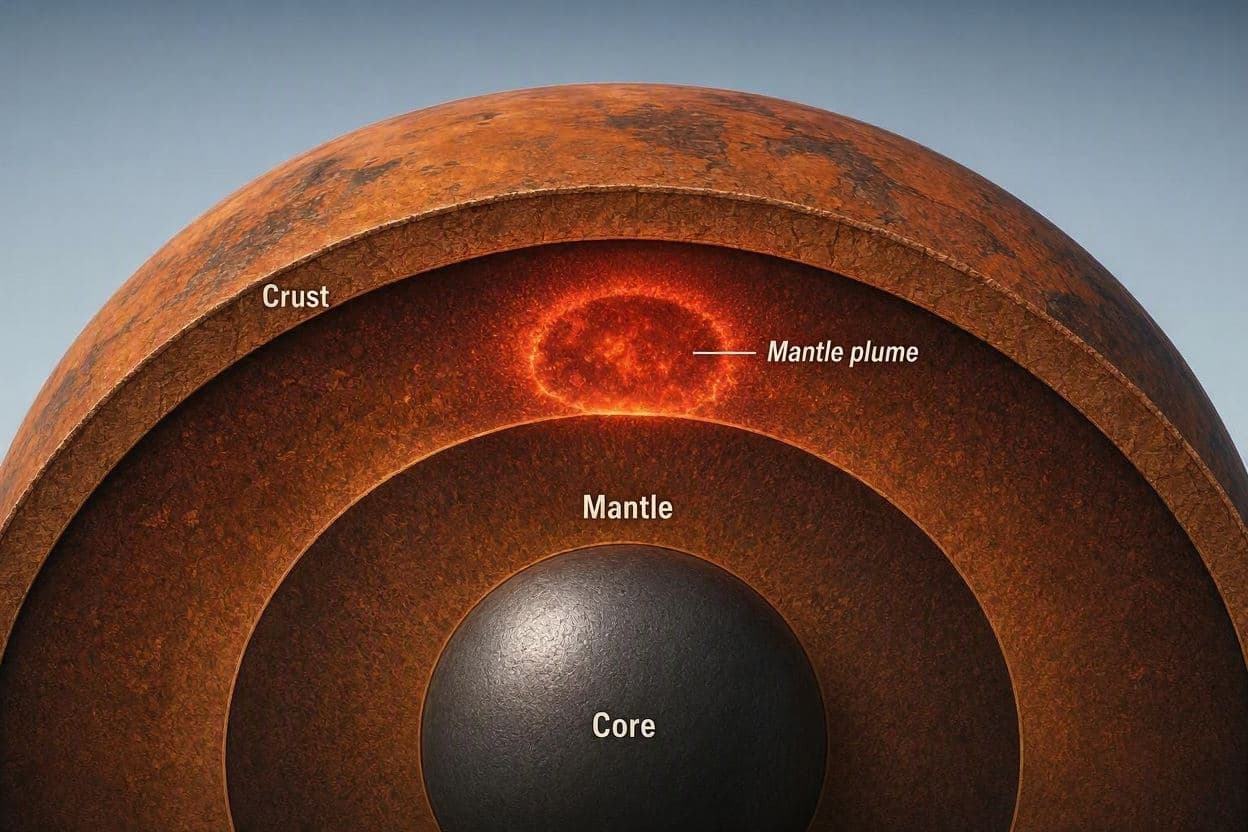
The size and location of the anomaly provide clues about the structure of the Martian interior. It may indicate the presence of a plume of hot material rising from deeper layers, similar to hotspots on Earth. Such features can create volcanic regions and affect the thickness of the crust. By studying these structures, scientists can better understand why Mars evolved differently from Earth, losing its atmosphere and surface water over time.
This discovery also has implications for future exploration. Regions with higher heat flow might be targets for searching for subsurface life, as warmth and liquid water are key ingredients for biological processes. While the surface of Mars is harsh and cold, the subsurface could offer a more hospitable environment for microbial life. The thermal anomaly highlights areas where future missions might focus their efforts.
The scientific process behind this discovery involves careful analysis of subtle signals. Seismic waves travel differently through hot and cold materials, allowing researchers to map the interior structure. Combining this with thermal data creates a comprehensive picture of the planet’s inner workings. It is a complex puzzle, but each piece brings us closer to understanding our planetary neighbor.
Public interest in Mars remains high, driven by the possibility of past or present life. Discoveries like the thermal anomaly keep the conversation alive, reminding us that there is still much to learn. They inspire curiosity and encourage support for space exploration, which often leads to technological advancements and scientific breakthroughs on Earth as well.
As we continue to study Mars, each finding adds depth to our knowledge. The thermal anomaly is not just a scientific datum but a story of a planet that is still active, still changing, and still full of surprises. It invites us to look beyond the surface and consider the hidden forces that shape worlds.
The discovery of a massive thermal anomaly beneath Mars’ surface opens new avenues for research and exploration. It reminds us that our neighboring planet is more dynamic than previously thought. As technology advances, we will continue to uncover the secrets of Mars, deepening our understanding of the solar system and our place within it.
AI Image Disclaimer: Visuals associated with this article are AI-generated conceptualizations intended to illustrate the scientific themes of planetary interiors, not actual images of the Martian subsurface.
Sources:
• Nature Astronomy
• NASA Jet Propulsion Laboratory
• Science Magazine
• BBC Science
Published by Banx Network. This article is part of the Banx decentralized media programme, powered by the BXE token on the XRP Ledger.