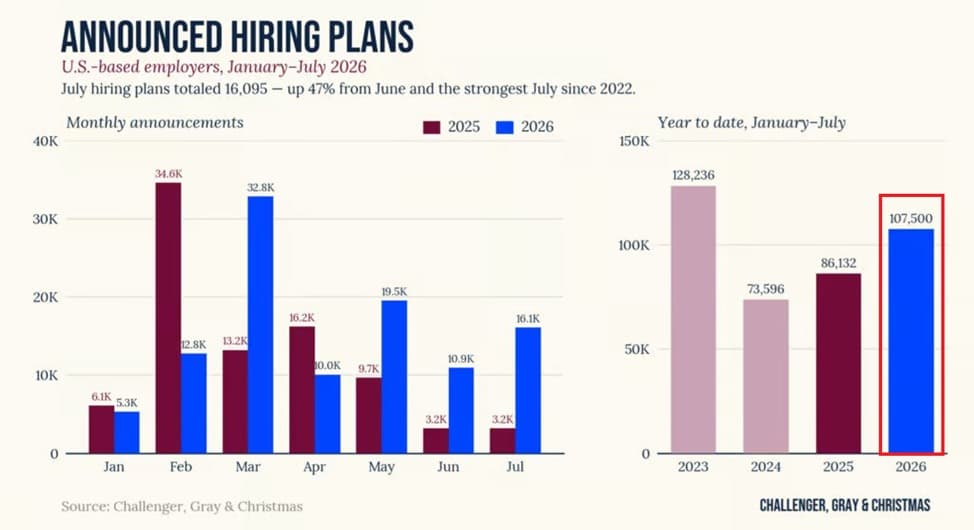
U.S.-based employers announced plans to add 16,095 jobs in July, representing a 47% increase from the 10,933 jobs announced in June, according to the information shown in The Kobeissi Letter post. The figure represents the strongest July total since 2022 and provides an encouraging signal about hiring intentions after a period in which employers had been announcing comparatively modest expansion plans. Hiring announcements do not necessarily translate directly into completed job creation. Companies can change their plans because economic conditions, budgets or business strategies shift. Nevertheless, planned hiring provides an important indication of how corporate leaders currently view future demand. When companies announce significant numbers of new positions, it can suggest that they expect enough business activity to justify expanding their workforce. The July increase is particularly notable because it follows a weaker period. The 16,095 planned jobs were substantially higher than June's 10,933, meaning announced hiring increased by nearly half in a single month. The comparison with previous years provides additional context, with July 2026 reportedly producing the strongest July total since 2022. The U.S. employment market remains one of the most closely watched components of the global economy. Employment influences household income, consumer spending, tax revenue and demand for goods and services. A healthier hiring environment can therefore support economic growth because newly employed workers generally have greater purchasing power. However, the headline number needs to be interpreted carefully. Announced hiring is different from payroll growth. A company may announce positions but fill them gradually, postpone recruitment or cancel openings. The data therefore should be viewed as an indicator of corporate intentions rather than a definitive measurement of employment growth. The timing is also important for monetary policy. The Federal Reserve closely watches labor-market conditions when assessing the economy. If hiring remains strong, it can suggest that economic activity continues to have momentum. If hiring weakens sharply, policymakers may become more concerned about slowing growth and rising unemployment. The July increase therefore adds an interesting data point to the broader debate over the direction of the U.S. economy. Businesses appear to have increased their hiring plans, but other indicators must be examined to determine whether the improvement represents a lasting trend. The composition of those jobs also matters. Hiring demand can vary significantly between technology, healthcare, manufacturing, logistics, professional services and consumer industries. A large number of jobs concentrated in a few sectors can tell a very different story from broad-based hiring across the economy. Artificial intelligence is another factor increasingly affecting corporate employment strategies. Some companies are hiring workers with specialized AI, data and engineering skills while simultaneously attempting to automate certain tasks. This creates a complicated employment environment in which technological investment can reduce demand for some roles while creating new demand for others. The U.S. labor market is therefore undergoing both cyclical and structural changes. Companies are responding to interest rates, consumer demand and economic expectations while also adapting to automation and AI. The comparison with July 2025 is also striking. The supplied post indicates that hiring plans in July 2025 were only around 3,200, meaning the latest figure represents a dramatic improvement year over year. If that comparison remains accurate after revisions and final hiring outcomes, it would suggest that employer confidence has strengthened substantially. Nevertheless, investors and economists will want confirmation from broader employment data. Actual payroll growth, unemployment claims, wage growth, job openings and labor-force participation provide a more complete picture of the labor market. The increase in planned hiring is therefore encouraging, but it should not be treated as proof that the U.S. economy has entered a new acceleration phase. Companies can announce hiring plans for many reasons, and the economy remains sensitive to interest rates, inflation, consumer spending and global conditions. For markets, the key question is whether stronger hiring intentions eventually translate into sustained employment growth. If they do, household incomes and consumer demand could receive additional support. If announcements fail to translate into actual jobs, the July surge could prove temporary. For now, however, the 16,095 planned hires represent a notable improvement in employer sentiment. After several months of weaker hiring announcements, July's rebound suggests that at least some U.S. companies are becoming more willing to expand their workforces.
Published by Banx Network. This article is part of the Banx decentralized media programme, powered by the BXE token on the XRP Ledger.