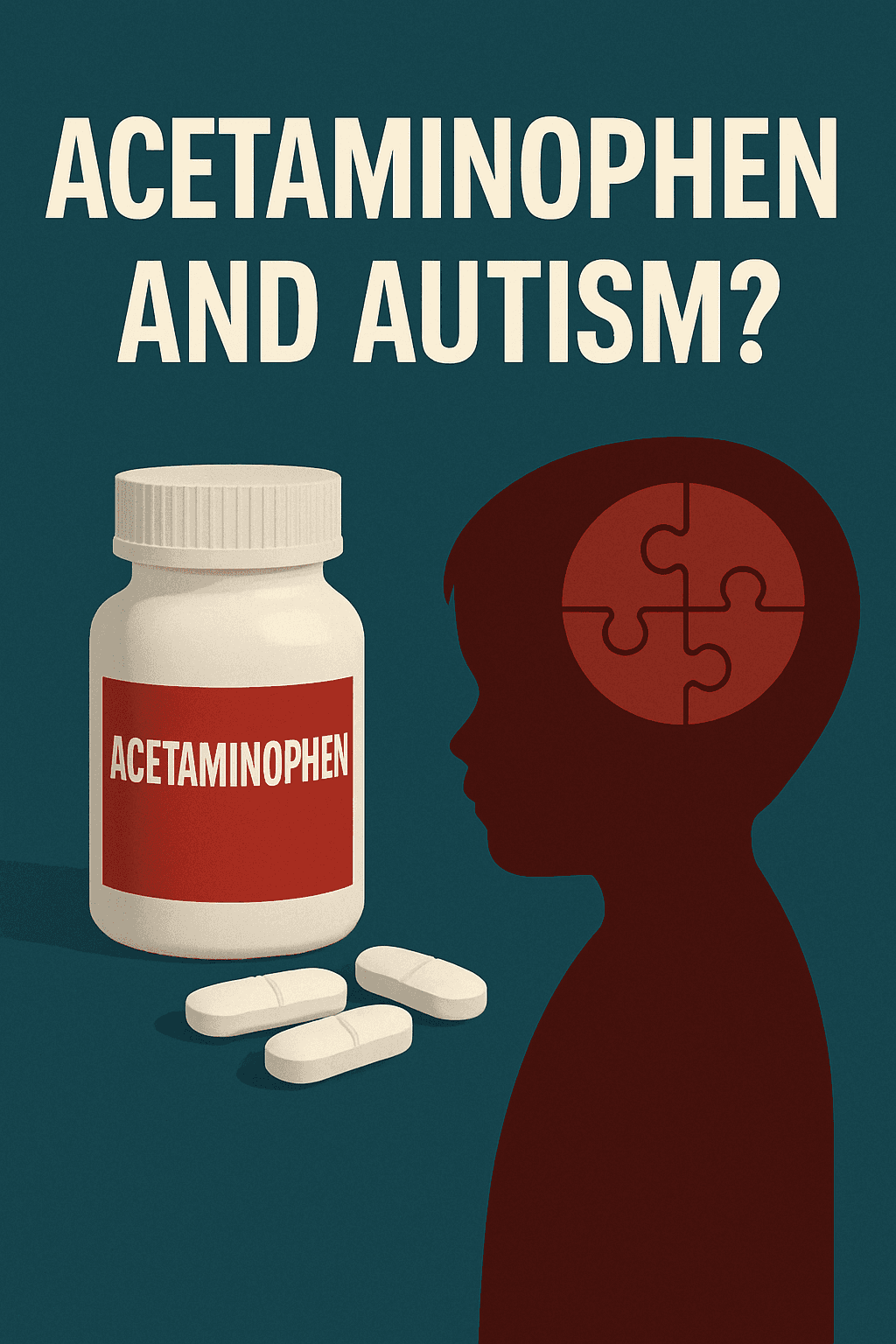
Today, the White House released a striking new fact sheet titled “FACT: Evidence Suggests Link Between Acetaminophen, Autism.” The announcement highlights studies suggesting that prenatal exposure to acetaminophen, best known by the brand name Tylenol, may be associated with an increased risk of autism spectrum disorder (ASD) and attention-deficit/hyperactivity disorder (ADHD) in children. The claim touches millions of households, as acetaminophen is one of the most widely used pain relievers in the world and has long been trusted by pregnant women as the “safer” alternative to other medications. If the White House is correct, this could alter medical practice, consumer habits, and public health policy in profound ways. The question, however, is what the science actually says and what families and healthcare providers should do now.
The fact sheet frames the issue in stark terms, asserting that mounting evidence links acetaminophen use during pregnancy to autism and ADHD. It emphasizes that the risk appears strongest with frequent use or use later in pregnancy. Several large-scale cohort studies are cited, including the Nurses’ Health Study II and the Boston Birth Cohort, with research from leading institutions such as Harvard, Johns Hopkins, and Mount Sinai referenced as supportive of the claim. The administration points to a 2021 international consensus that had already recommended minimizing acetaminophen use during pregnancy and now uses that as a foundation for taking the discussion to a new level. The language of the release signals more than just academic caution; it suggests a paradigm shift in how common over-the-counter medications might be evaluated in the context of maternal health.
The scientific picture is more complicated than the fact sheet suggests. On one hand, there is real research indicating an association between prenatal acetaminophen exposure and later developmental diagnoses. Observational studies have repeatedly found higher rates of ASD and ADHD among children whose mothers reported acetaminophen use during pregnancy. These findings are supported by proposed biological mechanisms, such as oxidative stress, interference with hormone signaling, and other disruptions that could affect fetal brain development. Some animal studies and mechanistic investigations lend plausibility to the idea that acetaminophen might have subtle neurological effects during key windows of gestation. That is why, even before today’s announcement, some in the research community were calling for caution. In 2021, a consensus statement from international experts urged pregnant women to use acetaminophen only at the lowest effective dose and for the shortest possible duration.
But correlation is not causation, and that remains the central limitation of the current body of evidence. The observational studies cited are not designed to prove that acetaminophen directly causes autism. They cannot fully control for the possibility that other factors are driving the observed associations. For example, many women take acetaminophen to manage fevers or infections during pregnancy, and those underlying conditions may themselves influence neurological development in the fetus. Other confounders such as genetic predisposition, socioeconomic status, diet, and environmental exposures complicate the picture further. Moreover, researchers do not yet agree on how much exposure constitutes risk, whether occasional use is significant, or whether the timing of use matters more than the dosage. These uncertainties mean that while the associations are concerning, the scientific community has not reached a consensus strong enough to declare causality.
If the White House’s framing is adopted into public health guidance, the implications would be extensive. Clinically, obstetricians may begin advising much stricter limits on acetaminophen, reserving it only for cases of high fever or acute pain rather than routine use. Non-drug alternatives such as hydration, rest, relaxation techniques, or physical therapies may take on a more central role in prenatal care. Healthcare providers would also need to spend more time educating patients, ensuring that pregnant women are neither left uninformed nor unnecessarily alarmed. At the same time, federal research priorities could shift toward more rigorous longitudinal studies to define dosage thresholds and clarify biological mechanisms, while regulators may push for stronger surveillance of medication safety in pregnancy.
Public policy changes could follow closely behind. Acetaminophen products might be required to carry warning labels specifically addressing pregnancy risk, akin to how alcohol and tobacco are labeled today. Public health campaigns would likely be launched to educate expectant mothers about safe pain relief strategies, balancing the need for caution against the danger of panic. Regulatory agencies such as the FDA and CDC may be pressured to issue formal advisories, while lawmakers may face calls to fund alternative pain management programs for expectant mothers. Legal and liability questions would inevitably arise if causation is eventually established. Pharmaceutical companies could face lawsuits, and regulators could be asked to explain why such a common medication was deemed safe for decades without stronger warnings. Equity concerns would also emerge, as disadvantaged communities may lack access to non-drug alternatives or more expensive “pregnancy-friendly” options, further deepening health disparities.
Beyond the medical and policy realms, the announcement carries profound ethical and social dimensions. Risk communication in this space is notoriously delicate: overstating the dangers of acetaminophen could create guilt and stigma for mothers who took the medication in good faith, while downplaying the risks could deny families the chance to make informed decisions. Trust in public institutions may hang in the balance. If the White House’s message proves premature or misleading, it could deepen skepticism about both science and government. Families raising children with autism may also feel retraumatized by the implication that a common, seemingly harmless medication could have played a role, underscoring the importance of providing resources, reassurance, and mental health support alongside any new health guidance.
The future may unfold along two different paths. In one scenario, further research strengthens the evidence and establishes a clear causal link between prenatal acetaminophen exposure and autism. This would lead to a dramatic reordering of medical guidelines, potential legal actions against manufacturers, new regulatory frameworks, and an expansion of screening and early intervention programs for children at risk. In the other scenario, more detailed studies may reveal that the associations observed so far are largely explained by confounding factors or that the risks are much smaller than initially feared. In that case, acetaminophen may remain available as a standard treatment during pregnancy, with only modest restrictions and warnings attached.
For pregnant women today, the most prudent course is caution without panic. Medical experts continue to recommend that acetaminophen, if used during pregnancy, should be limited to the lowest effective dose for the shortest possible duration, and ideally taken only when clearly necessary. Women should be mindful that acetaminophen appears in many combination products, such as cold and flu medicines, and unintentional overuse is a risk. Non-drug alternatives may be helpful for mild discomforts, though serious conditions like high fever should never be ignored and require medical guidance. Above all, expectant mothers should not make abrupt changes in medication habits without consulting their healthcare providers.
The White House’s announcement has thrust one of the most trusted household drugs into the spotlight in a way few expected. The cited studies do raise real concerns, but the evidence remains uncertain and incomplete. If the association is confirmed, the consequences would ripple across medicine, policy, law, and society. If not, the episode may stand as a cautionary tale about how preliminary science is communicated to the public. For now, the message is clear: acetaminophen should be used in pregnancy only with care and under medical supervision, while the scientific community continues to sort out whether the risk is real, how great it is, and what can be done to protect both mothers and children.
Published by Banx Network. This article is part of the Banx decentralized media programme, powered by the BXE token on the XRP Ledger.