For two years, the Hera spacecraft has been traveling toward a point of light. Didymos appeared as a single dot in the distance—a destination, a calculation, a promise. On the evening of October 18, at a distance of 1,280 kilometers, that dot became two. The smaller Dimorphos emerged from the blur of its parent body, and the mission that was built to investigate a collision finally saw what it had come to find.
The European Space Agency's Hera mission was designed to follow up on NASA's DART impact, which in September 2022 slammed a spacecraft into Dimorphos at 6.1 kilometers per second, slowing the asteroid's orbit around Didymos by about 33 minutes . That experiment proved that kinetic impact could deflect an asteroid. What it did not prove was how, exactly, the deflection worked—whether DART left a crater, reshaped the asteroid entirely, or something else. Hera was sent to find out.
The first resolved image, taken by Hera's monochromatic Asteroid Framing Camera, shows Dimorphos as roughly one pixel separated from Didymos. "With this image the smaller Dimorphos asteroid becomes visible for the first time," said Michael Kueppers. "Before this acquisition the spacecraft was still resolving the Didymos system as a single dot" . At 151 meters across, Dimorphos is about the size of the Great Pyramid of Giza. Didymos, at 780 meters, is a little smaller than the Burj Khalifa. They orbit each other at an average distance of 1.15 kilometers .
The image came after a pair of thruster firings that slowed Hera to just 20 meters per second relative to its targets, allowing the spacecraft to approach gradually. Sharper views are coming. On November 25, Hera will unveil the first detailed images of Dimorphos—the first object in the solar system to have had its orbit measurably shifted by human action . Two shoebox-sized CubeSats, Juventas and Milani, will be deployed for still closer surveys, with Juventas possibly attempting a landing .
What Hera seeks is not spectacle but understanding. The deflection was larger than impact simulations predicted, and scientists do not yet know why. The asteroid's makeup, structure, and mass remain uncertain. To turn a one-time experiment into a repeatable planetary defense technique, those questions need answers. Hera is the instrument of those answers.
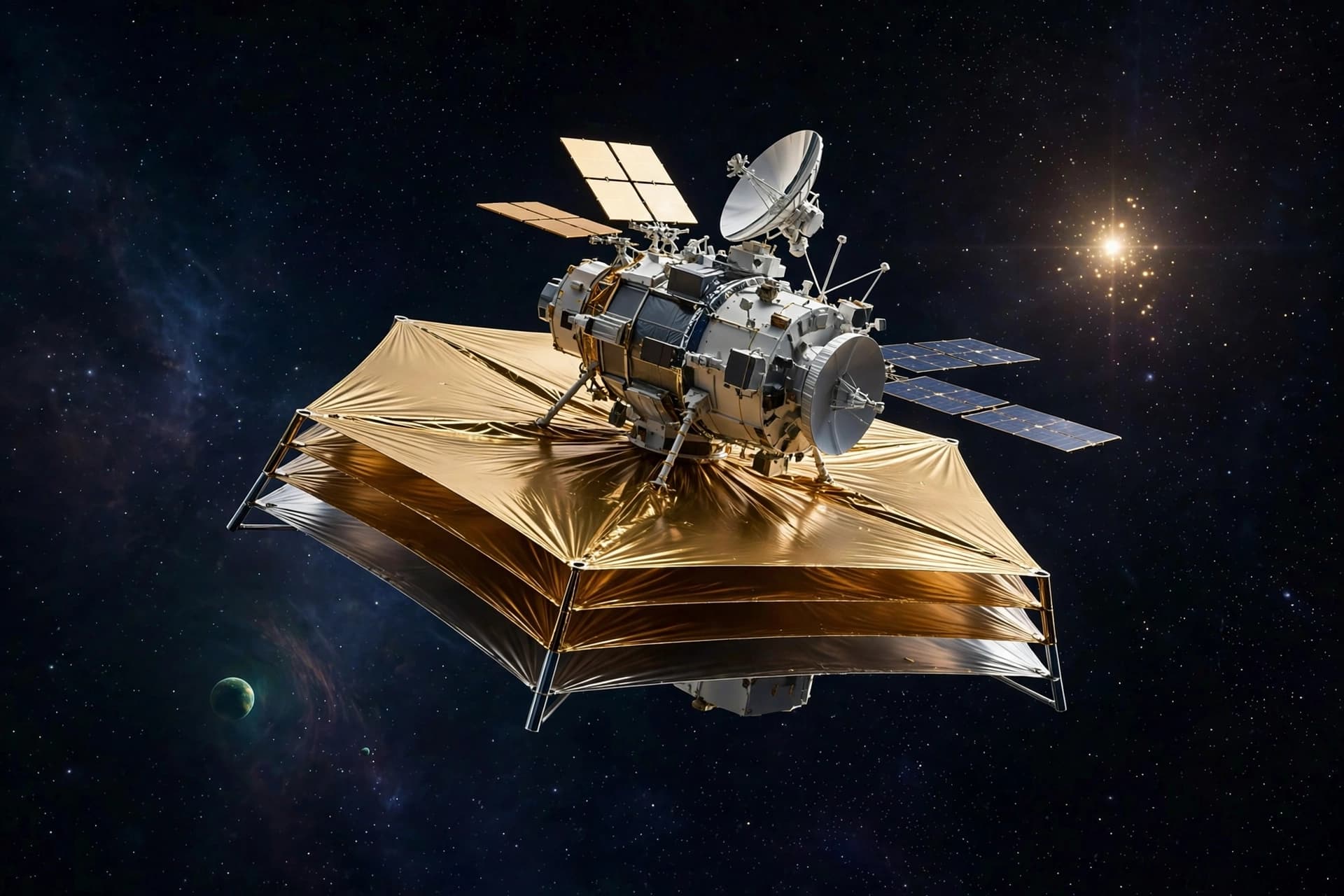
The images accompanying this article are AI-generated and are not actual photographs from the Hera mission.
Sources: European Space Agency, EET-China
Published by Banx Network. This article is part of the Banx decentralized media programme, powered by the BXE token on the XRP Ledger.