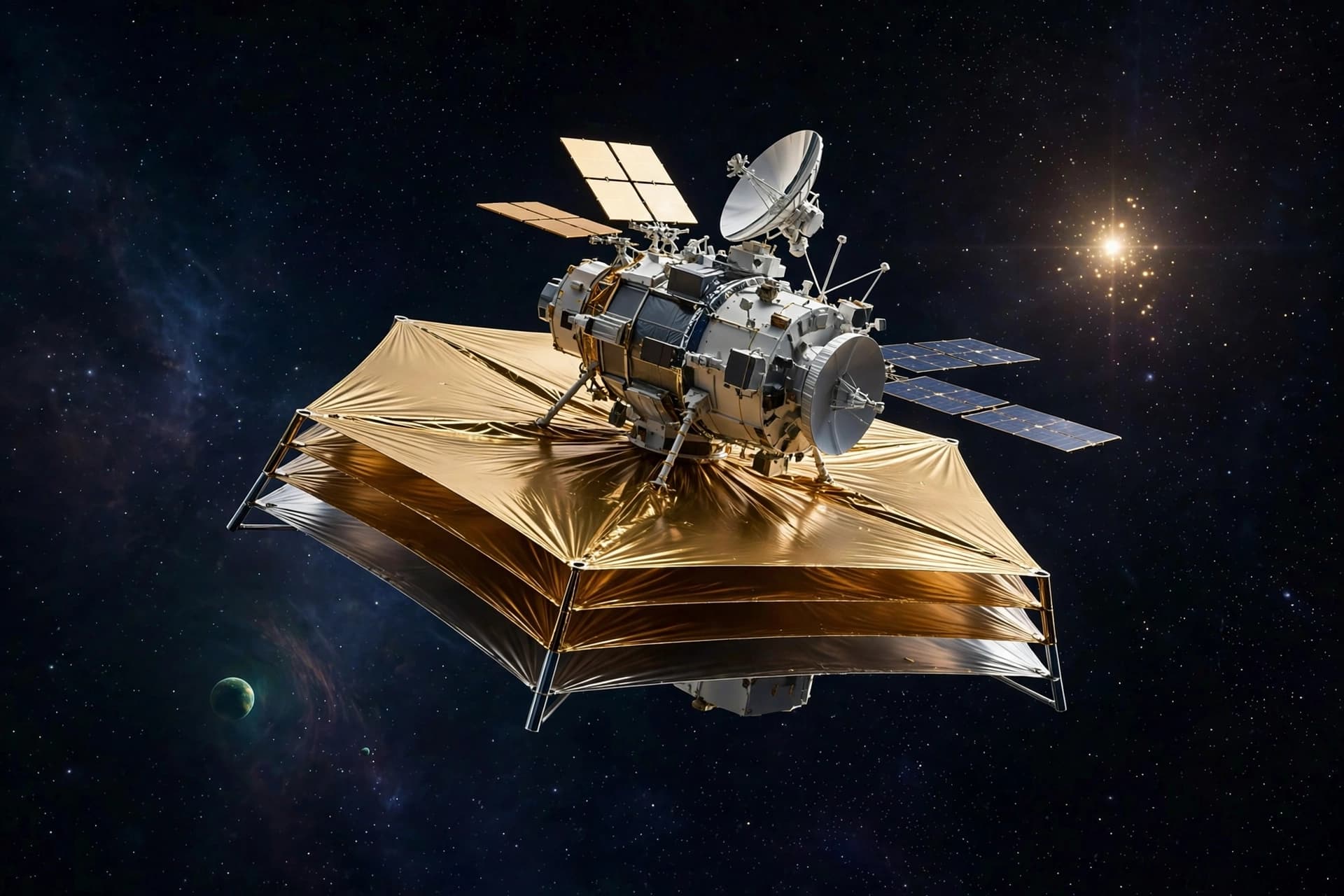
There is a moment in every new instrument's life when the question shifts from what it can do to what it should look at first. For the Lazuli Space Telescope, the world's first privately funded space telescope, that moment has arrived. A 3-meter mirror, larger than Hubble's, built on the vision of former Google CEO Eric Schmidt and scheduled to launch by 2029, Lazuli will carry an instrument called the ExtraSolar Coronagraph, designed to capture the faint reflected light of planets orbiting distant stars . The question is not whether it can see them, but which ones it should try.
Researchers Logan Pearce and Ewan Douglas have offered an answer: a list of 27 giant exoplanets, selected not for novelty but for efficiency. The targets all have well-characterized orbits, allowing the telescope to time its observations for the maximum likelihood of detection . Direct imaging of reflected starlight requires contrasts of ten to the negative seventh or ninth power, and exposure times stretching from tens to hundreds of hours. For a 3-meter observatory, uninformed searching is a luxury it cannot afford .
The list includes familiar names. 55 Cancri d, a Jupiter analog. HD 181433 d, which follows a highly eccentric path. Beta Pictoris b, one of the first exoplanets ever directly imaged, still interacting with its debris disk . What unites them is not their fame but their accessibility. Each represents a world whose orbit is known well enough to justify the hours of observation required to see it.
What makes Lazuli's approach distinct is its reliance on reflected light rather than thermal emission. As planets age, they cool and dim in infrared. But reflected starlight does not fade with time. It allows observations of mature planetary systems, and it permits detection at closer separations from the host star, because visible wavelengths offer better resolution than infrared . The planets on this list span ages and temperatures that previous direct imaging campaigns have not probed.
There is also a matter of synergy. Some of these targets will be visible to the Roman Space Telescope's coronagraph and to the METIS imager on the Extremely Large Telescope. Multiple observations of the same worlds, from different instruments, would provide a more comprehensive characterization of their atmospheres than any single telescope could achieve alone .
The researchers are careful about what they promise. Reflected light detection is difficult. Exposure times are long. The telescope is not yet in space. But the list itself represents a kind of preparation—a way of ensuring that when the instrument opens its eye, it knows where to look.
Private space telescopes are new. What they will mean for astronomy remains uncertain. But the first step is the same as it has always been: choosing a target, and waiting for the light.
The images in this article are AI-generated and are not actual astronomical photographs.
Sources: Universe Today, arXiv, Science News
Published by Banx Network. This article is part of the Banx decentralized media programme, powered by the BXE token on the XRP Ledger.