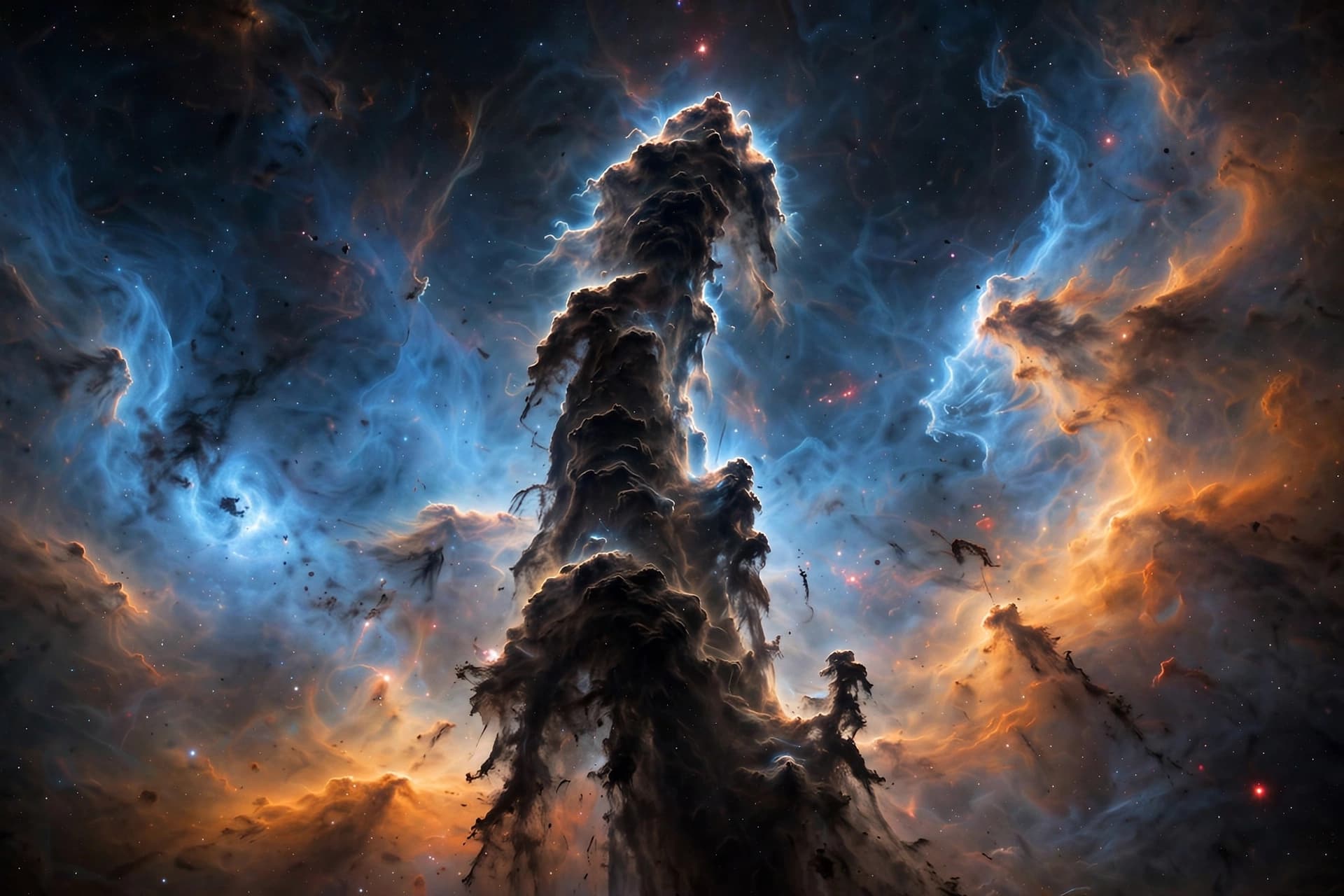
There are places in the sky where light and shadow conspire to make us see a face, a figure, a familiar shape in the mist. The human eye is tender that way, always searching for the known in the unknown. This week, two of humanity's most remarkable instruments turned their gaze toward one such place: a small, dusty pillar within the vast Carina Nebula, some 7,500 light-years from Earth, where the gas and grit of star birth arrange themselves into something that resembles a cat sitting with its back turned, head swiveled to the right, one glowing eye peering out from the dark . It is a trick of light and erosion, of course—a temporary sculpture carved by radiation and time. But it is also a window.
The Cat's Head Nebula, as astronomers have nicknamed this region, is not a single object but a scene in motion. The "head" is a dense pillar of dust and gas that has resisted the withering ultraviolet radiation and stellar winds pouring off massive nearby stars . The softer material around it has been worn away, leaving this denser knot standing like a stubborn dune in a desert windstorm. The glowing red "eye" is likely a young star, still partially wrapped in its dusty birth shroud, peering out as it forms . It is a portrait of creation and destruction happening at once—the very process by which stars are born and, eventually, how their birthplaces are torn apart.
What makes this particular view so instructive is that it comes to us through two different kinds of sight. The Hubble Space Telescope, in visible light, shows the pillar as an opaque, dark-brown silhouette against a backdrop of glowing gas—colors shifting from blue at the top to yellow, orange, and red below, tracing the excited emissions of oxygen, hydrogen, and sulfur . This is roughly what a human eye, if sufficiently sensitive, might see: the shadow of the dust, the bright rim of ionized gas where radiation is stripping the pillar's edge away.
Webb sees differently. Its near-infrared view pierces much of the dust, rendering the pillar more transparent and revealing a scattering of stars behind and within it—some still veiled, some fully exposed. The ghostly wisps of gas and dust to the left of the "cat" become visible, delicate filaments being slowly eroded by the same radiation that sculpts the larger shape . In mid-infrared light, Webb traces the warm dust and carbon-based molecules, outlining intricate structures and globules that visible light cannot reach. The "eye" remains, still glowing, still suggestive of the young star within.
There is a quiet lesson in this comparison. The same object, viewed through different windows, tells different stories. Hubble shows us the surface, the silhouette, the drama of light and shadow. Webb shows us what lies beneath and behind—the hidden stars, the fine structure, the warmth of dust that glows only in infrared. Neither view is complete. Together, they form something closer to understanding.
It is worth remembering, too, that this cat will not last. The intense radiation and winds from the massive stars of the Carina Nebula are steadily eroding the pillar. Denser knots resist longer, but eventually even they will be worn away, their material dispersed into the surrounding nebula to perhaps form new stars, new worlds, new something . The Cat's Head is a moment caught in a much longer story—a story of gas becoming stars, stars becoming light, and light, eventually, scattering the clouds that made it.
For now, though, it hangs there in the dark, 7,500 light-years away, wearing the shape of something familiar. It is a reminder that the cosmos does not intend to look like anything in particular. We are the ones who see the cat, who find the face in the nebula, who make meaning from dust and light. And perhaps that is its own kind of wonder.
Image Disclaimer: The visual accompanying this article was generated by artificial intelligence and is not an actual photograph from Hubble or Webb.
Sources: NASA Science, Space Telescope Science Institute (STScI), Scientias.nl, Qazinform
Published by Banx Network. This article is part of the Banx decentralized media programme, powered by the BXE token on the XRP Ledger.