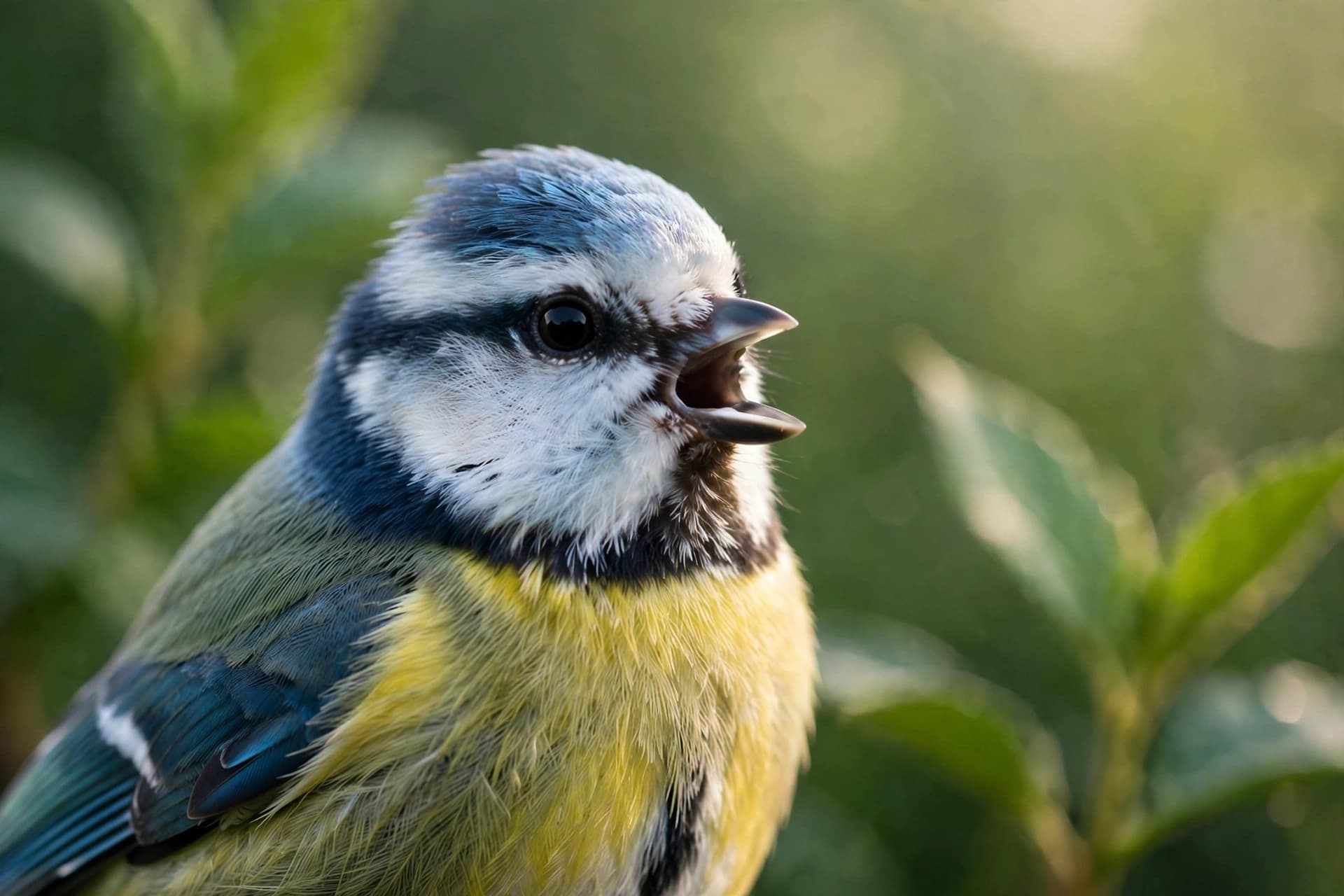
There is a rhythm we carry without knowing it, a cadence in the way we speak and sing that feels as natural as breathing. We pause at the ends of phrases, we let the last syllable linger, we avoid leaping too wildly from one pitch to the next. These habits seem human, shaped by culture and language, by the particular music of the tongue we learned as children. But a new study suggests that these patterns are not ours alone. They appear, with remarkable consistency, in the songs of birds—hundreds of species, across continents, in voices that evolved in a different branch of the tree of life entirely .
The research, published in Science, compared the vocalizations of 367 bird species with human speech and song from 52 languages. The team, led by researchers at McGill University and Imperial College London, gathered recordings from public repositories and citizen-science databases, manually annotating more than 70,000 individual vocal units—syllables, notes, phrases—for analysis . It is the first study to compare vocal patterns across birds that learn their songs and birds whose songs are innate, and the first to place those patterns alongside a global repository of human vocalization.
What they found was a set of shared tendencies. Both birds and humans tend to end their phrases with longer sounds, a pattern called phrase-final elongation. Both organize their vocalizations to minimize large jumps in pitch between adjacent syllables. Both produce rhythms that are regular and predictable, rather than chaotic . These patterns held across bird species regardless of whether they were vocal learners, like songbirds and hummingbirds, or non-learners, like suboscines and nightjars. The ability to imitate, it turns out, is not what drives the similarity.
The researchers propose that the shared patterns may arise from shared bodies. Birds and humans both must coordinate breathing with the muscles that control vocal output. Changing pitch dramatically from one note to the next is physically difficult. Ending a phrase with a longer sound may be a natural consequence of how breath is managed at the end of a vocalization . The parallels are not a matter of meaning or grammar, but of mechanics—the constraints and affordances of flesh and air.
There is a humility in this finding. Humans have long treated language as a boundary, a line separating us from the rest of the living world. The study does not erase that boundary; birdsong is not speech, and no one is claiming otherwise. But it suggests that some of the fundamental patterns we associate with human communication are not uniquely human at all. They are solutions to the problem of making sound with a body, solutions that evolution has found more than once .
The researchers are careful not to overstate. The similarities are statistical, not absolute, and the reasons behind them remain hypotheses rather than certainties. But the pattern is clear enough to invite further questions: Do other species share these tendencies? Do they appear in whales, in primates, in creatures whose vocal organs are built differently still? The study opens a door rather than closing a case.
For those who listen to birds, there is a quiet resonance in this. The robin at dawn, the finch in the hedge, the distant call of a nightjar—these are not merely sounds. They are vocalizations shaped by the same physical forces that shape our own, patterned by breath and bone and the limits of what a body can do. The music is different, but the grammar of the body is shared. And in that sharing, there is a kind of kinship that words alone cannot name.
Image Disclaimer: The visual accompanying this article was generated by artificial intelligence and is not a photograph of actual birds or human speakers.
Sources: Science, Imperial College London, The Conversation, McGill University
Published by Banx Network. This article is part of the Banx decentralized media programme, powered by the BXE token on the XRP Ledger.