There is a quiet choreography that happens thirty-six thousand kilometers above the Earth, where satellites hold their positions with the patience of celestial sentinels. In that vast, silent theater, two Chinese spacecraft spent months dancing together—approaching, docking, and then separating—before anyone on the ground could say with certainty what they had done. Some achievements announce themselves with headlines; others reveal their significance only in the questions they leave behind.
A research paper undergoing peer review for the Journal of Deep Space Exploration states that China "successfully provided room-temperature propellant refueling for a high-orbit BeiDou satellite for the first time" . The authors, from the state-funded Deep Space Exploration Laboratory, offered no operational details. They described the achievement as valuable experience but emphasized that future work must develop technologies for transferring extremely low-temperature propellants, which offer better performance for large spacecraft and deep-space missions .
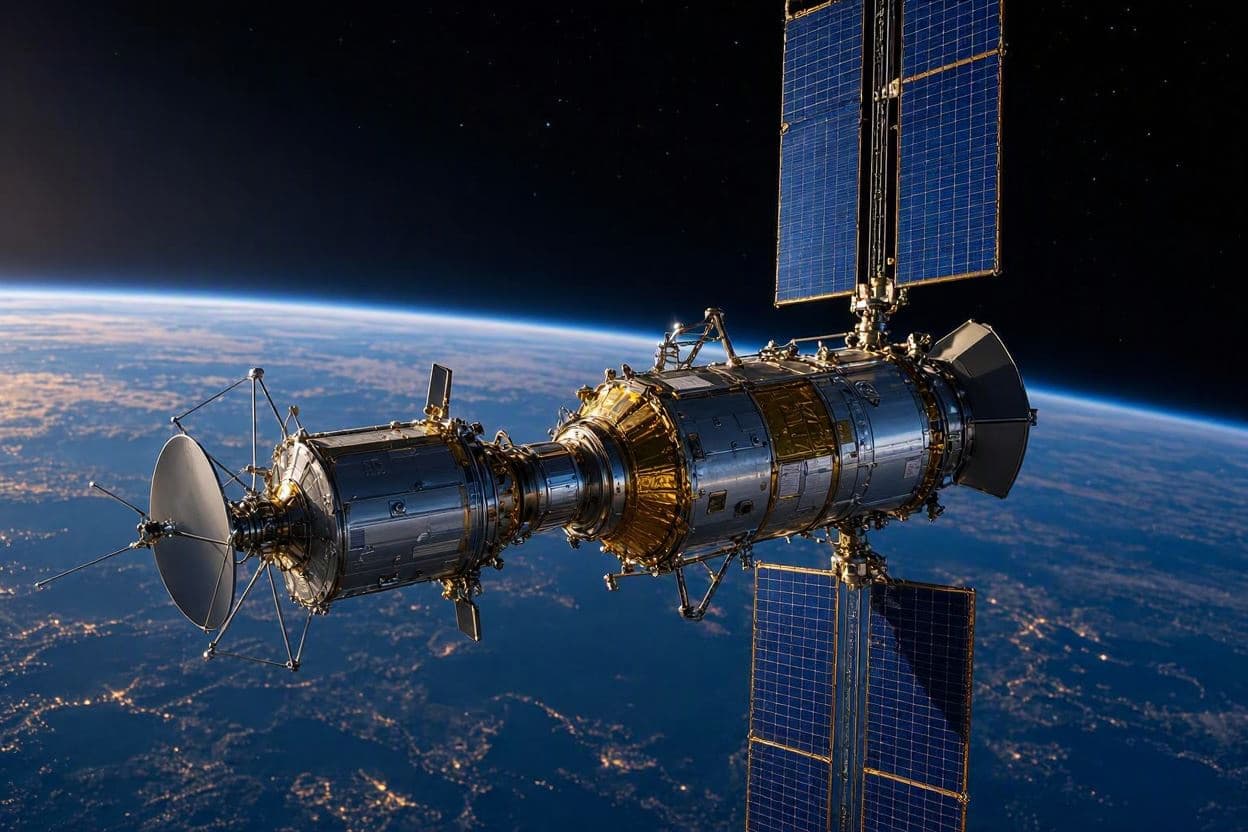
The operation itself appears to have occurred in February 2025, though specifics only emerged months later . According to satellite tracking observations, the experimental Shijian-25 spacecraft launched in January 2025 on a Long March 3B rocket with a stated mission of "verification of satellite refueling and life-extension technologies" . It rendezvoused with Shijian-21, a satellite launched in 2021 that had previously made headlines by towing a defunct BeiDou satellite to a graveyard orbit in 2022—a maneuver that drained its own fuel reserves, making it an ideal candidate for a refueling test .
The two satellites docked in late June or early July 2025 and remained attached for months, becoming virtually indistinguishable from Earth-based observations . Swiss tracking company S2a Systems confirmed the docking and later observed the pair performing maneuvers that changed their orbital plane, requiring significant fuel expenditure . A former US Space Command official described it as "the largest maneuver ever performed in geostationary orbit," with a velocity change exceeding 330 meters per second . The satellites separated on November 29, 2025 .
Throughout the operation, China maintained near-total silence. No official statement was issued beyond the original launch announcement . This opacity drew scrutiny, particularly because geostationary orbit hosts communications, weather, and missile-warning satellites—assets of obvious strategic value . Two US surveillance satellites, USA 270 and USA 271, positioned themselves nearby to observe . Experts noted that the ability to refuel a satellite also implies the ability to approach, manipulate, or potentially neutralize it .
Yet the civilian implications are equally significant. A geostationary satellite costs hundreds of millions of dollars, and its lifespan is often limited by fuel rather than electronics. In-orbit refueling could extend missions by years or even decades, reduce the need for replacement launches, and decrease the accumulation of space debris . For future deep-space missions—to the Moon or Mars—the ability to resupply spacecraft in orbit could reshape mission architectures .
Chinese researchers have reported the first successful satellite-to-satellite refueling in high Earth orbit, involving the Shijian-21 and Shijian-25 spacecraft. The operation occurred in early 2025 but was only revealed through research papers and independent tracking observations. China has issued no official statement, and the technology's dual-use potential has drawn international attention.
AI Image Disclaimer: The images accompanying this article are generated by artificial intelligence and are intended for illustrative purposes only. They do not depict actual spacecraft or operations.
Sources: South China Morning Post, Journal of Deep Space Exploration, Breaking Defense, S2a Systems, Universe Space Tech, Futura-Sciences, Militarnyi, SpaceNews
Published by Banx Network. This article is part of the Banx decentralized media programme, powered by the BXE token on the XRP Ledger.