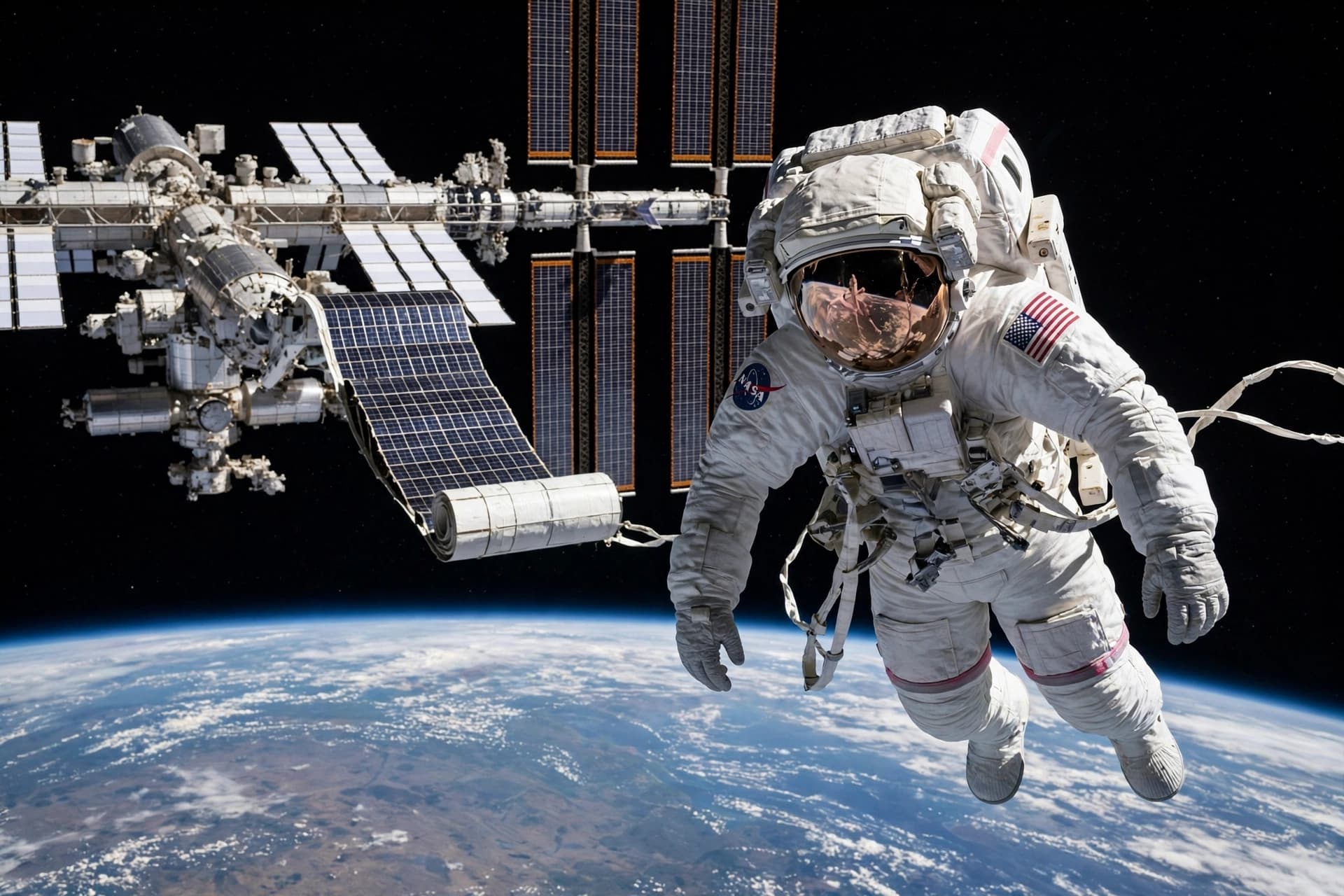
There is a quiet choreography to life in orbit, a rhythm of work and rest, of preparation and execution, played out against the backdrop of Earth's curve and the deep black beyond. On October 29, two astronauts stepped outside the International Space Station and spent more than seven hours in the vacuum, their movements slow and deliberate, their task precise. When they returned, they had installed the seventh of eight new solar arrays—a piece of infrastructure that will help power the station through its remaining years and, eventually, through its planned retirement .
The spacewalkers were NASA astronaut Anil Menon and Canadian Space Agency astronaut Joshua Kutryk. For Kutryk, it was his first spacewalk, a milestone in a career that had prepared him for the moment but could not fully simulate it. The two men worked for seven hours and eleven minutes, installing and deploying an International Space Station Roll-Out Solar Array on the station's 2A electrical power channel. The array is the seventh of its kind, part of a campaign that began in 2021 to augment the station's aging power system .
The new arrays are designed to supplement the station's original solar panels, which have been in orbit for decades and have gradually degraded. The roll-out arrays are lighter and more compact, unfurling like carpets rather than requiring the complex deployment mechanisms of the originals. Once all eight are installed, the station's power generation capacity will increase by up to thirty percent, from 160 kilowatts to approximately 215 kilowatts. That additional power is not a luxury. It supports critical operations, including the systems that will eventually guide the station to a safe and controlled deorbit .
The spacewalk was not solely about the array itself. Menon and Kutryk also completed several get-ahead tasks, preparing for the next and final spacewalk scheduled for November 5. On that day, they will install the eighth and last IROSA on the station's 3B power channel, completing the augmentation campaign that has spanned more than five years . When that final array is deployed, the station's power system will be fully upgraded, ready to support the scientific research and operational demands of its remaining lifetime.
For Kutryk, the experience carries a particular weight. The Canadian Space Agency noted that this was his first spacewalk, a moment that few humans ever experience. The training for such an event is extensive—hours in neutral buoyancy pools, simulations, and rehearsals—but the reality of floating outside the station, with only a suit between you and the void, is something else entirely . That he completed the task successfully, alongside a veteran of the procedure, speaks to the preparation and the partnership that define life aboard the orbiting laboratory.
The station itself is entering a transitional phase. It has been continuously inhabited since November 2000, a remarkable achievement of international collaboration. But its components are aging, and its future beyond the current decade is uncertain. The new solar arrays are part of a broader effort to ensure that the station remains functional and safe until its planned retirement. The power they provide will keep the lights on, the experiments running, and the systems that will one day bring the station down in a controlled manner operating as they should .
After the November 5 spacewalk, the augmentation will be complete. The eighth array will unfurl, the power will flow, and the station will have a new source of energy for its final chapter. The astronauts will return inside, close the hatch, and resume the ordinary routines of orbital life—exercise, maintenance, science, sleep. The arrays will turn silently in the sunlight, doing their work without ceremony. But for those who follow the station's progress, the completion of this campaign will mark a quiet milestone: a system upgraded, a mission extended, a crew prepared for whatever comes next.
Image Disclaimer: The image with this article was created using AI generation tools and does not depict actual astronauts or station hardware.
Sources: NASA, Canadian Space Agency, Antena 3
Published by Banx Network. This article is part of the Banx decentralized media programme, powered by the BXE token on the XRP Ledger.