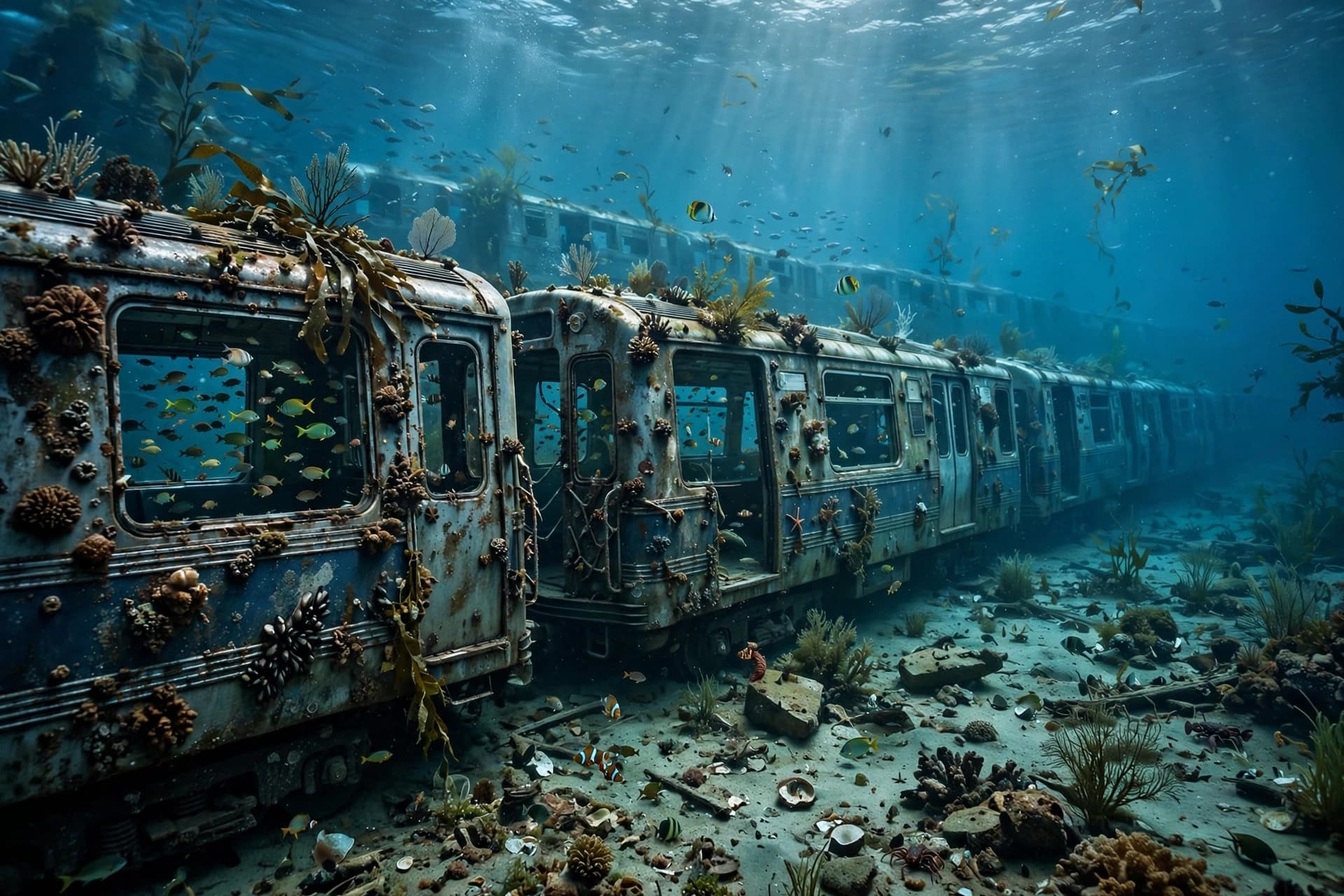
There is a strange poetry to the afterlife of things we no longer need—the way discarded objects can find new purpose in unexpected places, transformed by the passage of time and the slow work of the sea. Twenty-four meters below the surface of the Atlantic, off the coast of Delaware, lies a landscape that could belong to a dream: hundreds of New York City subway cars, their windows removed and doors stripped away, resting in rows on the ocean floor. Tanks and armored personnel carriers sit nearby. Tugboats, barges, and a cruise ship keep them company. Together, they form Redbird Reef, an artificial habitat larger than Central Park, and one of the most visited dive and fishing sites on the Eastern Seaboard .
The reef takes its name from the Redbird cars—R26 through R36 series subway carriages that once carried millions of New Yorkers through the city's tunnels. When they were retired, they were cleaned of hazardous materials, stripped of doors and windowpanes, and sunk by the hundreds as part of Delaware's artificial reef program . According to the Delaware Department of Natural Resources and Environmental Control, the broader program has placed more than two million tons of rock, 100,000 tons of concrete, 86 tanks and armored personnel carriers, upwards of 1,350 retired subway cars, and 32 vessels ranging from forty to 653 feet in length . The reef covers 1.3 square nautical miles, and from 2001 to 2008, the amount of marine food per square foot in its vicinity increased four hundred times .
The ecological logic behind such projects is straightforward: a flat, sandy seabed offers little shelter or attachment surface for marine life, while a vertical structure creates habitat. The subway cars, with their rectangular shapes and open interiors, provide exactly that. They attract black sea bass, tautog, triggerfish, flounder, blue mussels, sponges, barnacles, and coral. Tuna and mackerel hunt at the reef's edges. It has become so popular that fishermen sometimes steal from one another, and other states have applied for their own shipments of retired subway cars .
Yet the story is not without complication. A 2016 study published by the American Geophysical Union examined how storms have affected the structures. Superstorm Sandy in 2012 damaged or destroyed eight subway cars, and Winter Storm Jonas in 2016 rotated a forty-seven-meter Navy barge nearly sixty degrees . The study's authors warned that once destroyed or collapsed by waves, the subway cars go from providing beneficial habitat above the surrounding seabed to being scattered, low-relief marine debris . It is, they wrote, a "cautionary tale"—a reminder that even well-intentioned projects must consider how materials will withstand the forces of currents and storms.
That lesson was learned the hard way in Florida, where the Osborne Reef became an environmental catastrophe. In the 1970s, hundreds of thousands of tires were dumped into the ocean in an attempt to create habitat. They were not properly secured, and decades later, cleanup efforts are still underway . The contrast with Redbird Reef is instructive: proper preparation, appropriate materials, and careful placement can create thriving ecosystems. Careless disposal, even with good intentions, can create decades of harm.
The Redbird cars were never meant to be permanent. They were built to carry passengers, not to shelter fish. But in their retirement, they have become part of something larger—a reef that brings an estimated six million dollars into the local economy each year through fishing and diving . The subway cars that once rattled through dark tunnels now rest in blue water, colonized by mussels and sponges, circled by sea bass and sharks. It is a transformation that says something about the resilience of the ocean, and about the unexpected ways that human artifacts can become part of the natural world.
AI Image Disclaimer: All images in this article are AI-generated and are intended for illustrative purposes only.
Sources: BBC Wildlife Magazine, Delaware Department of Natural Resources and Environmental Control, Wikipedia, AGU
Published by Banx Network. This article is part of the Banx decentralized media programme, powered by the BXE token on the XRP Ledger.