The dream of returning from Mars has long been hindered by a simple logistical problem: carrying enough fuel for the journey home. With a thin atmosphere composed mostly of carbon dioxide, the Red Planet seems an unlikely source for propellant. However, recent advancements in technology are turning this challenge into an opportunity. New breakthroughs in converting Martian air into methane and oxygen suggest that future astronauts may be able to manufacture their own rocket fuel on-site, reducing the mass and cost of interplanetary missions.
Building on the success of NASA’s MOXIE instrument, which demonstrated the production of oxygen from Martian CO2, researchers are now focusing on the next step: creating methane. Methane, when combined with oxygen, serves as a powerful rocket fuel. Recent studies have explored efficient methods for synthesizing methane using local resources, such as subsurface water ice and atmospheric carbon dioxide. These processes, known as In-Situ Resource Utilization (ISRU), are key to sustainable human presence on Mars.
One promising approach involves electrolysis of water extracted from Martian soil or ice, combined with the Sabatier reaction to produce methane. This method requires significant energy, likely supplied by nuclear or solar power sources, but it eliminates the need to transport heavy fuel from Earth. By producing fuel on Mars, mission planners can design lighter spacecraft for the outbound journey, knowing that the return trip’s provisions will be manufactured locally.
Recent experiments have shown improved efficiency in these chemical processes, with new catalysts and reactor designs reducing energy consumption and increasing yield. These breakthroughs bring the concept of self-sufficiency closer to reality, addressing one of the most critical barriers to human exploration. The ability to produce fuel on demand also adds a layer of safety, allowing for flexibility in mission timelines and emergency scenarios.
The implications extend beyond mere logistics. Establishing a local fuel supply chain is a foundational step toward colonization. It transforms Mars from a destination to visit into a place where humans can live and work. This shift in perspective encourages investment in infrastructure and technology that supports long-term habitation, fostering a new era of space exploration.
Challenges remain, including the need for reliable power sources and robust equipment that can withstand the harsh Martian environment. Dust storms, extreme temperatures, and radiation pose significant risks to industrial operations. However, ongoing research and testing on Earth, as well as data from current Mars missions, are helping to mitigate these risks. Each success builds confidence in the feasibility of ISRU technologies.
Public interest in Mars exploration continues to grow, driven by the vision of a multi-planetary future. Stories of technological breakthroughs capture the imagination, inspiring the next generation of engineers and scientists. They remind us that what once seemed like science fiction is becoming increasingly attainable through persistent innovation and collaboration.
As we look to the horizon, the prospect of making rocket fuel from Martian air is no longer a distant dream but a tangible goal. It represents a milestone in our journey to the stars, demonstrating our ability to adapt and thrive in new environments. With each breakthrough, we take another step toward making Mars a second home for humanity.
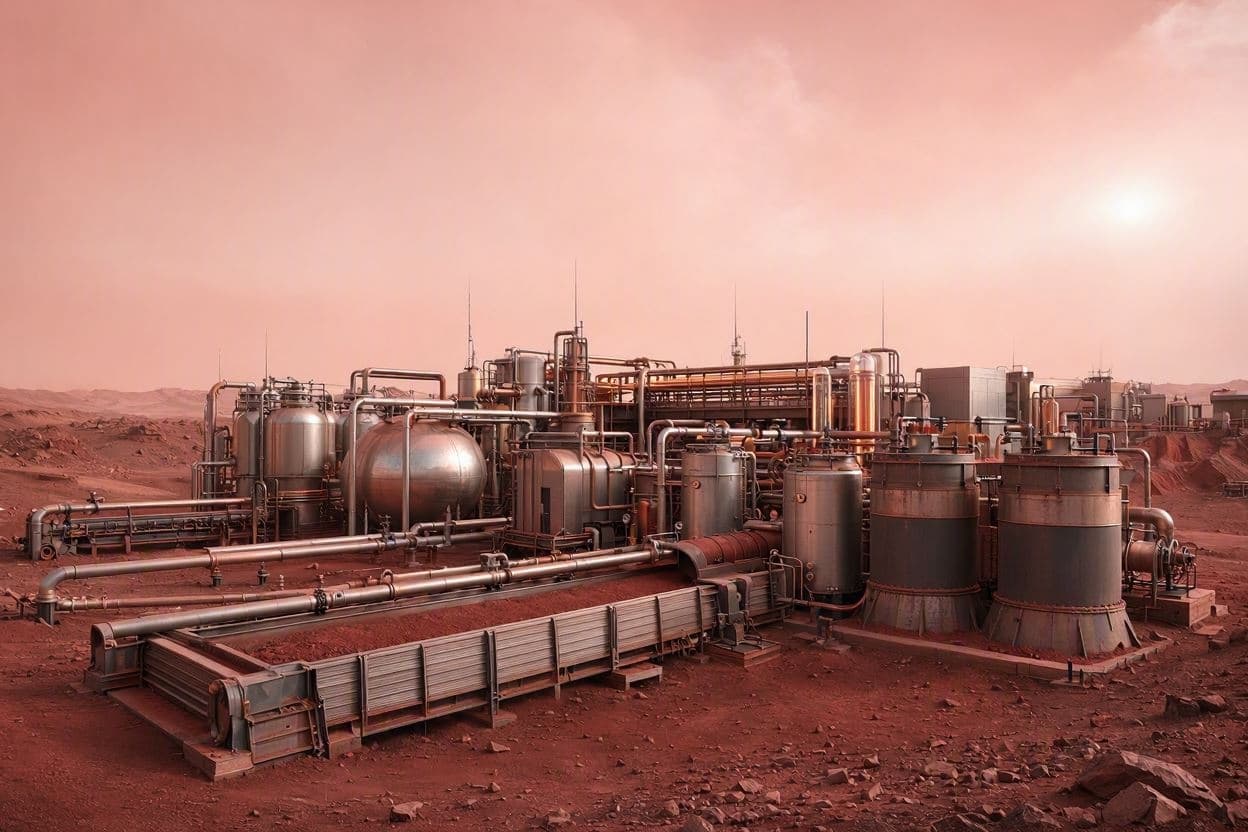
AI Image Disclaimer: The visuals provided are AI-generated conceptualizations of Martian industrial processes and are not actual images from the surface of Mars.
Sources: Phys.org NASA Jet Propulsion Laboratory IEEE Spectrum
Published by Banx Network. This article is part of the Banx decentralized media programme, powered by the BXE token on the XRP Ledger.