Key Highlights
- Trade Agreements:President Trump secured significant trade deals with Malaysia and Cambodia.
- Industry Support:U.S. business and agricultural communities expressed strong approval of the agreements.
- Economic Impact:The deals aim to enhance market access for American industries and farmers.
President Trump’s historic Asia tour kicked off with a seismic shift for American trade, delivering immediate, tangible results. In a powerful display of economic diplomacy, the administration secured signed trade deals with Malaysia and Cambodia, while simultaneously establishing reciprocal trade frameworks with Thailand and Vietnam. This strategic move is not just a diplomatic victory; it’s a direct injection of certainty and growth for key American industries back home.
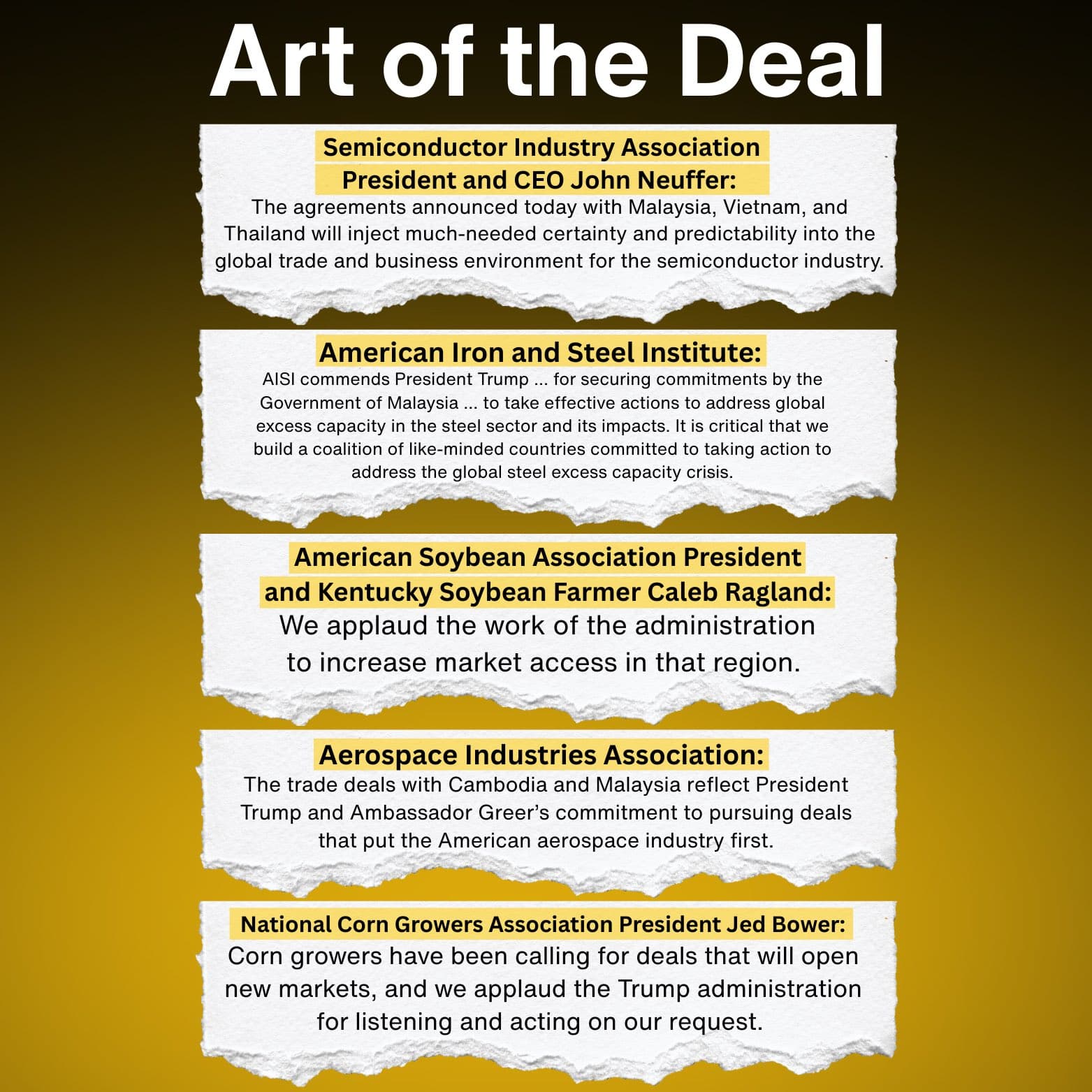
The response from the U.S. business and agricultural community was swift and overwhelmingly positive. The Semiconductor Industry Association hailed the agreements for providing the "much-needed certainty and predictability" vital for global operations. For American steel, it was a landmark moment, with the American Iron and Steel Institute (AISI) praising the commitment from Malaysia to directly address the global steel excess capacity crisis, a critical issue for U.S. manufacturers.
From the heartland, American farmers voiced strong approval. The American Soybean Association and the National Corn Growers Association applauded the new pacts for finally "increasing market access" and "opening new markets" for their vital agricultural exports. Completing this wave of support, the Aerospace Industries Association confirmed the deals put the "American aerospace industry first."
This isn't just policy; it's a clear, actionable plan delivering on the promise of putting American interests at the forefront of global trade, creating a coalition of like-minded nations and unlocking unprecedented opportunities for farmers, producers, and manufacturers across the United States.
The implications of these agreements extend beyond immediate economic benefits. By fostering stronger ties with Southeast Asian nations, the U.S. is positioning itself as a key player in the region, countering the influence of other global powers. This proactive approach to trade is expected to enhance the competitiveness of American goods and services in international markets.
As the administration continues to navigate complex global trade dynamics, the success of this Asia tour may serve as a blueprint for future engagements. The focus on reciprocal trade agreements reflects a shift towards more balanced trade relationships, which could lead to sustainable economic growth for the U.S. in the long term.
In conclusion, President Trump's Asia tour marks a significant milestone in U.S. trade policy, with the potential to reshape economic relationships in the region. The administration's commitment to securing beneficial agreements for American industries and agriculture underscores a strategic vision aimed at revitalizing the U.S. economy on the global stage.
Published by Banx Network. This article is part of the Banx decentralized media programme, powered by the BXE token on the XRP Ledger.