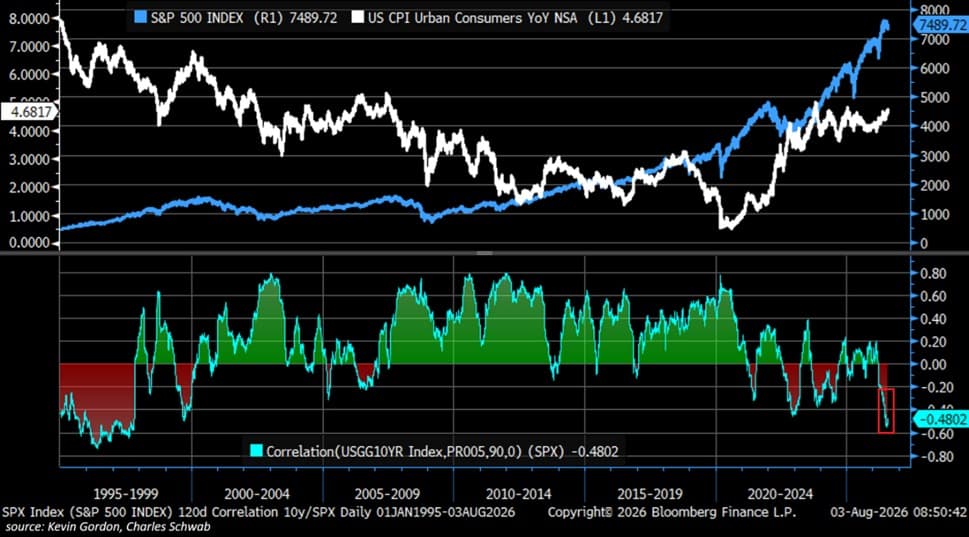
new market analysis has highlighted an unusual development in global financial markets: U.S. Treasury yields and the S&P 500 have recently moved in the same direction, creating one of the strongest positive correlations seen in years. Traditionally, government bonds and equities often move inversely, with investors buying Treasuries during periods of market uncertainty and shifting into stocks when confidence improves. The latest trend suggests investors are reassessing economic expectations in a changing interest-rate environment. Treasury yields represent the return investors receive for holding U.S. government debt. Because Treasuries are considered among the world's safest financial assets, their yields influence borrowing costs, mortgage rates, corporate financing, and global investment decisions. Changes in Treasury yields therefore have broad implications across financial markets. The recent positive relationship between Treasury yields and equity markets indicates that investors are responding more to expectations of economic growth than to traditional risk-off behavior. Strong economic data, resilient corporate earnings, and evolving Federal Reserve expectations have encouraged investors to remain active in equities even as bond yields have risen. Market strategists note that this environment differs from previous cycles where higher yields typically pressured stock valuations. Instead, investors appear to believe that economic resilience can support corporate profitability despite elevated financing costs. This has allowed both asset classes to strengthen simultaneously during certain trading periods. Institutional investors are closely monitoring whether this correlation proves temporary or signals a longer-term structural shift. Pension funds, hedge funds, sovereign wealth funds, and asset managers frequently adjust portfolio allocations based on the historical relationship between bonds and equities. Any sustained change could influence portfolio construction strategies across global markets. Central bank policy remains a major factor. Future interest rate decisions, inflation trends, labor market data, and economic growth figures will continue shaping both Treasury yields and equity performance. Investors are therefore watching upcoming economic releases for signs of whether the current market relationship will persist. Although correlations naturally fluctuate over time, the latest market behavior illustrates how changing macroeconomic conditions can alter long-standing investment patterns. Analysts believe continued monitoring will be essential as investors navigate an environment defined by evolving monetary policy and resilient economic growth.
Published by Banx Network. This article is part of the Banx decentralized media programme, powered by the BXE token on the XRP Ledger.