Key Highlights
- Fatalities:Fourteen people died in a minibus accident in Nepal.
- Survivors:Six others are receiving medical treatment following the crash.
- Investigation:Authorities are probing the cause of the accident.
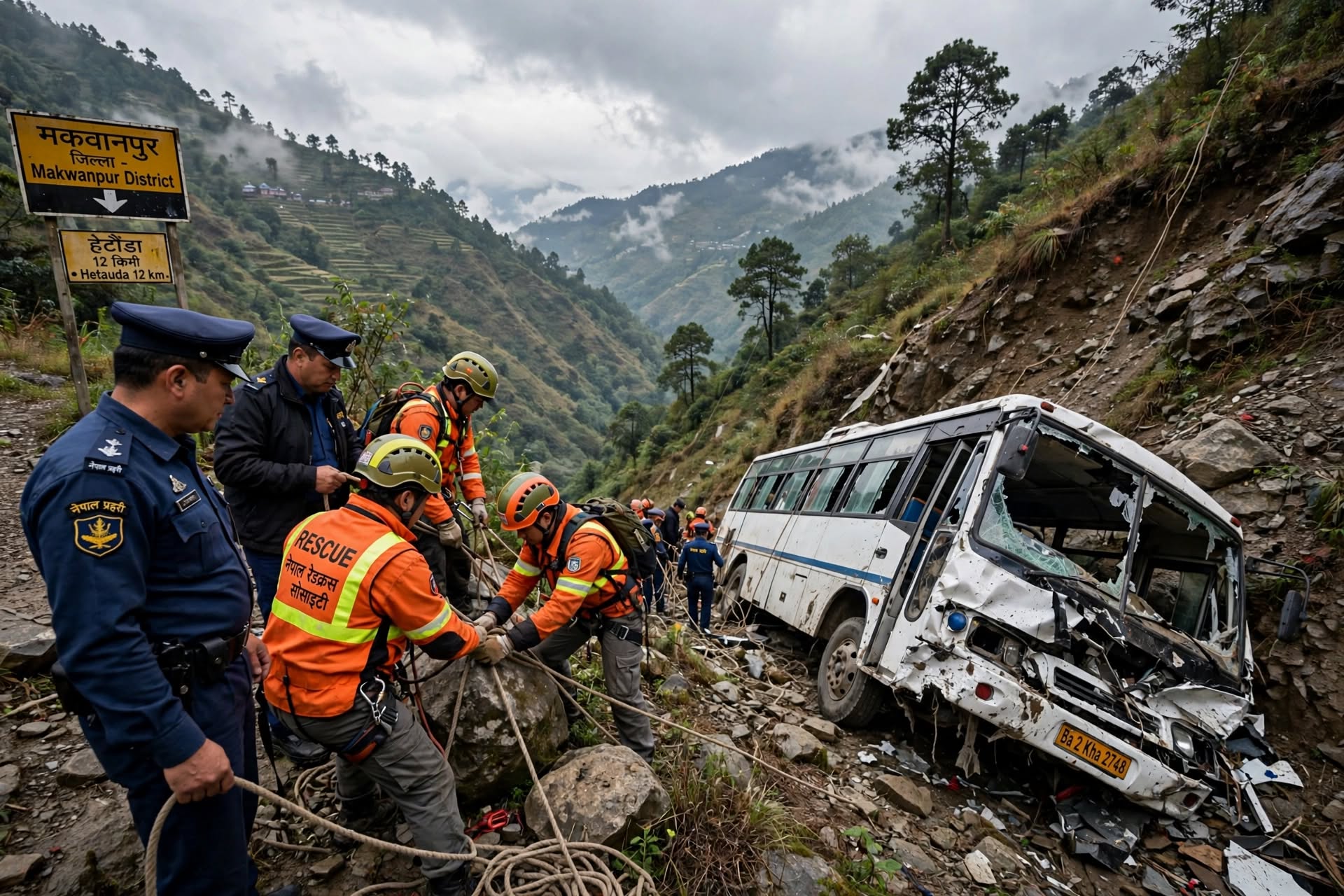
Hetauda, Nepal—A devastating accident occurred early Thursday morning when an electric passenger microbus veered off a narrow mountain highway, plunging approximately 500 meters down a rocky ravine in the Makwanpur district. The incident, which took place around 5:45 a.m., resulted in the tragic deaths of fourteen individuals, with six others currently under medical care. The vehicle was transporting commuters from Kathmandu to the southern plains of Sarlahi for Chhath festival celebrations.
The microbus, identified as a commercial electric Hiace with registration plate Madhesh Province 03-001 Ja 0880, was carrying 20 passengers when the driver lost control on a sharp bend near Chisapani Gadhi along the Bhimphedi-Kulekhani-Kathmandu road. The vehicle's descent was marked by the sound of steel crumpling against boulders, and rescue teams faced significant challenges in retrieving the victims from the steep, wooded slope. Final body recoveries and formal identifications were completed on Friday, November 13, 2026.
Among the deceased, thirteen individuals hailed from a single neighborhood in Sundarpur Tol within Chakraghatta Rural Municipality-4 in Sarlahi, including six members of the same extended family. The driver, 30-year-old Ravi Shankar Kumar Mandal from Kabilasi Rural Municipality-8, was also among the fatalities. District police units, Armed Police Force personnel, and local villagers collaborated in the rescue efforts, utilizing ropes and bamboo stretchers to transport the deceased and injured back up the sheer embankment. The difficult terrain, characterized by thick scrub and loose scree, significantly hampered the extraction process.
Deputy Superintendent of Police Madhav Kafle, spokesperson for the District Police Office in Makwanpur, confirmed that the deceased included nine men and five women and children, with the youngest victims being girls aged five, seven, and ten. The remains were transferred to Hetauda Hospital for post-mortem examinations before being released to relatives who traveled from Sarlahi.
Three survivors with minor injuries were discharged after receiving initial emergency treatment, while three others required urgent transfer to specialized trauma centers. Two toddlers, three-year-old Sujan Yadav and 14-month-old Sudip Yadav, were referred to Mediciti Hospital in Kathmandu for critical care, alongside 31-year-old Devendra Rai, who was sent to Manakamana Hospital in Bharatpur.
The Bhimphedi-Kulekhani-Kathmandu route is known for its steep and winding nature, serving as a shortcut that connects the capital valley to the Terai plains. This route is often favored by commercial microbus operators looking to reduce travel time, despite the absence of steel guardrails along several precarious drops. The increasing use of electric microbuses on Nepal's short-haul hill routes has been attributed to lower charging costs and government incentives, although concerns have been raised regarding their performance on steep descents, particularly regarding regenerative braking and battery weight distribution.
In response to this tragic incident, provincial and federal authorities have established an investigation committee to determine the cause of the accident, focusing on potential mechanical failure, brake fade, or driver fatigue. Technical inspectors are set to examine the wreckage and electronic drive logs recovered from the gorge floor. The police have impounded the damaged vehicle as the inquiry panel begins interviewing surviving passengers and reviewing route permit records from Kathmandu transport terminals.
Published by Banx Network. This article is part of the Banx decentralized media programme, powered by the BXE token on the XRP Ledger.