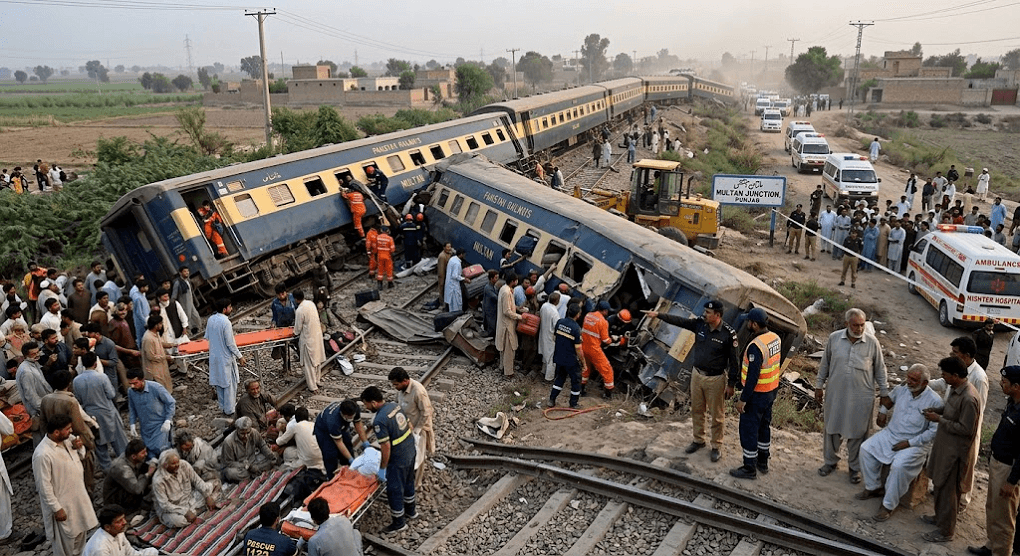
MULTAN, PAKISTAN — At least four people were killed and over a dozen others injured early Tuesday morning, October 13, 2026 after a passenger train derailed near Multan in the southern region of Pakistan’s Punjab province.
The disaster unfolded around 5:21 a.m. local time when carriages of the passenger train—en route from Karachi to Peshawar—went off the tracks near Sher Shah in the Multan district. Emergency response teams, including ambulances and rescue personnel, rushed to the scene shortly after receiving emergency calls reporting the derailment.
Rescue workers equipped with heavy machinery arrived at the crash site to free trapped passengers from the twisted metal of the overturned carriages.
"Four people have been confirmed dead and at least 17 others injured," confirmed Farooq Ahmed, a spokesperson for Punjab's Emergency Services department (Rescue 1122), during initial reports from the site. Paramedics treated several victims with minor injuries on site, while those with more severe trauma were rushed to local hospitals in Multan for urgent medical care.
The cause of the derailment remains under investigation, with railway authorities and law enforcement officials assessing the tracks and wreckage to determine what led to the accident.
Following the tragic news, leadership expressed deep grief over the loss of life, offering condolences to the affected families and instructing health officials to ensure the best possible care for the wounded. Railway safety concerns have come under renewed scrutiny across the country as investigators work to clear the line and restore transit services.
In response to the incident, Pakistan Railways announced the formation of a special inquiry committee tasked with submitting a comprehensive report on the structural integrity of the tracks and signaling systems in the region. Transit officials indicated that temporary delays across the main line are expected to persist as heavy cranes work to clear the damaged cars and clear debris from the tracks.
Meanwhile, civil society groups and transport union representatives have called for immediate structural reforms and increased funding for aging rail infrastructure. They emphasized that modernizing safety protocols and performing routine maintenance checks are crucial steps needed to prevent similar derailments from recurring on heavily traveled long-distance routes.
Published by Banx Network. This article is part of the Banx decentralized media programme, powered by the BXE token on the XRP Ledger.