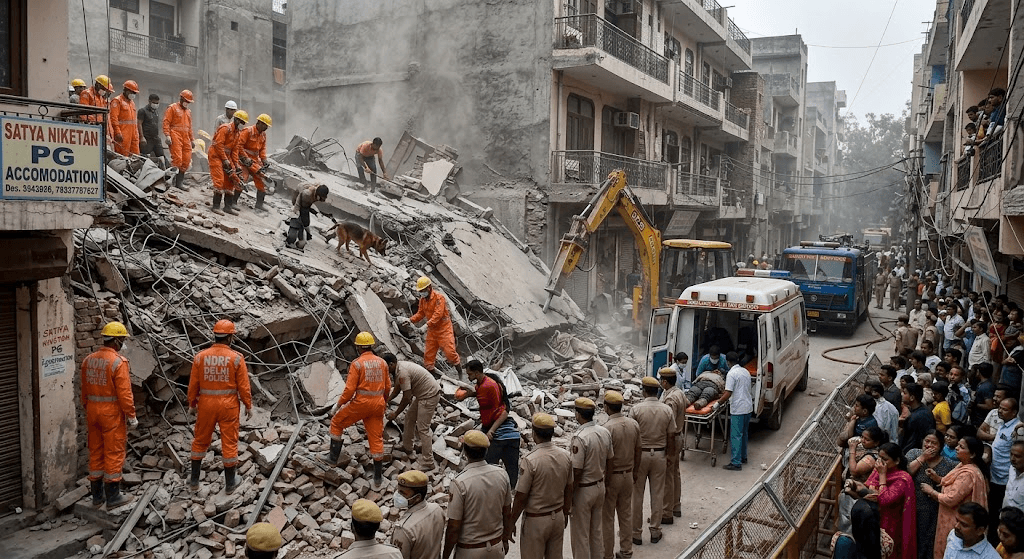
NEW DELHI, INDIA — A catastrophic structural collapse struck South Delhi’s Satya Niketan neighborhood on Monday morning, September 7, 2026 when an under-renovation five-storey building suddenly pancaked, killing at least six people and leaving dozens more feared trapped beneath a mountain of twisted concrete and metal.
The collapse occurred shortly after 10:00 a.m. local time in a densely populated commercial and residential pocket popular with university students. Witnesses reported hearing a deafening crack followed by a massive cloud of dust as the entire structure caved in on itself within seconds, crushing adjacent alleyways and trapping site workers along with neighboring pedestrians.
National Disaster Response Force (NDRF) teams, Delhi Fire Services, and local police units rapidly deployed heavy machinery, specialized cutters, and search-dog units to lead the high-stakes rescue operation. Emergency personnel have been working feverishly through dense piles of debris to establish voice contact with survivors trapped in small pockets beneath the rubble, managing to extricate several critically injured workers who were immediately rushed to nearby hospitals.
Preliminary reports indicate that the building was undergoing extensive structural modifications and renovations at the time of the collapse. Municipal authorities have cordoned off the surrounding block over concerns regarding the stability of adjacent structures, many of which share common walls with the collapsed edifice.
Senior municipal officials and Delhi Police have initiated a formal inquiry to determine the exact cause of the disaster. Investigators are examining whether unauthorized construction work, structural integrity violations, or failure to secure mandatory civil safety permits contributed to the deadly collapse, while a search remains underway for the building owner and site contractors.
The tragedy has sparked sharp criticism from neighborhood associations and urban safety advocates regarding urban planning enforcement and unregulated alterations in congested residential zones. Local representatives called for a city-wide audit of aging structures undergoing commercial conversions, demanding stricter oversight by the Municipal Corporation of Delhi (MCD) to identify unapproved architectural modifications before further catastrophic failures occur in densely packed student hubs.
Published by Banx Network. This article is part of the Banx decentralized media programme, powered by the BXE token on the XRP Ledger.