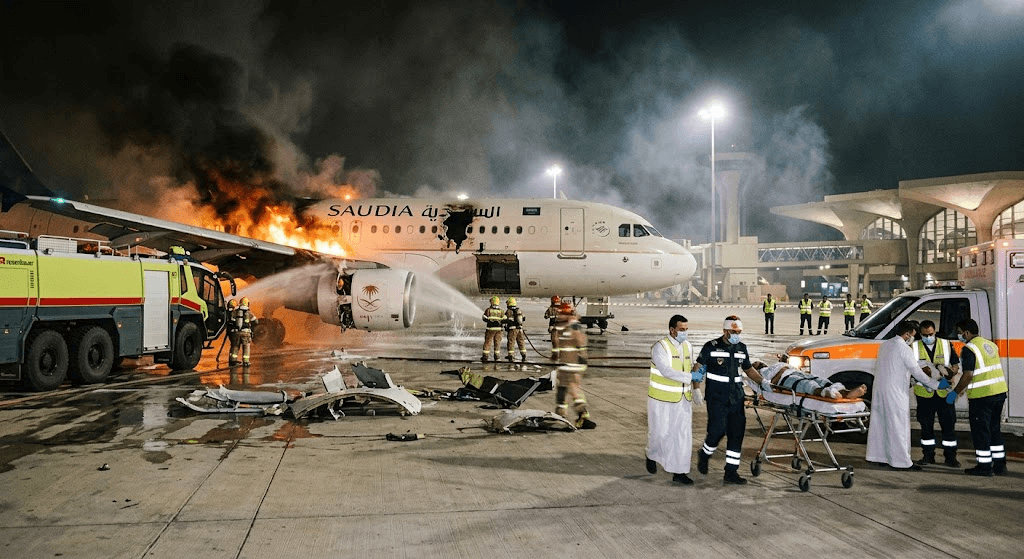
RIYADH, SAUDI ARABIA — A sequence of strikes hit King Khalid International Airport, killing three Saudi citizens—including a commercial airline pilot—and leaving several others injured. The strikes direct targeted essential airport terminal infrastructure before striking a commercial passenger aircraft belonging to national flag carrier Saudia on the tarmac.
Saudi Arabia's General Authority of Civil Aviation (GACA) confirmed that two distinct strikes occurred during the operation. The initial strike damaged primary airport facility zones, followed by a secondary impact that struck a parked Saudia airliner.
The attack resulted in casualties among both local citizens and international residents, with injuries ranging from minor to critical. Emergency response personnel and specialized hazardous units rushed to the terminal and apron areas to contain fires, secure passengers, and transport victims to regional medical facilities.
The attack prompted widespread cancellations and flight delays across the region, with international carriers briefly suspending flights into the capital while security protocols were elevated.
"Emergency teams responded immediately in line with approved crisis management protocols. Air traffic and operational activities at King Khalid International Airport have since returned to normal." — General Authority of Civil Aviation (GACA) Statement
Yemen's Iran-backed Houthi rebel movement subsequently claimed responsibility for launching the aerial campaign targeting the capital's main transport hub. Civil aviation authorities confirmed that emergency teams succeeded in restoring order to terminal operations, allowing flights to resume under heightened airspace defense measures.
International security analysts warn that the escalated targeting of key aviation infrastructure marks a significant shift in regional dynamics, prompting civil aviation bodies across the Gulf to review defense readiness. In response, Saudi defense forces have bolstered air defense systems around major population centers and crucial economic corridors to intercept potential follow-up threats.
In addition to heightening physical defenses, regional aviation authorities and international carriers are closely monitoring airspace safety advisories. Major global airlines have already announced temporary route suspensions and flight diversions away from the capital's airspace pending further security assessments. Meanwhile, local emergency management units remain on high alert across commercial transport hubs, working alongside defense personnel to ensure passenger safety and maintain essential logistics corridors.
Published by Banx Network. This article is part of the Banx decentralized media programme, powered by the BXE token on the XRP Ledger.