There are stories that begin not with a grand plan but with a single quiet decision—to walk a field, to listen for what the ground might say. Oliver Riedl, a licensed metal detectorist in western Germany, made that decision one day near the town of Wesseling, south of Cologne. His device beeped, as it often does. He dug. What he found was not the scattered debris of ordinary history but something far more deliberate: a cache of silver coins, and beneath them, a promise of more .
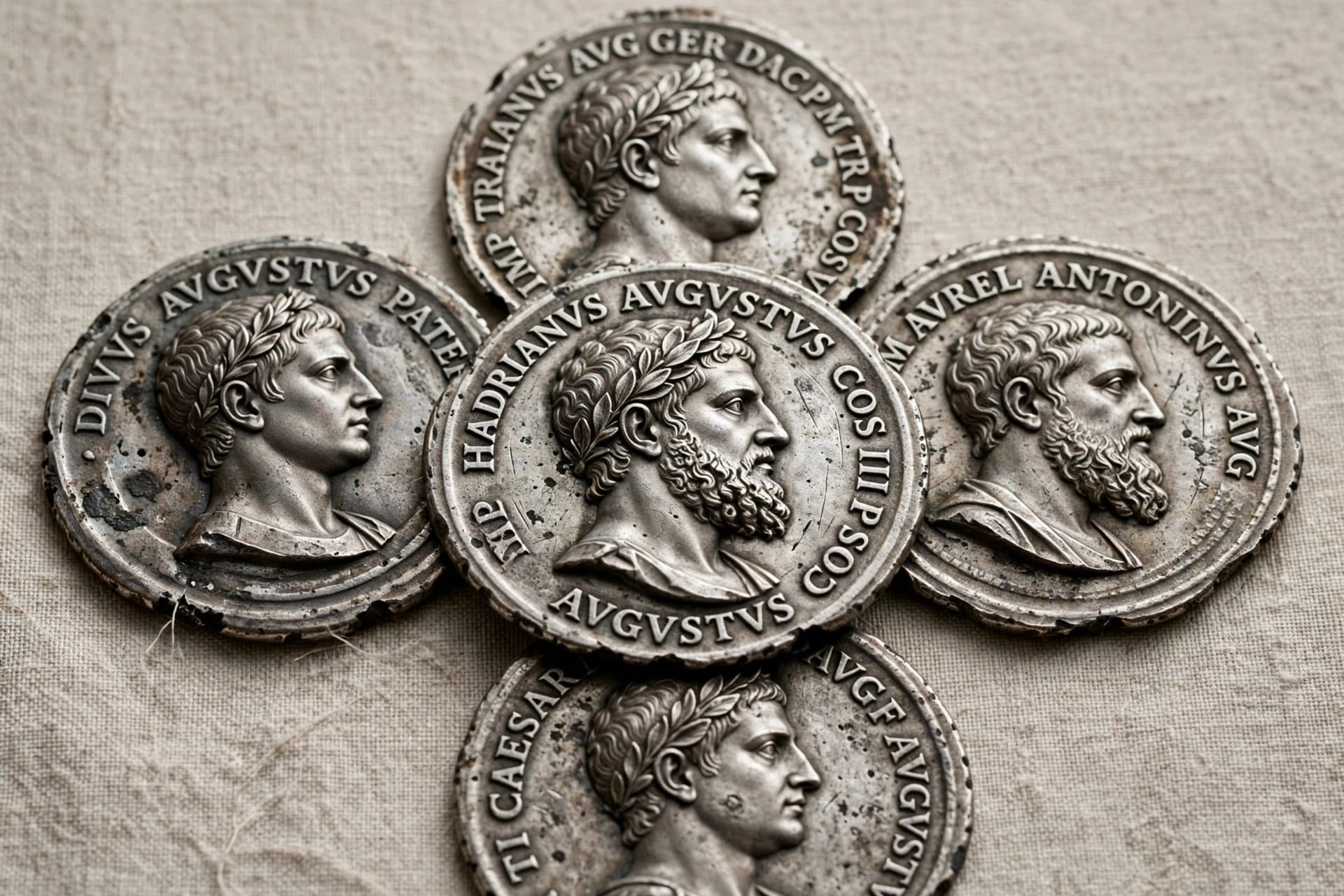
What Riedl uncovered has now been confirmed as the largest hoard of Roman silver coins from the reign of Emperor Hadrian ever found in Germany . The collection comprises nine hundred and thirty-four silver denarii, weighing nearly seven pounds, spanning nearly three hundred years of Roman history—from 148 B.C.E. to approximately 124 or 125 C.E. . The coins were found buried in a ceramic pot lined with straw, though agricultural activity over the centuries had scattered the coins and destroyed the vessel .
The discovery was not merely the result of luck but of careful, responsible practice. Riedl, who held a permit to use his metal detector in North Rhine-Westphalia, immediately alerted authorities after finding the first fifteen coins . Experts from the LVR Office for the Preservation of Archaeological Monuments in the Rhineland arrived and ultimately removed the entire block of earth containing the coins, taking it to a restoration workshop where X-rays revealed what lay within . The hoard is now on display at the LVR-LandesMuseum Bonn .
Why someone buried such a fortune—and why they never returned—remains a question that historians can only approach through speculation. At the time, banks did not exist, and burial was a common way to safeguard wealth . Erich Classen, state archaeologist and director of the LVR Office, suggested that the owner may have died before recovering the coins or before passing on knowledge of their location . The region was under Roman control from approximately 39 B.C.E. to 459 C.E., and Cologne was the site of a military outpost known as Colonia Agrippina, established to protect the empire’s northern frontier along the Rhine .
To understand the value of what was buried, scholars point to the pay of Roman legionaries, which is well documented in written sources. An ordinary soldier earned three hundred denarii per year, with roughly half withheld for food and equipment . A legionary would have needed to save all disposable income for approximately six years to amass the Wesseling hoard . The find represents, in the words of one expert, “a time capsule of the money the people in that period actually used day by day” .
The significance of the discovery extends beyond its monetary value. It offers a tangible connection to a period when the Rhineland was a frontier of empire, when soldiers and civilians lived under Roman rule, and when the security of wealth depended not on institutions but on the soil itself. The coins bear portraits and inscriptions that speak across two millennia, remnants of a system of exchange that sustained an empire .
For Riedl, the find was the culmination of a hobby pursued with care. For archaeologists, it is a contribution to the collective understanding of a distant past. The hoard has been described as a story of “how to do things right”—a licensed detectorist, a prompt report, an orderly excavation, and a treasure now preserved as cultural heritage . What was buried for centuries has returned to the light, carrying with it the silence of its original owner and the questions that history cannot answer.
AI Image Disclaimer: The visual elements in this article were generated by artificial intelligence and serve an illustrative purpose only.
Sources:
· Smithsonian Magazine · Associated Press (via Daily Sabah) · Fox News Digital (via News24) · The Guardian
Published by Banx Network. This article is part of the Banx decentralized media programme, powered by the BXE token on the XRP Ledger.