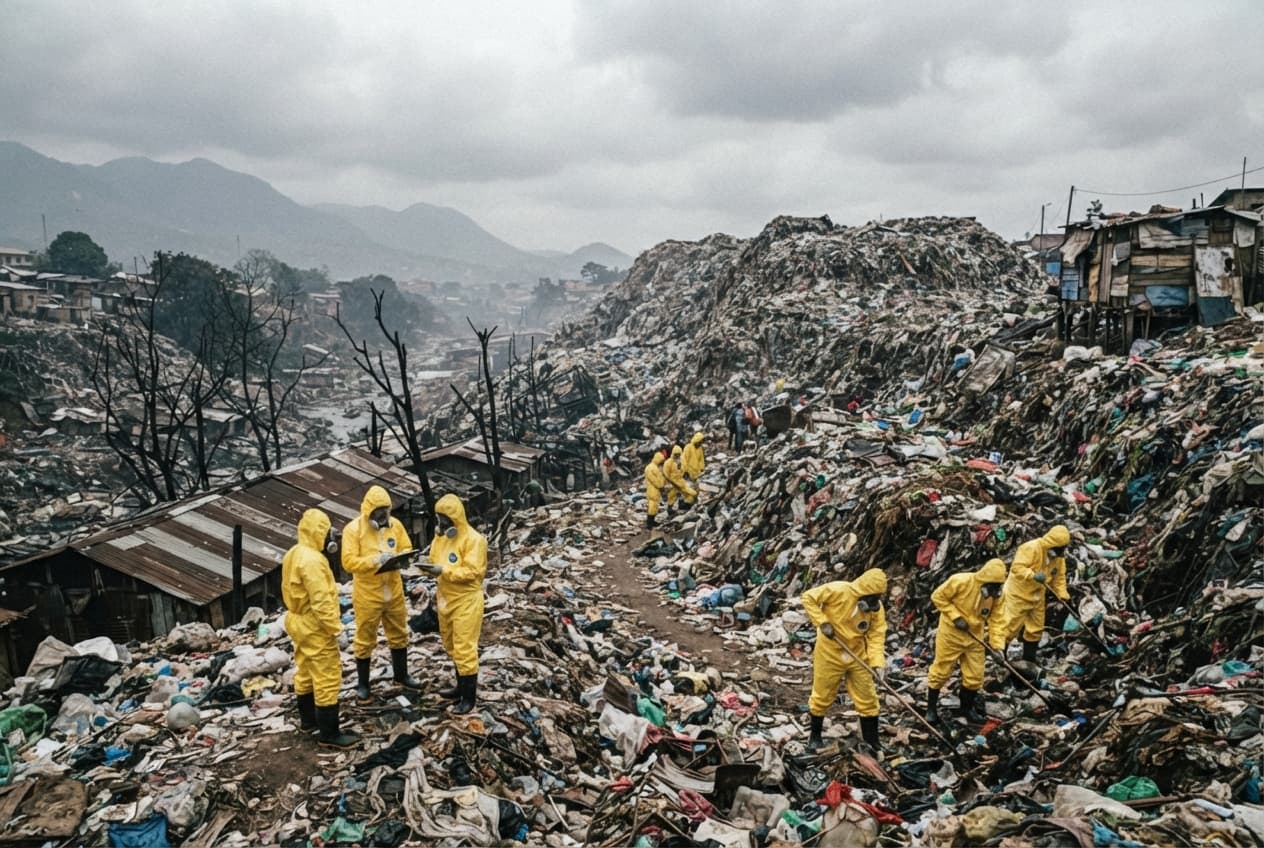
Conakry, Guinea—Heavy excavation machinery ground to a halt as thick, yellowish plumes billowed from deep fissures in the mountain of trash. Emergency personnel on the ground pulled back their respirators, coughing violently as underground chemical reactions released suffocating methane and sulfur combinations into the humid morning air. Days after the massive slope failure at the capital's primary municipal dumpsite, the race against time had transformed into a hazardous battle against invisible chemical threats. Dozens of families remained encamped along the perimeter, staring blankly at the shifting mass of refuse that swallowed their homes under cover of darkness.
Rescue coordinators confirmed that pockets of toxic gas continued to accumulate within the dense, decomposing core of the waste mountain. Heavy rainfall earlier in the week destabilized the structural integrity of the site, causing millions of cubic feet of garbage to shear off and bury makeshift dwellings. Specialized chemical detection units were brought to the perimeter, but their monitors beeped continuously in the red danger zone. Below the surface, decomposing organic matter and industrial chemical runoff created an underground labyrinth of asphyxiating chambers.
Civil protection officers moved cautiously across unstable layers of domestic refuse and industrial sludge. Every step risked triggering secondary slides that could plunge rescuers into identical pits of debris. Shovels and bare hands gave way to hydraulic claws, yet operators had to constantly monitor wind directions to avoid drifting clouds of toxic vapor. Medical tents stationed near the access road treated multiple rescue workers for acute respiratory irritation and chemical exposure symptoms.
Local authorities faced intense public fury over the continued operation of the overloaded facility despite years of relocation promises. Neighborhood residents pointed toward the jagged scar left by the collapse, noting that municipal warnings arrived far too late to prevent the catastrophe. Heavy security cordons kept grieving relatives hundreds of meters away from the active dig zones. Arguments occasionally broke out between desperate family members and perimeter guards as excavator buckets lifted twisted sheets of corrugated iron from the mud.
Official casualty figures held steady as teams struggled to reach the deepest burial zones near the base of the retaining slope. Heavy rains resumed overhead, turning the surface silt into a treacherous, sliding paste that clogged mechanical treads. Engineers warned that saturation levels remained dangerously high across the entire upper ridge. Further structural shifts threatened to wipe out existing stabilization anchors placed just hours prior.
The logistical nightmare deepened as heavy transport trucks struggled to deliver additional oxygen tanks and specialized extraction gear through flooded neighborhood arteries. Conakry's municipal infrastructure buckled under the compound pressure of the disaster response and ongoing seasonal deluges. Senior disaster management officials held whispered consultations near command vehicles, avoiding direct eye contact with the gathered crowd. Medical teams prepared additional stretchers while monitoring the shifting wind patterns above the waste trench.
Operations ground forward in agonizingly slow increments as specialized HAZMAT teams probed individual gas pockets with long metal lances. Every suspected void was vented manually before mechanical diggers were permitted to scrape away the upper layers of compacted refuse. Search dogs displayed visible distress, whining and pulling away from the heavy chemical stench radiating from the interior fissures. Hand-dug inspection tunnels remained prone to sudden collapses whenever internal pressure releases shook the surrounding earth.
Heavy equipment operators worked in staggered twenty-minute shifts to mitigate the effects of heat exhaustion and toxic inhalation inside the containment zone. Communication lines crackled with static as spotters on the ridge warned of fresh ground fractures opening near the western perimeter. The sun dipped lower behind heavy storm clouds, casting a bruised orange glare over the sprawling municipal waste facility. Heavy excavators kept their engines idling against the deepening mud while searchlights swept across the jagged face of the debris field.
Published by Banx Network. This article is part of the Banx decentralized media programme, powered by the BXE token on the XRP Ledger.