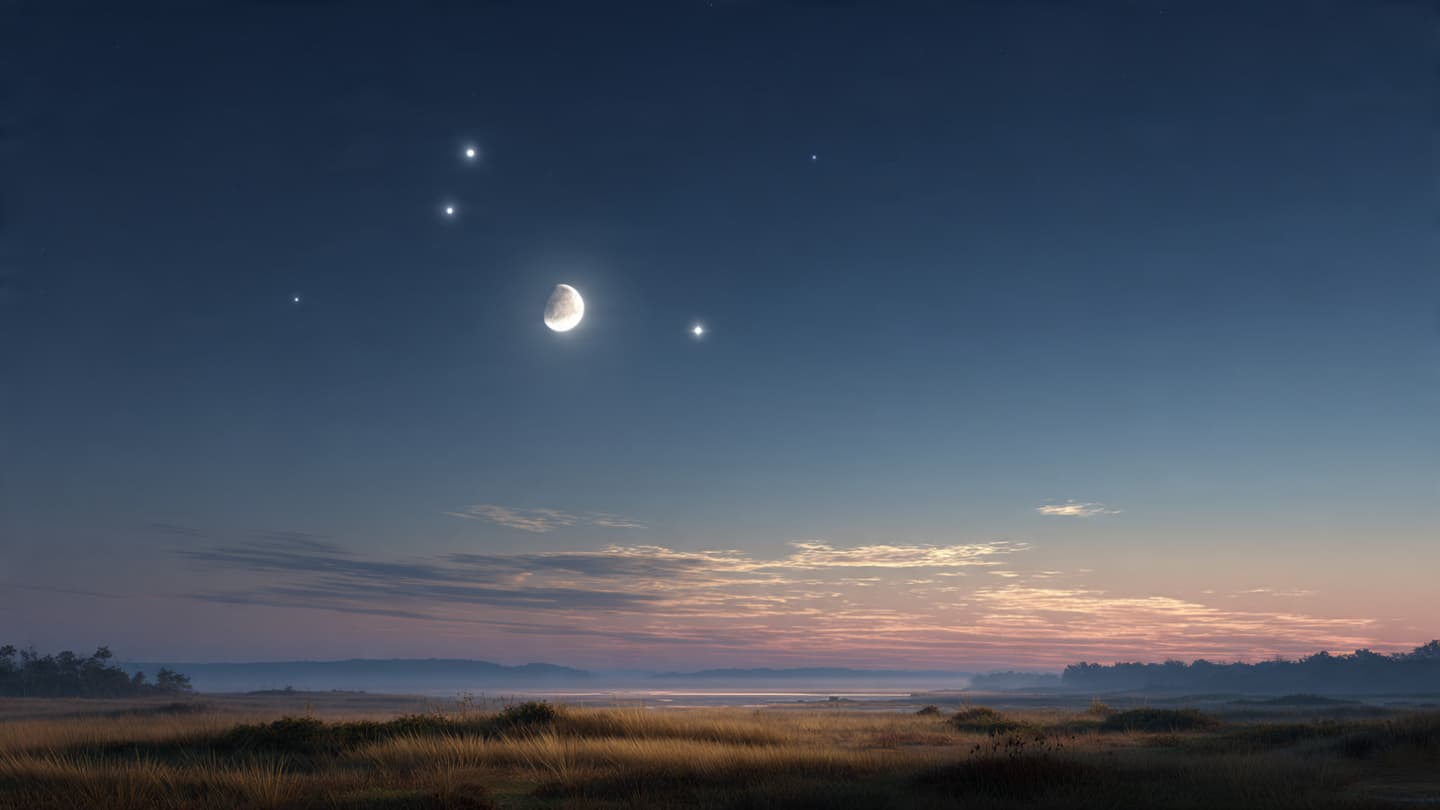
There are evenings when the sky seems less like an empty distance and more like a carefully arranged conversation. Tonight, the Moon rises beside a gathering of bright celestial neighbors, while Jupiter, Venus, and Mercury appear close together along the horizon. For many observers, the event offers a quiet reminder that even in an age shaped by screens and constant movement, the night sky still has the power to gather attention in silence.
Planetary alignments occur because the planets orbit the Sun along roughly the same flat plane known as the ecliptic. From Earth, this shared orbital path can occasionally make several planets appear close together in the sky, even though vast distances still separate them in space. Astronomers say these visual alignments are not rare in a cosmic sense, but each one carries its own timing and viewing conditions.
Venus is expected to appear as one of the brightest objects in the evening sky, reflecting sunlight strongly through its thick cloud cover. Jupiter, much farther from Earth, remains visible due to its immense size and reflective atmosphere. Mercury, often more difficult to observe because of its proximity to the Sun, joins the arrangement low near the horizon shortly after sunset.
The Moon’s presence adds further visibility and emotional resonance to the event. Depending on local weather conditions and light pollution, viewers may also notice nearby stars gradually emerging around the planetary grouping. Astronomers often encourage casual observers to use these moments as opportunities to become familiar with the changing patterns of the night sky.
Skywatching events like this have long carried cultural and historical significance. Ancient civilizations tracked planetary movements for navigation, agriculture, religious ceremonies, and early astronomical study. While modern science now explains the mechanics behind these alignments, many people still experience them with a sense of reflection and wonder.
Astronomers note that no special equipment is required to observe the planets during favorable conditions. Binoculars or small telescopes may reveal additional details, such as Jupiter’s moons or the crescent phases of Venus and Mercury. However, much of the event remains visible to the naked eye shortly after dusk.
The alignment also highlights the continuing public interest in astronomy. In recent years, advances in telescope technology, smartphone astronomy applications, and online observatories have made celestial observation more accessible to wider audiences. Public observatories and astronomy groups frequently organize gatherings during visible planetary events.
Scientists emphasize that these alignments are visual perspectives rather than physical clustering in space. The planets remain separated by millions of miles while appearing near one another from Earth’s viewpoint. Even so, the illusion creates one of the most striking experiences available in ordinary night skies.
Astronomers say favorable viewing conditions are expected in many regions during the evening hours, though local weather and light pollution may affect visibility. Observers are encouraged to look toward the western horizon shortly after sunset.
AI Image Disclaimer: The accompanying space visuals were created using AI-generated imagery inspired by astronomical observations.
Sources: NASA, Sky & Telescope, Space.com, EarthSky, BBC Sky at Night Magazine
Published by Banx Network. This article is part of the Banx decentralized media programme, powered by the BXE token on the XRP Ledger.