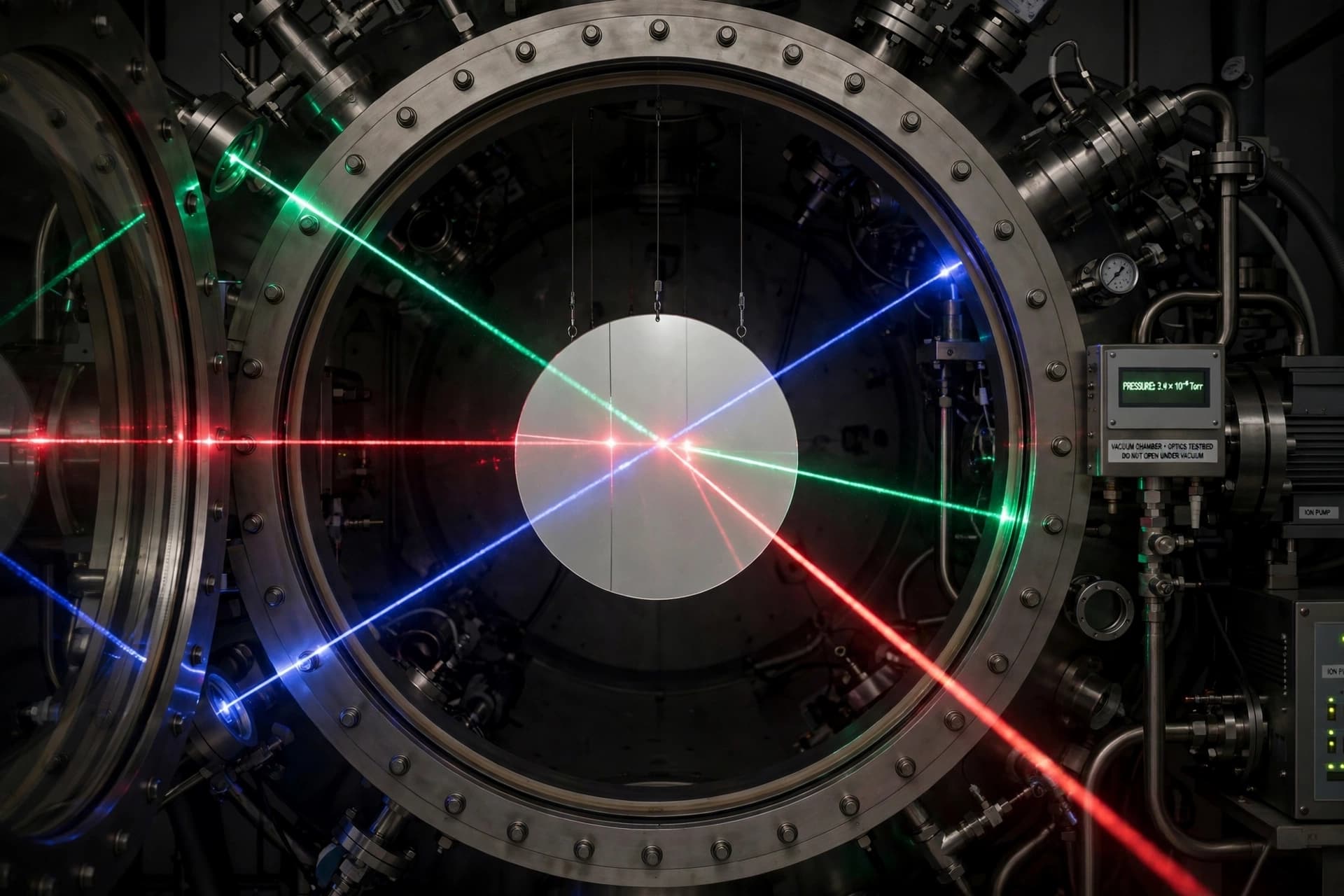
Gravitational waves are the faintest whispers the universe has to offer—ripples in the fabric of spacetime created by cataclysmic events so distant that by the time they reach Earth, they have been stretched and weakened to nearly nothing. To hear them, scientists must build instruments of almost impossible sensitivity, mirrors that can detect movements smaller than the width of a proton. Every source of noise must be silenced, every imperfection minimized. And in Australia, researchers have been working on one of the quietest problems in the field: the coatings on those mirrors.
The University of Western Australia (UWA) has played a central role in this effort. Through the Australian Consortium for Interferometric Gravitational Astronomy (ACIGA), UWA researchers have been investigating the optical and mechanical properties of thin films used in gravitational wave detectors . The goal is to reduce what is known as mechanical loss—the tiny amount of energy that is dissipated when a mirror’s coating vibrates or flexes, creating noise that can obscure a gravitational wave signal .
The most recent work, published in Applied Optics, focuses on mixed oxide coatings made from tantalum oxide and silicon oxide . These materials offer a combination of properties that are difficult to achieve: a high refractive index, which is important for building efficient mirrors, and low mechanical loss, which is essential for reducing thermal noise . The researchers used a technique called microwave plasma assisted co-sputtering to deposit the films, and then studied how post-annealing treatments affected their performance. They found that increasing the annealing temperature reduced both mechanical loss and optical absorption, and that the addition of silicon oxide to the mixture increased the material‘s energy band gap .
These improvements may sound incremental, but in the world of gravitational wave astronomy, even small reductions in noise can make the difference between detecting a signal and missing it entirely. The mirrors at the heart of detectors like LIGO, Virgo, and KAGRA are the most precise ever built, suspended in vacuum and isolated from vibration . But their coatings remain one of the limiting sources of thermal noise. By developing materials with lower mechanical loss, researchers can push the sensitivity of these detectors to new levels.
The work at UWA is part of a broader international effort. Australia has long been involved in gravitational wave research, and ACIGA has contributed to the global network through its research on high-power interferometry, thermal compensation, and parametric instabilities . The Gingin facility in Western Australia has served as a testing ground for advanced interferometer technologies, including cryogenic silicon test masses and crystalline coatings .
The implications of this research extend beyond the detection of gravitational waves themselves. Improved mirror coatings could enable detectors to observe more distant and more diverse events, from the mergers of black holes and neutron stars to the subtle vibrations of a newborn universe . They could also contribute to a deeper understanding of neutron star interiors, where matter is compressed to densities impossible to reproduce on Earth.
For now, the work continues in quiet laboratories, where researchers deposit films a few atoms thick and measure losses that are almost too small to comprehend. The gravitational waves, when they arrive, will be faint. But with each improvement, the universe becomes a little less silent.
AI Image Disclaimer: All images in this report were generated using AI tools and do not depict actual equipment or locations.
Sources: University of Western Australia, Applied Optics, OzGrav, ACIGA
Published by Banx Network. This article is part of the Banx decentralized media programme, powered by the BXE token on the XRP Ledger.