Key Highlights
- New research suggests tiny plasma whirlpools on the Sun's surface may drive coronal heating.
- These structures, only a few dozen kilometers wide, were observed using the Daniel K. Inouye Solar Telescope.
- The study indicates that a small fraction of energy from these whirlpools could maintain the Sun's corona temperature.
[Understanding the Sun's Paradox]
For centuries, the Sun has provided warmth and light, yet its extreme temperatures have puzzled scientists. The surface of the Sun burns at approximately ten thousand degrees Fahrenheit, while its outer atmosphere, or corona, reaches temperatures hundreds of times hotter. This paradox has long been a topic of intrigue in solar physics, prompting researchers to seek explanations for the mechanisms behind such phenomena.
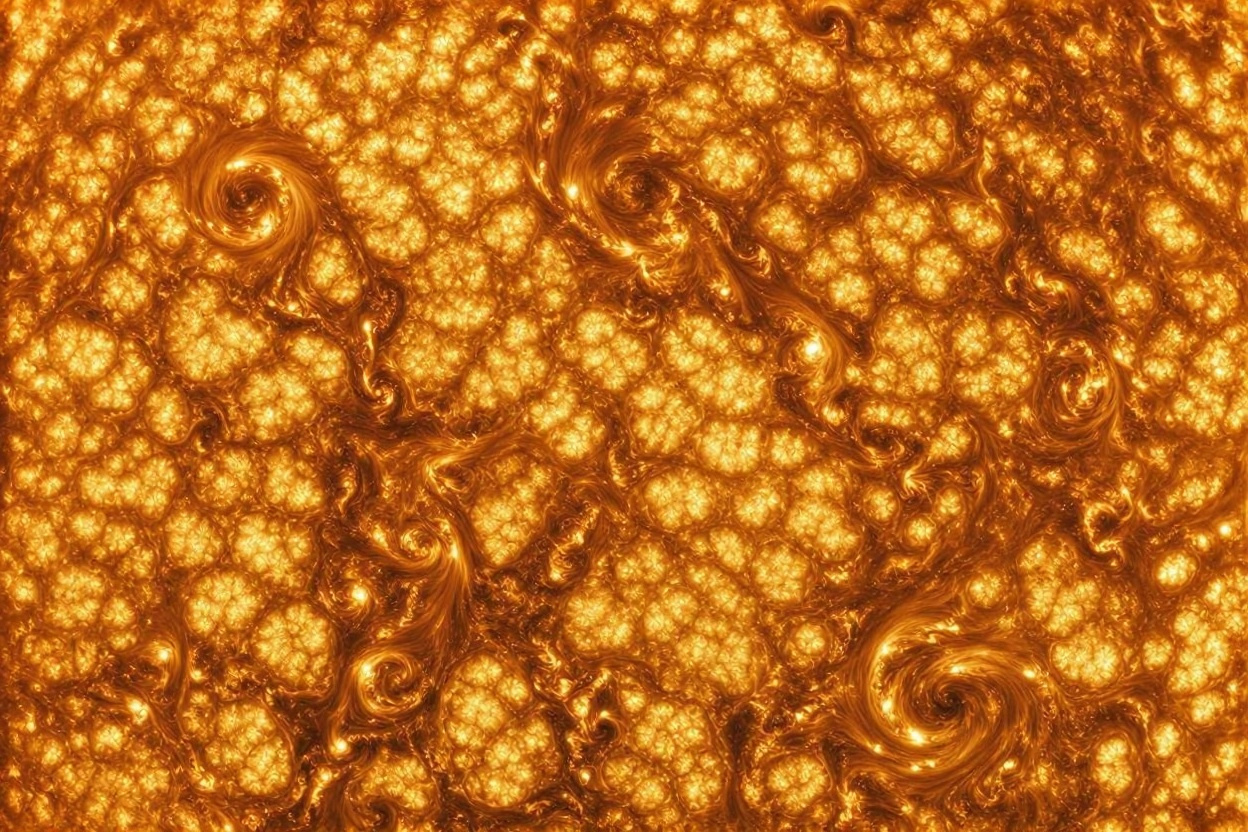
Recent research published in The Astrophysical Journal Letters by Dr. Katariina Nykyri from Embry-Riddle Aeronautical University proposes that the answer may lie in millions of tiny plasma whirlpools scattered across the Sun's surface. These vortices, only a few dozen kilometers in diameter, were first observed using the advanced imaging capabilities of the Daniel K. Inouye Solar Telescope in Hawaii. This groundbreaking observation marks a significant advancement in our understanding of solar dynamics.
[The Physics Behind the Whirlpools]
The whirlpools are formed through a process known as Kelvin-Helmholtz instability, which also occurs in ocean waves and atmospheric phenomena on Earth and other planets. In the Sun, fast-moving plasma interacts with slower, magnetized plasma, resulting in the formation of vortices that carry immense amounts of mechanical energy. According to Dr. Nykyri's estimates, each vortex contains around two septillion ergs of energy, a staggering figure that highlights the scale of these solar structures.
When these vortices dissipate, they do not simply lose their energy. Instead, they twist and compress the Sun's magnetic field lines, leading to a phenomenon known as magnetic reconnection. This process converts stored magnetic energy into heat and high-speed plasma jets, contributing to the heating of the corona. While the idea of magnetic reconnection is not new, Nykyri's research suggests that these tiny whirlpools may be the driving force behind it.
[Explaining the Temperature Discrepancy]
The significant temperature difference between the Sun's surface and its corona can be attributed to the density of particles in each region. When a magnetic field line snaps near the surface, the energy is distributed among trillions of atoms, resulting in only a slight increase in temperature for each atom. Conversely, in the corona, the same energy is shared among far fewer particles, leading to a much greater increase in temperature. This analogy can be likened to pouring water from a kettle into a bathtub versus a teacup, where the latter experiences a more pronounced effect.
Dr. Nykyri's research indicates that only five to eight percent of the mechanical energy from these vortices needs to reach the corona to sustain its temperature, making this theory not only plausible but also compelling. Even in cooler regions of the corona, such as coronal holes, a maximum of twenty-one percent of the energy would suffice to maintain the observed temperatures.
[Future Research Directions]
While this research provides a promising explanation for the Sun's extreme temperatures, it is important to note that it is not yet settled science. Further investigations are needed to track how energy travels through the chromosphere, the layer between the Sun's surface and the corona, to fully confirm the proposed mechanisms. If Dr. Nykyri's hypothesis holds true, it could revolutionize our understanding of solar physics, illustrating how some of the most dramatic solar phenomena may originate from the smallest motions.
Images in this article are AI-generated.
Published by Banx Network. This article is part of the Banx decentralized media programme, powered by the BXE token on the XRP Ledger.