In the quiet darkness of space, long before the sun ignited or the planets coalesced into their familiar orbits, there existed a vast cloud of gas and dust. This primordial nebula was the cradle of our solar system, yet its original composition has largely been lost to time and transformation. However, scattered across the cosmos and occasionally landing on Earth, meteorites serve as ancient messengers. They carry within their rocky hearts chemical fingerprints that predate the formation of our solar system, offering a rare glimpse into the universe’s deep past.
These extraterrestrial stones are not merely debris; they are time capsules. Recent studies have focused on presolar grains—microscopic particles found within certain types of meteorites—that formed in the atmospheres of dying stars billions of years ago. These grains survived the violent processes that created the solar system, remaining chemically distinct from the surrounding material. By analyzing their isotopic signatures, scientists can trace their origins back to specific stellar events, such as supernovae or red giant stars.
The discovery of these presolar components challenges our understanding of how matter is recycled in the galaxy. It suggests that the building blocks of our solar system were not created in isolation but were inherited from previous generations of stars. This continuity connects us to the broader cosmic cycle, reminding us that the atoms in our bodies and the rocks beneath our feet share a common ancestry with distant, ancient suns. It is a profound realization of our place in the universe.
Analyzing these clues requires meticulous laboratory work. Scientists use advanced mass spectrometry to detect minute variations in isotopes, distinguishing presolar grains from those formed within our own solar system. The process is akin to finding a needle in a haystack, as these grains are incredibly rare and small. Yet, each successful identification adds a piece to the puzzle of stellar evolution and galactic chemistry.
The implications extend beyond astronomy into chemistry and physics. Understanding the conditions under which these grains formed helps refine models of stellar nucleosynthesis, the process by which stars create elements. It provides empirical data that supports theoretical predictions, bridging the gap between observation and calculation. This interdisciplinary effort highlights the collaborative nature of modern science.
For the public, the idea that a simple rock can hold secrets older than the sun is captivating. It transforms meteorites from curiosities into precious artifacts of cosmic history. Museums and research institutions play a vital role in preserving and studying these samples, ensuring that their stories are told. Each meteorite that falls is an opportunity to learn more about the universe’s origins.
As technology improves, our ability to extract information from these tiny grains will only grow. Future missions may return samples from asteroids that are even more pristine, offering clearer views of the early solar nebula. The journey of discovery is ongoing, driven by curiosity and the desire to understand where we come from. Meteorites that preserve chemical clues from before the solar system formed are invaluable windows into the past. They remind us that our cosmic home is part of a larger, enduring cycle of creation and destruction. As we continue to study these ancient stones, we gain a deeper appreciation for the intricate history of the universe.
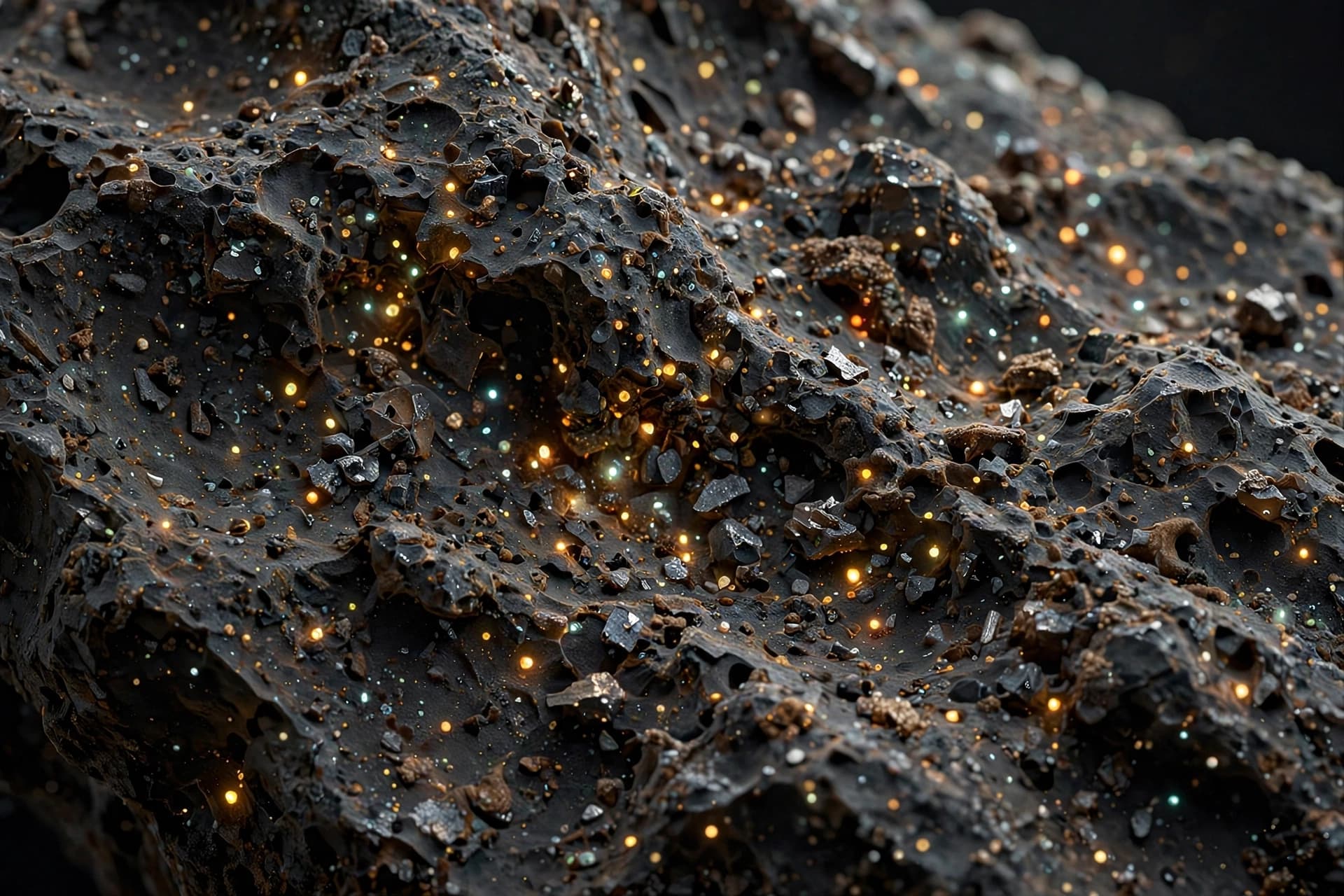
AI Image Disclaimer: The visual elements in this article are AI-generated illustrations depicting meteorites and microscopic presolar grains, not actual laboratory photographs.
Sources: Nature Astronomy University of Chicago News Live Science
Published by Banx Network. This article is part of the Banx decentralized media programme, powered by the BXE token on the XRP Ledger.