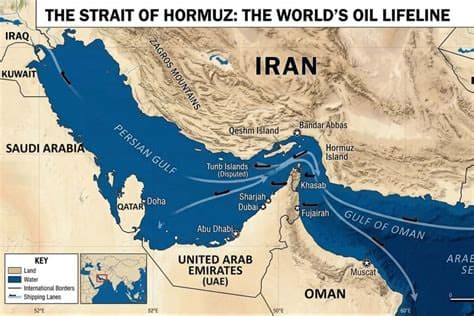
The sea around the Gulf often appears unchanging—its horizon drawn in a steady line, its tides moving with quiet persistence. Along the coasts, desalination plants work in a rhythm that mirrors the water itself: intake, filtration, release. In a region where fresh water is drawn carefully from the salt, these facilities are not only industrial structures but essential threads in the fabric of daily life.
In recent days, officials in Bahrain announced that a water desalination plant had been damaged in a drone attack attributed to Iran. The statement placed an essential civilian infrastructure site within the expanding perimeter of regional tensions, underscoring how modern conflict can move across both military and public systems.
Authorities described the incident as involving an unmanned aerial vehicle that struck or caused damage to the facility. While details regarding the scale of the damage were limited, officials confirmed that the plant sustained impact and that emergency assessments were underway to determine operational effects. Desalination plants in the Gulf typically supply drinking water to densely populated urban areas, and any disruption can carry immediate logistical significance.
Water in Bahrain, as in much of the Arabian Peninsula, depends heavily on desalination. The technology—converting seawater into potable supply—has become a cornerstone of national resilience. Facilities are often positioned along the coast, drawing directly from the Gulf’s waters before sending treated water inland to homes, hospitals, schools, and businesses. When such infrastructure is affected, even temporarily, contingency systems are activated to maintain stability in distribution networks.
Officials stated that response teams were dispatched promptly, securing the site and evaluating structural components. There were no immediate reports of widespread service interruption, though authorities emphasized that technical inspections would continue. In regions where infrastructure is closely monitored, redundancy systems and emergency reserves are typically in place to mitigate unexpected disruptions.
The reported attack comes amid heightened regional tensions, where drone technology has increasingly shaped the contours of conflict. Unmanned aerial systems can travel long distances, operate with minimal warning, and target fixed installations. As a result, energy facilities, ports, and industrial sites across the Gulf have in recent years strengthened protective measures.
Desalination plants, though civilian in function, occupy a sensitive position in this landscape. Their role in sustaining public water supply makes them critical infrastructure, and governments across the region have invested heavily in safeguarding them. Security protocols often include layered defenses, surveillance systems, and coordination with air monitoring networks.
In the broader context of regional dynamics, incidents involving infrastructure tend to prompt diplomatic exchanges and calls for restraint. The Gulf states maintain complex relationships with neighboring countries, balancing security concerns, economic ties, and regional stability. Water facilities, by their very nature, sit at the intersection of environmental necessity and strategic vulnerability.
For residents, the immediate concern remains practical: the steady flow of water that sustains daily life. Even brief disruptions can affect households and commercial operations, especially in densely populated areas. Officials have indicated that assessments will determine whether repairs are required and how quickly the plant can return to full capacity.
As investigations proceed, the damaged facility stands as another reminder of how infrastructure and geopolitics can overlap in modern conflicts. Desalination plants, power stations, and transport hubs—built to serve communities—sometimes find themselves within the range of expanding regional disputes.
For now, the waters along Bahrain’s coastline continue their steady movement, rising and falling with the tide. Engineers and technicians examine equipment, authorities review security measures, and the wider region watches for developments.
In the Gulf, where water is both resource and symbol, the protection of desalination plants remains closely tied to stability. The coming days will likely clarify the extent of repairs and any broader implications for supply. Until then, the incident adds another layer to a regional story that continues to unfold across sea, sky, and shoreline.
AI Image Disclaimer Illustrations were created using AI tools and are not real photographs.
Sources Reuters Associated Press BBC Al Jazeera Bloomberg
Published by Banx Network. This article is part of the Banx decentralized media programme, powered by the BXE token on the XRP Ledger.