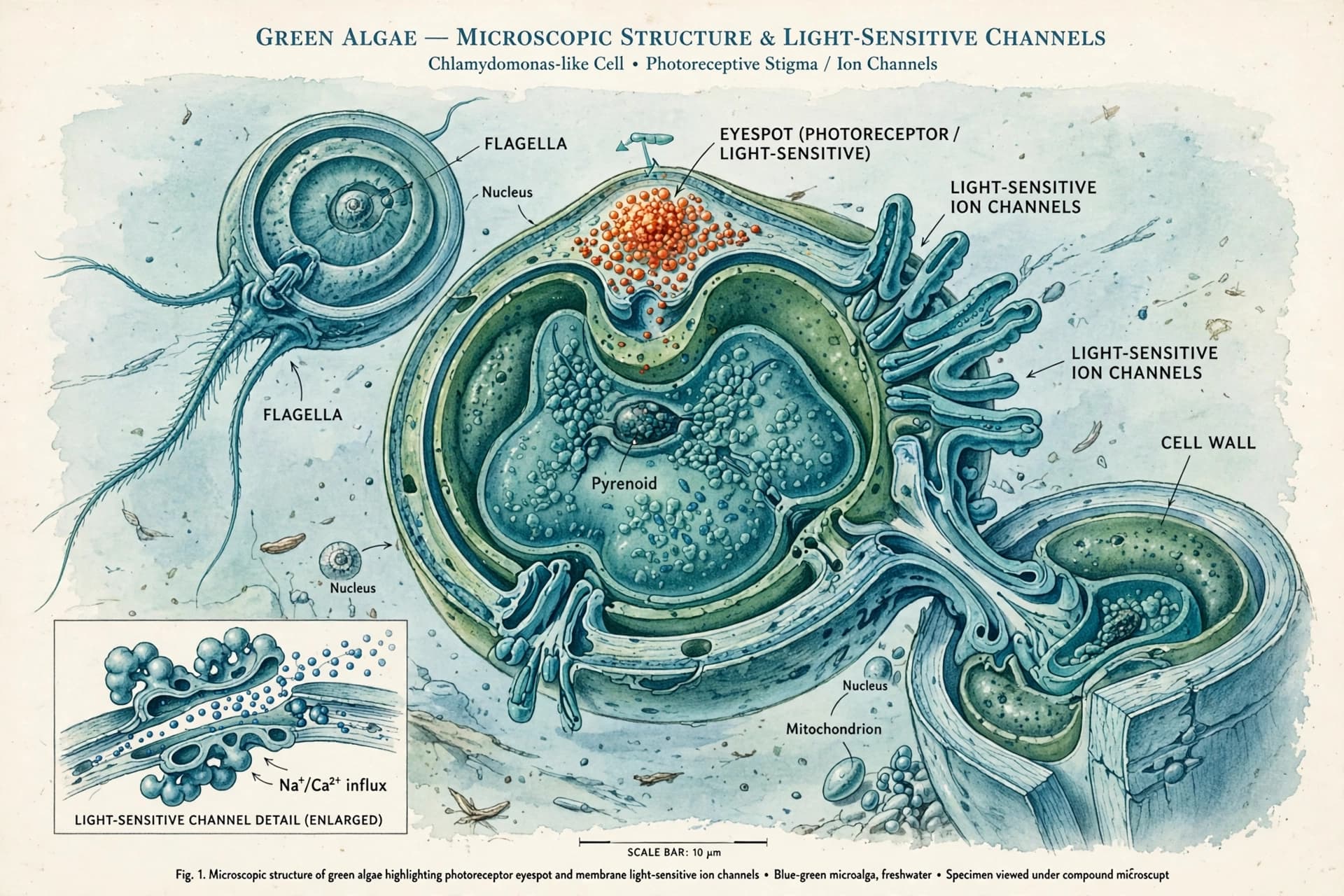
There is a particular elegance in a scientific discovery that begins with something as unassuming as a single-celled alga—a creature so small it is invisible to the naked eye, yet possessing a mechanism that would ultimately illuminate the deepest mysteries of the human brain. On Monday, the Nobel Assembly at the Karolinska Institute awarded the 2026 Nobel Prize in Physiology or Medicine to three scientists—Karl Deisseroth of the United States and Peter Hegemann and Georg Nagel of Germany—for their discoveries concerning light-gated ion channels and optogenetics, a technique that has fundamentally transformed how neuroscientists investigate the brain .
The journey began in the 1990s, when Hegemann was studying how a green alga called Chlamydomonas swims toward light. He hypothesized that a single protein captured light and acted as an ion channel. Nagel tested this by injecting algal genes into frog eggs, discovering channelrhodopsin-2—an ion channel that opens when exposed to blue light. In 2003, they published that this protein could be introduced into human and hamster cells to generate electrical impulses using light . Deisseroth then took the next step, introducing the gene for channelrhodopsin into nerve cells from rats. By illuminating the cells with blue light, he was able to trigger a nerve signal. He published this breakthrough in 2005, and two years later, made the light-controlled switch work in the brains of living mice .
The method was named optogenetics a year later, and its implications were immediately profound. For the first time, researchers could control the activity of specific neurons with millisecond precision, in living animals, without drugs or electrodes. As Thomas Perlmann, secretary-general of the Nobel Assembly, said, the technique “makes it possible to switch on, or off, the activity of individual nerve cells in a living brain” and is now being used in laboratories around the world to reveal the brain’s mysteries .
The scientific and medical applications have been extensive. Optogenetics has enabled researchers to identify the neural circuits governing specific memories, feelings, and behaviors, and to link them to neurological and psychiatric disorders . In clinical trials, researchers are now restoring vision to people blinded by a condition called retinitis pigmentosa by inserting a light-sensitive protein into the retina. Researchers also hope optogenetics could improve cochlear implants, allowing more precise stimulation of the auditory nerve than current electrical devices . The method has also provided important insights into how the nervous system interacts with cells in other organs such as the heart and intestines .
The three laureates will split the prize of 12 million Swedish crowns, approximately $1.7 million Canadian . Deisseroth is based at Stanford University and the Howard Hughes Medical Institute, while Hegemann is at Humboldt University of Berlin and Nagel at the University of Würzburg . All three were surprised by the news, and Perlmann noted that they shared a common sentiment: they were delighted to receive the prize together with friends .
What makes the discovery remarkable is not just the science but the improbability of its origin. The protein that allows algae to swim toward light became the tool that allows neuroscientists to control the brain. There is no design in this—only the slow, patient work of basic research, of asking questions that seem disconnected from any practical application. The Nobel committee described optogenetics as opening a “new era” in neuroscience . And it began with a pond, a patch of algae, and a question about how a single cell finds the sun.
AI Image Disclaimer: The images accompanying this article were generated by artificial intelligence and are for illustrative purposes only.
Sources: NHK World-Japan, Australian Broadcasting Corporation, CBC News, Deutsches Ärzteblatt, EurekAlert!, Xinhua
Published by Banx Network. This article is part of the Banx decentralized media programme, powered by the BXE token on the XRP Ledger.