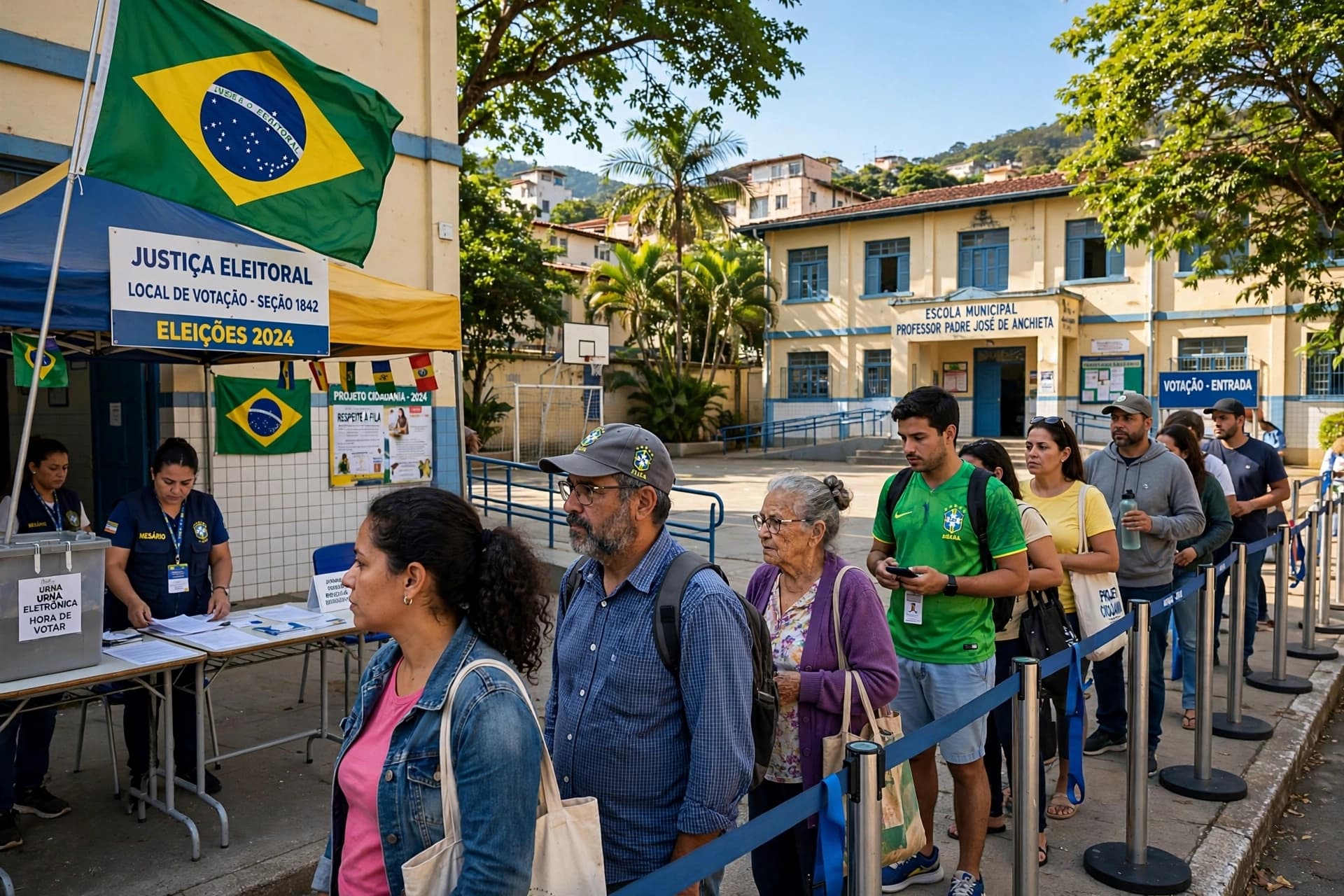
There is a particular tension that accompanies the counting of votes in a nation as vast and divided as Brazil—a tension that begins with the first exit polls from the Pacific and continues through the long hours until the last ballot is tallied in the Amazon. On Sunday, Brazilians went to the polls in the first round of a presidential election that polls had suggested was tightening. As the day unfolded, the picture that emerged from the ballot boxes was one of a race closer than either candidate might have hoped, and one that appeared increasingly likely to require a second round.
The Datafolha poll released Saturday, on the eve of the vote, showed President Luiz Inácio Lula da Silva with 45 percent of valid votes and Senator Flávio Bolsonaro with 42 percent—a gap of three points, within the margin of error and far narrower than the double-digit lead Lula had held in August. In total votes including blank, null, and undecided, Lula had 42 percent and Bolsonaro 40 percent. The poll interviewed 4,006 voters and had a margin of error of two percentage points.
Voting closed at 5 p.m. Brasília time, and the counting began. In the early returns from abroad, where nearly one million Brazilians were eligible to vote in 134 countries, Lula performed strongly. He won in New Zealand with 70 percent, in South Korea with 57 percent, in Singapore with 55 percent, in Malaysia with 54 percent, and in China with 66 percent. Bolsonaro won in the Philippines, Thailand, and Taiwan. Australia, with 29 sections reported, also leaned toward Lula. The overseas vote represents only about 0.5 percent of the national electorate, but its early release offered a glimpse of the broader dynamic.
Both candidates voted early and spoke to the press. Lula, voting in São Bernardo do Campo, framed the election as a choice between democracy and barbarism. “Votemos pensando en nuestros hijos,” he said—let us vote thinking of our children. Flávio Bolsonaro, voting in Rio de Janeiro in a yellow shirt bearing his ballot number, promised to guarantee freedom and called for a protest vote against what he described as the era of backwardness. He said he wanted to win outright and saw no reason for a second round.
The possibility of a runoff, scheduled for October 25, remains open. If no candidate reaches more than 50 percent of valid votes, the top two will face each other again. The Datafolha numbers—45 to 42—suggest that outcome is likely. For now, the count continues, and the country waits.
AI Image Disclaimer: All images in this article are AI-generated and are intended for illustrative purposes only.
Sources: Datafolha, SBT News, CBN, La Estrella de Panamá, Hora do Povo
Published by Banx Network. This article is part of the Banx decentralized media programme, powered by the BXE token on the XRP Ledger.