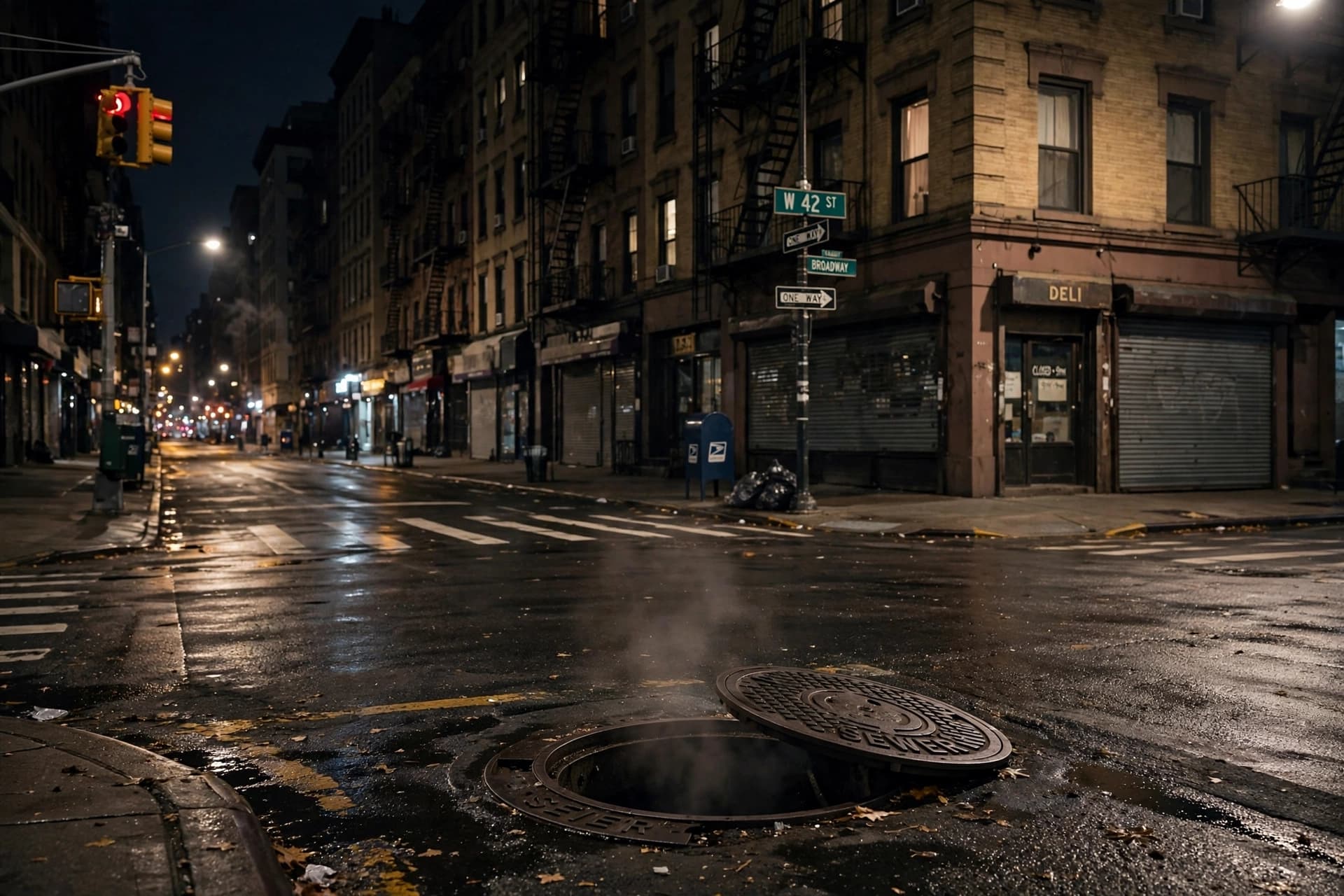
There is a particular fascination with the underground, a realm that exists beneath the orderly surface of the city, where the rules are different and the light does not reach. For decades, New Yorkers have traded stories of "mole people" living in the tunnels and sewers beneath their feet, tales that hovered somewhere between urban legend and uneasy truth. This week, those stories acquired another entry. Early Sunday morning, police responded to a report of three men climbing into a manhole on West 141st Street in Hamilton Heights, the latest in a string of sightings that have puzzled authorities and intrigued a city that thought it had seen everything.
The call came shortly before 1 a.m. A witness reported the trio disappearing into the sewer, and at least one was later seen climbing out and getting into a silver vehicle before driving away . Firefighters arrived shortly after and described the report as "unfounded," but the incident remains under investigation . For a city accustomed to the unusual, the response was measured—curious, but not alarmed.
What makes these sightings notable is not their novelty but their persistence. In August, a video captured three men in overalls and headlamps emerging from a manhole near Madison Square Garden, a block from Penn Station . In September, two men were arrested after they were spotted entering a sewer on the Upper East Side, near a hotel where Israeli Prime Minister Benjamin Netanyahu was staying during the UN General Assembly . Just days before the latest sighting, five people were seen emerging from a manhole on East 82nd Street . The pattern is unmistakable: something is happening beneath the streets, and it is not new.
The explanation offered by those caught is disarmingly simple. "We go into the sewer and look for valuables that get stuck in the storm drains and sewers, gold, anything of value," one of the arrested men told police . Another, caught in a similar expedition last year, explained that people lose their gold down there, and that he and his companions went down to retrieve it and sell it . City officials have acknowledged the plausibility of this theory, suggesting that scavengers may be searching for coins, wallets, scrap metal, or jewelry that have washed into the system .
But not everyone is convinced that treasure hunting tells the whole story. One law enforcement source told reporters that some of the items being sought are stolen and flushed with AirTags, allowing the underground divers to track and retrieve them . The suggestion adds a layer of intrigue to a phenomenon that has already captured the public imagination. For a city that has long entertained theories about what lies beneath—alligators, turtles trained in martial arts, and now gold-hunting scavengers—the reality may be stranger than the fiction.
What is certain is that the sewers are dangerous. Rob Wolejsza, a spokesperson for the New York City Department of Environmental Protection, warned that the underground system contains "noxious and potentially deadly gases, unstable surfaces, flooding risks and confined spaces" . The department's guidance is unambiguous: members of the public should never enter a pipe, drain, catch basin, manhole, or outfall. For those who venture below, the risks are real, whatever the potential reward.
The investigation into the latest sighting continues. Police have not identified the three men, and no arrests have been made in connection with Sunday's report. For now, the city is left with questions that have no easy answers: what drives people to descend into the darkness beneath one of the world's most densely populated cities, and what do they hope to find there? The mole people, whatever they are, remain a mystery—one that the surface world has not yet solved.
AI Image Disclaimer: The imagery accompanying this article is AI-generated and intended for illustrative purposes only.
Sources:
· New York Post · amNewYork · The Guardian
Published by Banx Network. This article is part of the Banx decentralized media programme, powered by the BXE token on the XRP Ledger.