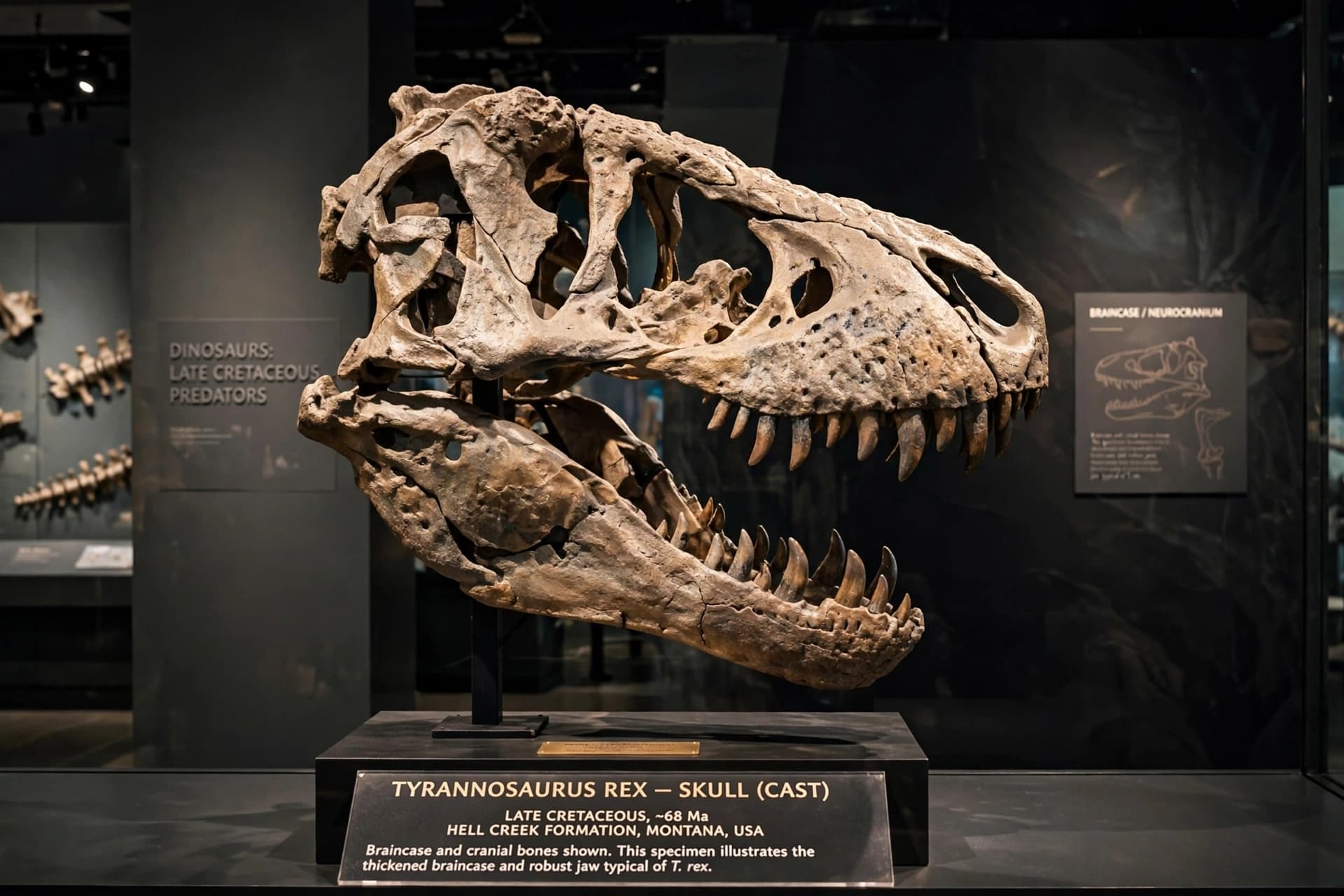
There is a particular image that has settled into the public imagination—the tyrant lizard king as a mindless engine of teeth and muscle, a brute driven by appetite alone. It is a convenient picture, and a comforting one. But science has a way of unsettling what we think we know, and the question of what Tyrannosaurus rex was thinking has become one of the most contentious debates in paleontology.
The argument began in 2023, when neuroscientist Suzana Herculano-Houzel published a study estimating that T. rex had approximately 3.3 billion neurons in its forebrain—a number comparable to that of a baboon. She suggested this could mean flexible intelligence, problem-solving abilities, even the use of simple tools and the transmission of cultural knowledge .
The claim was met with immediate skepticism. In April 2024, an international team of paleontologists, neuroanatomists, and animal cognition experts published a detailed rebuttal in The Anatomical Record. Led by Kai Caspar of Heinrich Heine University, the team argued that the original study had overestimated brain size—particularly the forebrain—and that neuron counts are not a reliable guide to intelligence in extinct species .
Their central point was anatomical. The brains of reptiles and birds are organized differently from those of mammals, and having the same number of neurons as a primate does not mean having the same cognitive architecture. "Having the same number of neurons as a primate doesn't make you a primate," said Cristián Gutiérrez-Ibáñez of the University of Alberta . The team suggested that T. rex was likely more comparable to a "giant intelligent crocodile" than a scaly baboon .
The debate is not merely about T. rex. It is about the limits of what can be inferred from fossils. Brain tissue does not fossilize; scientists must estimate brain volume from the shape of the skull cavity, then infer neuron counts using scaling rules derived from living animals. Each step introduces uncertainty. As Darren Naish of the University of Southampton put it, attributing primate-level intelligence to T. rex "goes far beyond what the evidence supports" .
But the rebuttal does not diminish T. rex. Even the critics acknowledge that the dinosaur was a highly successful predator, dominant in its ecosystem for millions of years. It would have needed to find prey, locate nesting sites, and navigate a complex social and physical environment. Hady George of the University of Bristol noted that dinosaurs had "fascinating displays including awesome crests and beautiful feathers"—evidence of communication and, by extension, of cognitive capacity .
The question of whether T. rex used tools or passed down knowledge may never be definitively answered. But the debate itself has value. It pushes scientists to be more rigorous, to question their assumptions, and to recognize that the past is not a simple mirror of the present. T. rex was not a baboon. It was not a crocodile. It was something else entirely—something we are still learning to see.
AI Image Disclaimer: The images in this article are AI-generated and are for illustrative purposes only.
Sources: Futura-Sciences, The Anatomical Record, University of Bristol, EurekAlert!, BBC Newsround
Published by Banx Network. This article is part of the Banx decentralized media programme, powered by the BXE token on the XRP Ledger.