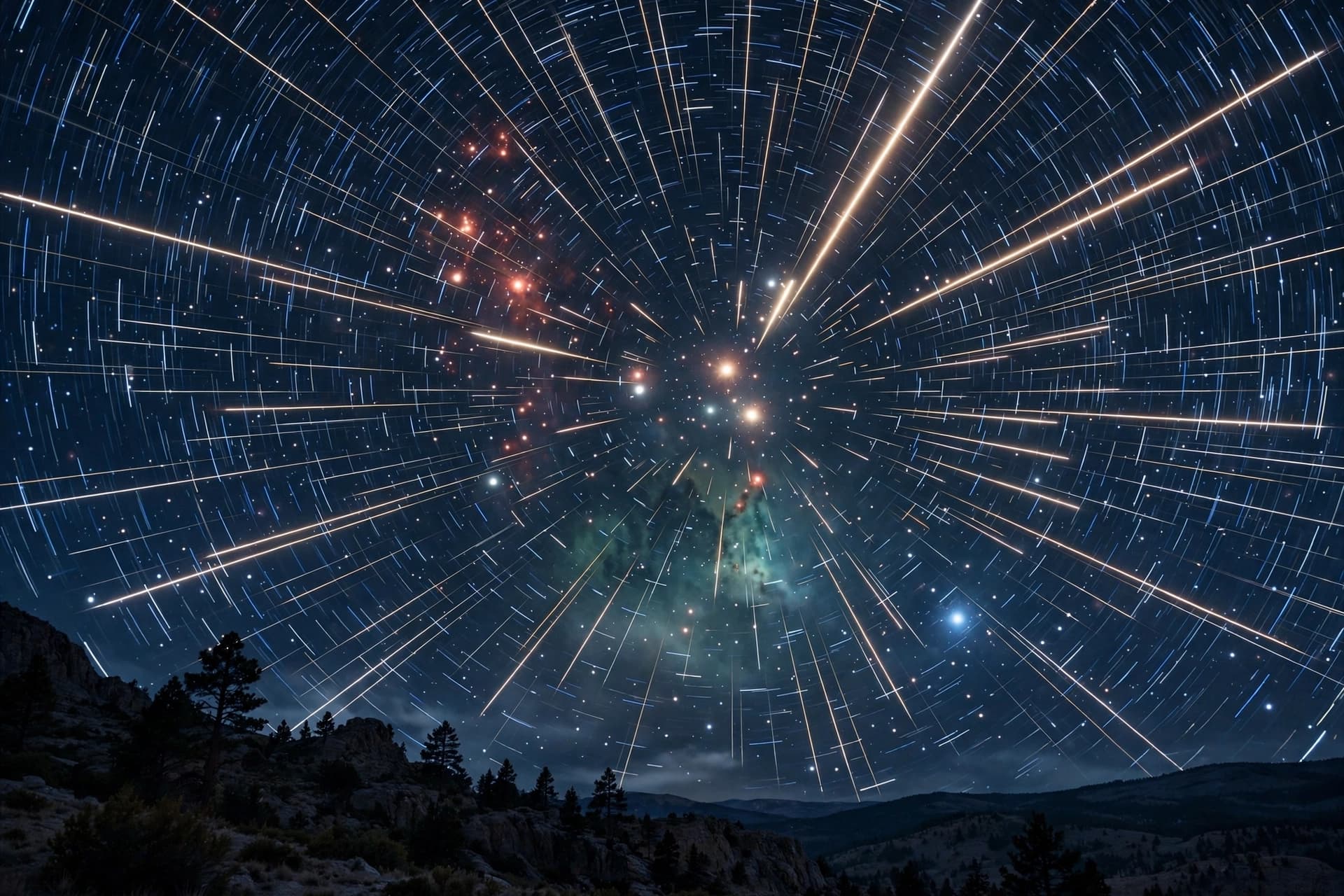
Halley's Comet is not coming back until 2061. It is, at this moment, more than three billion miles from Earth, a frozen remnant hurtling through the dark on a path that will not bring it near us for another thirty-five years. And yet, on a clear October night, it put on a show. The Orionid meteor shower, the annual display created when Earth passes through the debris trail left by the comet, peaked this week, and astrophotographers captured what the naked eye can only glimpse: streaks of light racing away from Orion, each one a particle shed by Halley's Comet centuries ago .
Tim McCollum, an astrophotographer in Toccoa, Georgia, produced a composite image that has circulated widely—a trio of vivid Orionid meteors captured between 3 and 4 a.m. on October 21, each streak radiating from the shower's apparent point of origin near the red giant star Betelgeuse . The image also captured Orion's Belt, the Orion Nebula, the Rosette Nebula, and the dense starfields of the Milky Way's galactic plane. It is a photograph of two things at once: the fleeting and the ancient.
The Orionids are active from early October through early November, with peak activity typically falling around October 21 and 22. Under dark skies, observers can expect ten to twenty meteors per hour, though a bright waxing moon this year washed out many of the fainter streaks . The particles themselves travel at approximately 66 kilometers per second, fast enough to produce fireballs and trains of light that linger for seconds after the meteor itself has burned away .
What makes the Orionids remarkable is not their number but their origin. Most meteor showers are associated with comets that pass relatively close to Earth's orbit, their debris trails fresh and concentrated. Halley's Comet is different. It orbits the Sun once every seventy-six years, and its debris has been spreading along its orbital path for millennia. Earth crosses that path twice annually: in May, producing the Eta Aquariids, and in October, producing the Orionids. The particles we see burning up in the atmosphere are ancient, cast off during passes of the comet that occurred long before anyone was watching.
There is a poignancy to this arrangement. Halley's Comet is one of the most famous objects in the sky, recorded by Chinese astronomers as early as 240 BCE and named for Edmond Halley, who predicted its return in 1705 . Its 1986 apparition was a global event, watched by millions. Its next return, in 2061, will be witnessed by people not yet born. The Orionids offer a kind of interim communion—a chance to see the comet's leavings, to watch its dust flare and fade, without waiting for the comet itself.
For astrophotographers, capturing the shower is an exercise in patience and technical precision. McCollum used a star tracker to keep his camera fixed on the radiant, shooting multiple 30-second exposures and combining them later . The result is not what the eye sees but what the eye might see if it could hold a moment open long enough. The meteors appear as deliberate strokes against a backdrop of nebulae and star clusters, each streak a small reminder that the solar system is not empty but full of paths that intersect, however briefly.
The Orionids will continue until about November 7, though the peak has passed. The moon will grow darker in the coming nights, and the meteors will be fewer but easier to see. Halley's Comet will not return for another generation. But its dust will keep arriving, year after year, a reminder that even the most distant wanderers leave something behind.
AI Image Disclaimer: This article uses AI-generated imagery for illustrative purposes; it does not depict the actual photographs referenced.
Sources: Space.com, EurekAlert!, Xinhua, Scinexx, Deník.cz
Published by Banx Network. This article is part of the Banx decentralized media programme, powered by the BXE token on the XRP Ledger.