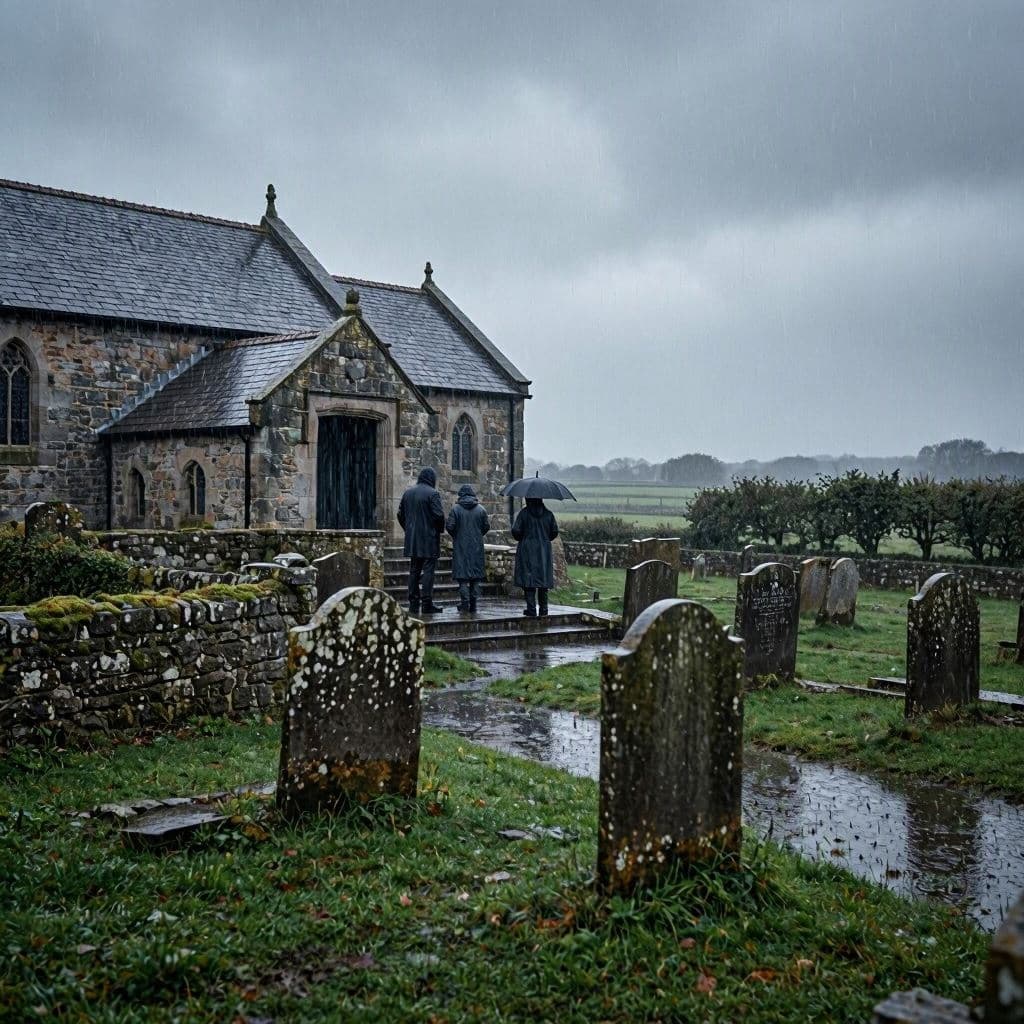
There are places where history does not fade so much as it waits—quietly, stubbornly, beneath the surface of ordinary life. Drumcree is one such place, a rural church on the outskirts of Portadown where the past and present have never quite agreed to separate.
After nearly three decades, an Orange Order parade was due to walk down the Garvaghy Road once more, a route that had been blocked since 1998. The march was permitted by the Parades Commission, and a court ruled that the determination must be respected . But as Sunday stretched into evening, the Orangemen never left Drumcree Church. Protesters on the Garvaghy Road refused to move, and police declined to force them aside .
By nightfall, the crowd on the Garvaghy Road had grown to an estimated 300 to 400 people, with musicians playing in gazebos and voices joining in song. At Drumcree Church, only 35 Orangemen remained, with a handful of supporters and a police presence that had been scaled back to two cars and one Land Rover .
The impasse was not violent, but it was absolute. Police Chief Constable Jon Boutcher said his officers had managed an "exceptionally challenging situation" and that the operation had "helped ensure there has been no violence or disorder" . Assistant Chief Constable Ryan Henderson explained that removing the crowd—including women, children, and older people—would have required a level of force that "would have significantly jeopardised" public safety .
The politics surrounding the standoff were as dense as the rain that fell throughout the day. First Minister Michelle O'Neill joined the protest on the Garvaghy Road, drawing accusations from the DUP that she had acted unlawfully . Northern Ireland Secretary Chris Bryant cut short his attendance at the Labour Party conference to return to Belfast, holding talks with both the Orange Order and the Garvaghy Road Residents Coalition. He described the discussions as "constructive" and said he was "exploring every option" .
The Garvaghy Road Residents' Association made its position clear: the community had never wanted the march, and their petitions had been ignored. "We will keep mobilising," said Breandán Mac Cionnaith. "As long as it takes" .
By late evening, the street was quiet. The Orangemen remained at the church. The protesters remained on the road. No march occurred, and no arrests were made. The deadlock had held—not resolved, not broken, simply held. For a place like Drumcree, perhaps that is its own kind of outcome: a night without violence, a morning still uncertain.
AI Image Disclaimer: The images in this article were created using artificial intelligence and are for illustrative purposes only.
Sources: BBC News, BBC News NI, Alliance Party statements, PSNI statements
Published by Banx Network. This article is part of the Banx decentralized media programme, powered by the BXE token on the XRP Ledger.