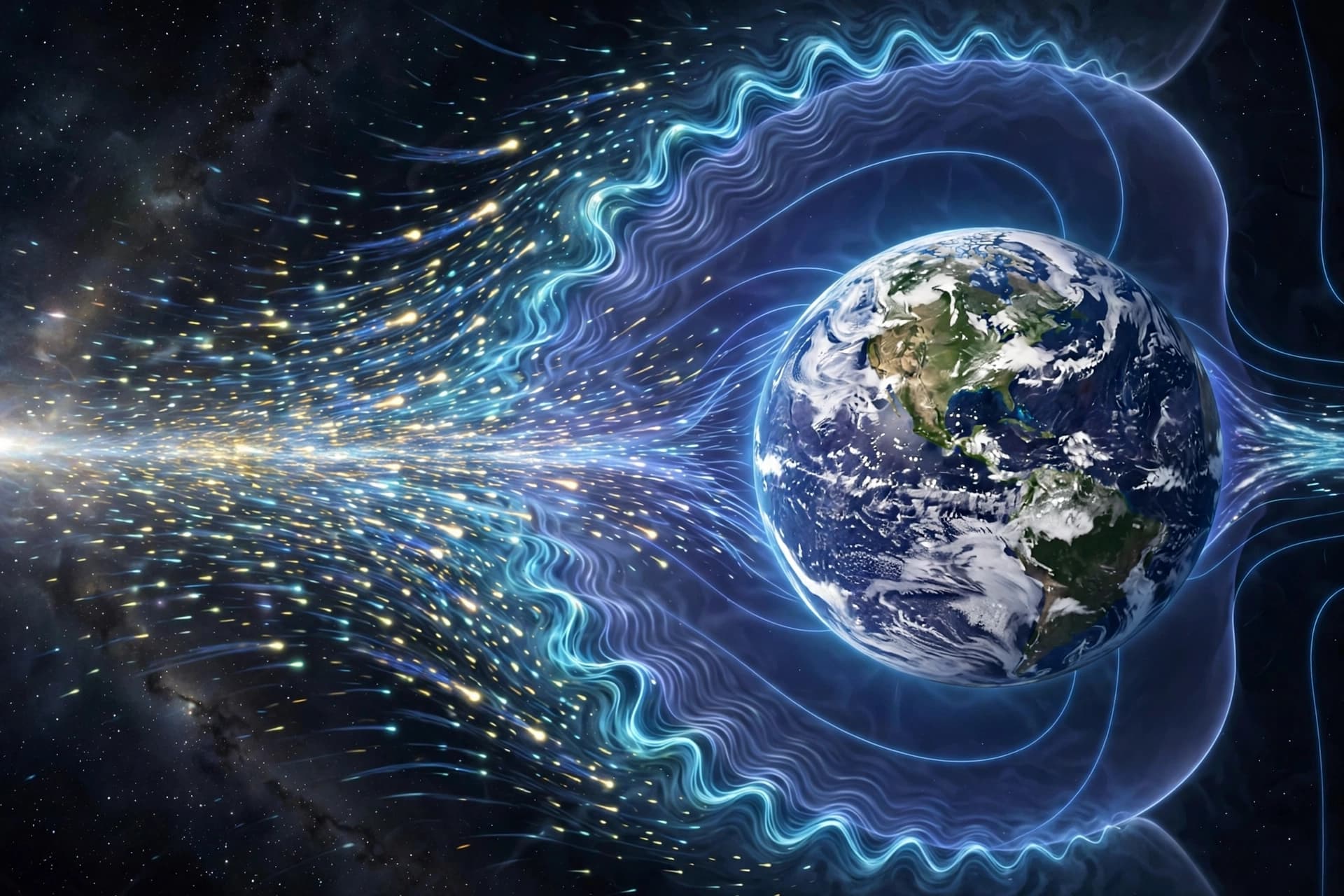
There are rules in the universe that feel almost sacred. Gravity pulls. Light travels at its appointed pace. And black holes—those dark anchors of galaxies—are said to grow only so fast, limited by a boundary set by physics itself. Astronomers call it the Eddington limit, a kind of cosmic “speed limit” that balances the inward pull of gravity against the outward pressure of radiation. It is a quiet agreement between light and matter.
Yet somewhere in the deep sky, that agreement appears to be bending.
Researchers have identified a black hole growing at roughly 13 times the rate once thought to be its maximum sustainable pace. The discovery challenges long-standing models of how black holes feed and evolve. If confirmed through further study, it may reshape our understanding of how some of the universe’s most massive objects formed so quickly in its early history.
The Eddington limit is not arbitrary. When material spirals toward a black hole, it forms a bright, superheated disk known as an accretion disk. As gas and dust fall inward, friction heats them to extraordinary temperatures, producing intense radiation. That radiation pushes outward. If the outward force becomes too strong, it can halt or even reverse the inflow of matter. In theory, this sets a natural cap on how rapidly a black hole can grow.
But nature, it seems, has a way of finding complexity within simplicity.
Using powerful telescopes and spectral analysis, astronomers observed a distant active galactic nucleus—an intensely luminous region at the heart of a galaxy powered by a feeding supermassive black hole. The brightness and characteristics of the emitted light suggest that matter is pouring into the black hole at a rate far exceeding the classical Eddington threshold. Instead of obeying the limit, this object appears to be devouring material with unexpected efficiency.
How could such a thing occur? Scientists propose several possibilities. One idea involves the geometry of the accretion flow. If material funnels inward in dense streams or through thick, disk-like structures, radiation might escape along specific pathways rather than pushing uniformly outward. In such a configuration, the outward pressure would not entirely counteract gravity, allowing more matter to fall in than previously predicted.
Another possibility lies in the nature of the black hole’s environment. In the early universe, galaxies were richer in gas and more turbulent. Under such conditions, feeding rates may have been episodically extreme, with bursts of super-Eddington accretion that briefly outpaced theoretical limits. If black holes can grow in spurts like this, it could help explain one of cosmology’s enduring puzzles: how supermassive black holes reached billions of solar masses so quickly after the Big Bang.
The newly observed object offers more than just a data point. It serves as a reminder that theoretical limits often describe averages, not absolutes. Physics remains intact, but the pathways through which it operates may be more intricate than once assumed. Radiation pressure, magnetic fields, and the structure of inflowing gas may combine in ways that allow black holes to momentarily exceed what we considered their “speed limit.”
Importantly, this does not mean that physical laws are broken. Rather, it suggests that our simplified models may need refinement. Astrophysics has long advanced through such moments—when observation nudges theory toward greater nuance. A limit once drawn with a firm line may, in practice, be edged with gradients.
The discovery also carries implications for galaxy evolution. Supermassive black holes are not passive residents at galactic centers; they influence star formation, regulate gas flows, and shape their cosmic neighborhoods. If they can grow faster than anticipated, their impact on host galaxies may also be more dynamic than previously modeled.
For now, astronomers are continuing to analyze data and seek additional examples of similar behavior. Independent observations and refined simulations will be crucial in determining whether this black hole is an exception—or part of a broader pattern that has quietly unfolded across cosmic time.
The findings suggest that at least some black holes can accrete matter at rates significantly above the traditional Eddington limit. Researchers note that further study is required to confirm the mechanisms involved and to understand how common such extreme growth phases may be. As new telescopes come online and data accumulates, scientists expect to clarify how these rule-bending giants fit into the larger story of cosmic evolution.
AI Image Disclaimer: The images shown are AI-generated for illustrative purposes only.
Sources: Nature Space.com Live Science BBC Science Scientific American
Published by Banx Network. This article is part of the Banx decentralized media programme, powered by the BXE token on the XRP Ledger.