There are visitors who arrive unannounced, who appear in places they were never expected to be, and who, for a brief time, transform the ordinary rhythms of a small town into something resembling a celebration. In Mayo, Yukon—a community of fewer than 500 people, situated at roughly the same latitude as Iqaluit—that visitor arrived this past weekend. It was a black vulture, a bird rarely if ever seen in Canada, and its presence has become, as one resident put it, "totally all the buzz" .
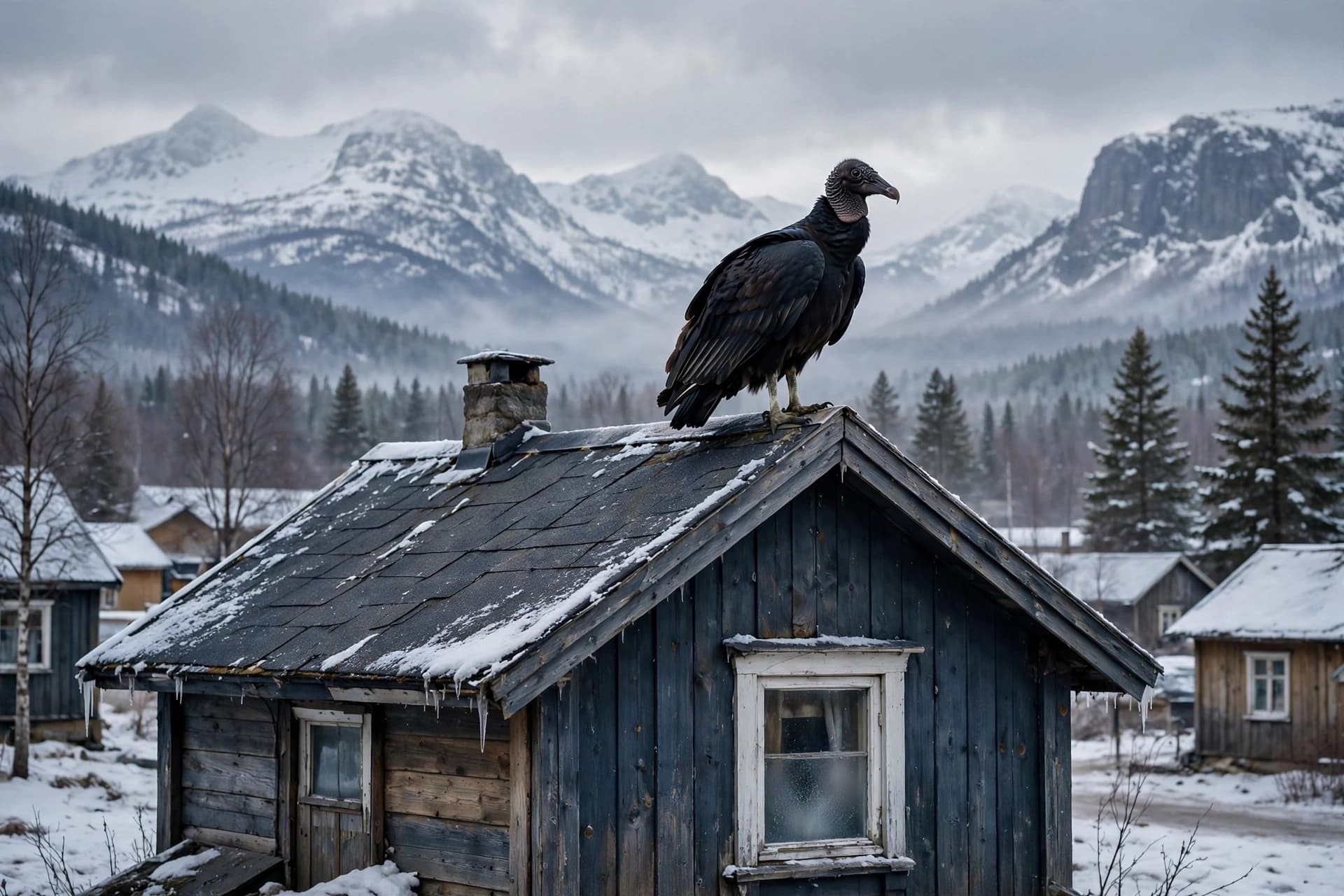
When word reached Cameron Eckert in Whitehorse, he packed his bags and made the five-hour drive to Mayo. "You're not going to drive to Mayo to see some birds," admitted Eckert, president of the Yukon Bird Club. "But a black vulture—that just seemed next level" . He arrived to find the bird hopping around yards, perching on roofs, and battling with ravens—doing, as he put it, "essentially what black vultures do" .
Black vultures have a vast range through North and South America and are the most numerous vulture in the Western Hemisphere. But they are rarely spotted as far north as Mayo. According to Birds Canada, sightings in Canada have become more common in recent decades, but primarily in "extreme southern Ontario, especially along the Niagara River" . As far as Eckert knows, the last black vulture sighting in the Yukon was in the 1980s, in the Kluane region .
The bird's presence has captured the attention of Mayo residents, including Dennis Peter, who does not call himself a birder but has found himself drawn to the unusual visitor. "When you get a rare sighting like this, it's hard not to be interested in it and see what's going on," he said . Peter has taken to carrying scraps of chicken and moose meat around, leaving them for the bird. Sometimes the ravens get to the food first, but Peter says the vulture has eaten some of it. "He hasn't complained so far," he said .
Eckert believes the bird is likely a juvenile, noting its speckled brown feathers. Black vultures, especially younger ones, are known for "extreme wanderings"—getting astray and heading off in the wrong direction. "This does seem like a first year or a juvenile bird that's just headed too far in the wrong direction and gone way too far," he said . Climate change may also be a factor, though Eckert says that is less clear; the species' range has expanded northward, but more so in eastern North America .
What happens next for the Mayo vulture is uncertain. Eckert says it might survive for a while on dog food and scraps around town, but ideally it will soon take flight and head back south. "It's got quite long legs that are bare," he said. "They don't have any feathers on their legs, and that bare head—this is not a bird that could tolerate sub-zero temperatures for any length of time" . For now, the people of Mayo are rooting for their unexpected guest. "Everybody would like to see this bird survive and get home," Peter said . Some residents have even given the bird a name. It is a small story, in a small town, in a vast territory—but it is a reminder that the natural world still contains surprises, and that sometimes the most remarkable things arrive when no one is looking for them.
AI Image Disclaimer: The visual elements in this article were created using AI generation tools and are intended for illustrative purposes only.
Sources: CBC News, Radio-Canada, Yahoo News Canada
Published by Banx Network. This article is part of the Banx decentralized media programme, powered by the BXE token on the XRP Ledger.