1. AI Becomes Infrastructure
Artificial intelligence is likely to become less visible as a standalone technology and more embedded into everyday systems.
Today, people deliberately use AI tools.
By 2040, that distinction could become increasingly difficult to make.
AI could manage logistics networks, assist doctors, optimise electricity grids, analyse financial markets, operate industrial systems and provide personalised education.
Rather than opening an AI application, people may simply interact with services that have AI built into them.
The biggest transformation may therefore not be humanoid robots or futuristic assistants.
It could be the quiet integration of AI into almost every major industry.
2. Humanoid Robots Enter the Workforce
Robotics could experience a similar transition.
Industrial robots already perform repetitive tasks in controlled environments, but humanoid robots are being developed to operate in spaces designed for humans.
That could eventually make them useful in warehouses, factories, construction, logistics and potentially healthcare.
By 2035, early commercial deployments could become increasingly common.
By 2050, more advanced machines could potentially perform a much wider range of physical tasks.
The biggest obstacle will not simply be making robots walk.
They will need to become safe, reliable, affordable and capable of operating independently for long periods.
If those challenges are solved, robotics could fundamentally change the economics of physical labour.
3. Commercial Space Becomes Routine
Space is increasingly becoming a commercial environment.
Companies are developing reusable rockets, private spacecraft, satellite networks and commercial space stations.
The cost of accessing orbit has already fallen significantly compared with earlier generations of spaceflight.
Over the next 25 years, this could accelerate.
Satellite infrastructure could expand further, commercial research could move into orbit and private companies could take on roles historically dominated by governments.
Space could gradually shift from being primarily a government-led scientific frontier to becoming another major commercial ecosystem.
4. Permanent Human Activity on the Moon
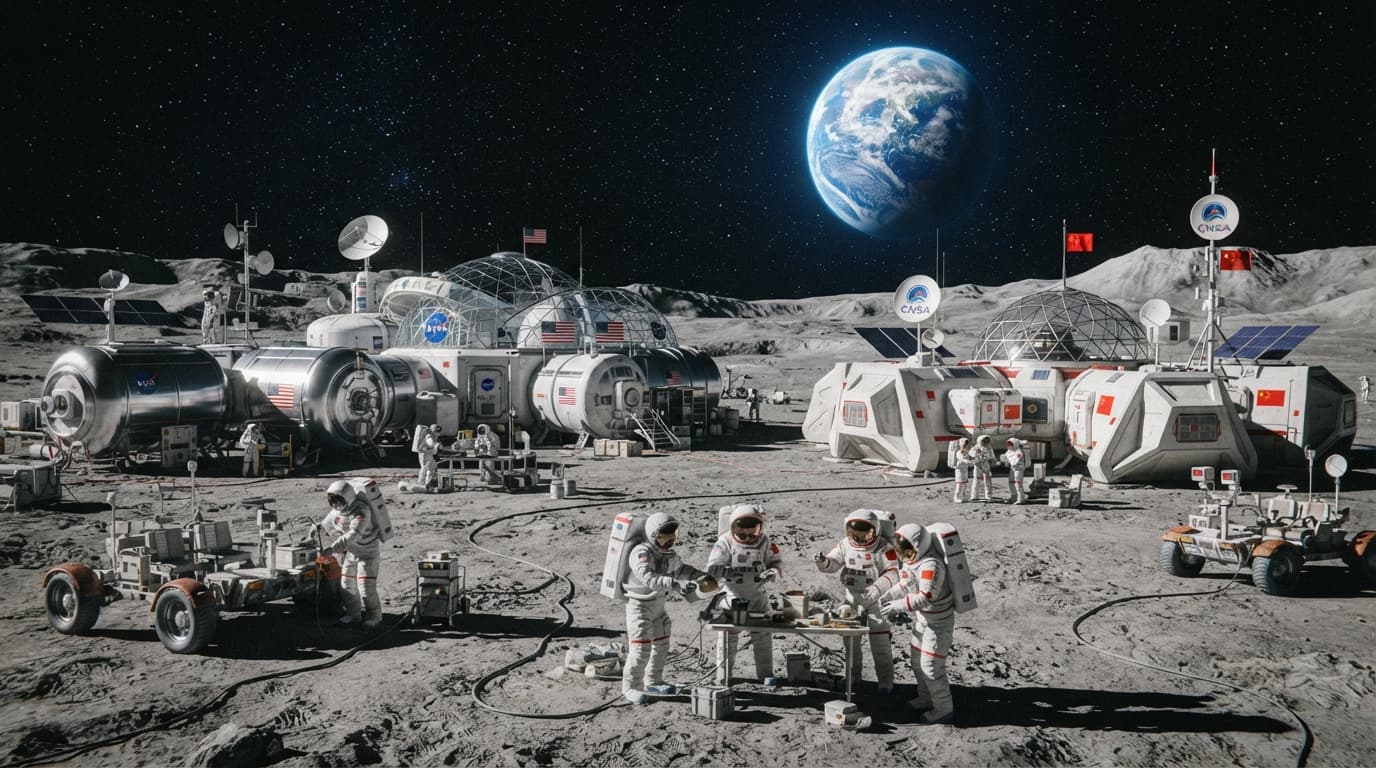
A permanent city on the Moon by 2050 remains uncertain.
A permanent human presence, however, is considerably more plausible.
Small research stations could eventually operate for extended periods, supported by regular cargo missions.
Lunar facilities could potentially conduct scientific research, extract resources and test technologies intended for deeper space missions.
Water ice at the lunar poles is particularly important because it could potentially be processed into water, oxygen and hydrogen-based propellant.
The Moon could therefore become more than a destination.
It could become infrastructure.
5. Fusion Energy Moves Closer to Commercial Reality
Nuclear fusion has been described as the ultimate energy source for decades.
The basic concept is straightforward: reproduce the process that powers stars by forcing light atomic nuclei to fuse under extreme conditions.
The engineering is anything but straightforward.
Researchers still need to solve problems involving plasma stability, materials, energy efficiency and the economics of building commercial reactors.
Nevertheless, continued progress could make the 2035–2050 period crucial.
Fusion may not dominate global electricity production by 2050.
But commercial demonstration plants could potentially establish whether the technology can become a major source of low-carbon energy.
If successful, fusion could become one of the most important energy technologies of the second half of the century.
6. Quantum Computing Finds Its Killer Applications
Quantum computers are unlikely to replace conventional computers.
Instead, they are likely to become specialised machines designed for problems that are extremely difficult for classical systems.
Potential applications include molecular simulation, materials science, chemistry, optimisation and cryptography.
The major question is not whether quantum computers can outperform conventional machines in carefully designed demonstrations.
It is whether they can deliver useful economic advantages for real-world problems.
If researchers solve the problems of error correction, scalability and reliability, quantum computing could move from experimental laboratories into selected industries during the next two decades.
7. Brain-Computer Interfaces Mature
Brain-computer interfaces could move significantly beyond today's experimental systems.
The most immediate applications will probably remain medical.
People with paralysis or severe neurological conditions could use BCIs to communicate, control computers or operate robotic devices.
By the 2040s, more reliable neural interfaces could potentially become available for a wider range of applications.
However, consumer brain implants should not be treated as inevitable.
Surgery, safety, privacy and cost create substantial barriers.
The most likely future may involve a mixture of implanted and non-invasive technologies rather than everyone receiving a permanent neural implant.
8. Medicine Becomes Increasingly Personalised
Medicine could become much more individualised.
Advances in genomics, artificial intelligence, medical imaging and biological modelling are making it increasingly possible to understand why different patients respond differently to the same treatment.
By 2050, doctors could routinely use large amounts of biological data to determine which treatments are most appropriate for individual patients.
Cancer treatment is one area where this approach is already developing.
Gene therapies could also become increasingly sophisticated, potentially allowing certain inherited diseases to be treated at their biological source.
The biggest challenge will be making these technologies affordable and accessible rather than restricting them to wealthy healthcare systems.
9. Gene Editing Becomes More Powerful
Gene-editing technology has already demonstrated the ability to modify DNA with extraordinary precision.
Over the next 25 years, researchers could develop increasingly sophisticated treatments for genetic diseases.
Some conditions that currently require lifelong treatment could potentially be addressed through one-time genetic interventions.
But this technology also creates difficult ethical questions.
Treating disease is fundamentally different from modifying traits.
Questions surrounding genetic enhancement, reproductive editing and access could become major political and social issues.
The science may advance faster than society's ability to agree on how it should be used.
10. Autonomous Transport Expands
Self-driving technology is likely to become increasingly common, although the transition may be slower than early predictions suggested.
Autonomous systems could become particularly valuable in controlled environments.
Long-distance freight, ports, warehouses, mining operations and dedicated transport networks may adopt autonomy faster than ordinary urban driving.
By 2050, some cities could have highly automated transport systems operating alongside conventional vehicles.
The transformation may therefore happen gradually rather than through a single moment when every vehicle becomes autonomous.
11. Cities Become More Automated
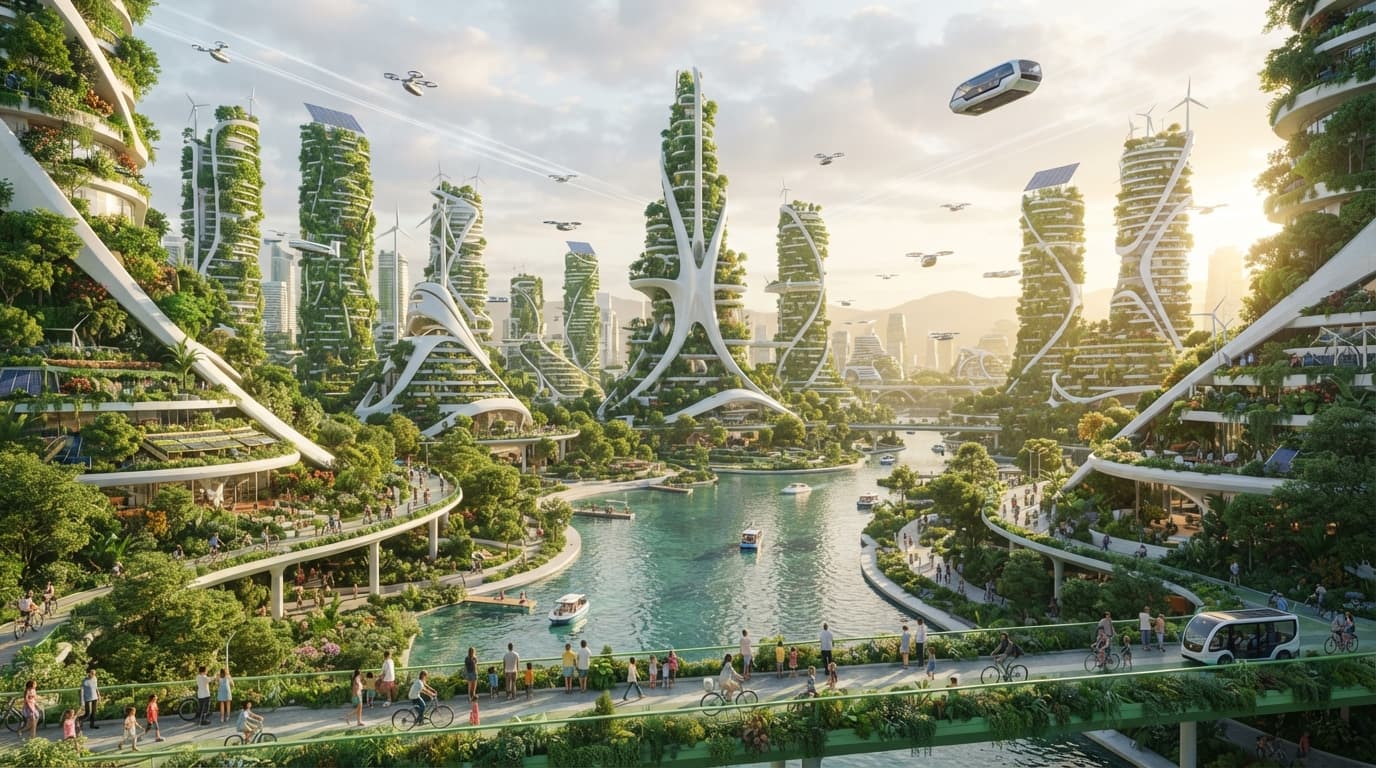
Cities could increasingly operate as interconnected technological systems.
Sensors could monitor traffic, energy consumption, air quality, water infrastructure and public transport.
AI systems could analyse this information and optimise how resources are distributed.
Buildings could automatically adjust heating, cooling and electricity consumption.
Transport networks could dynamically respond to demand.
Waste management could become increasingly automated.
The result could be a more efficient city — but also one that generates enormous amounts of data.
That creates a new challenge:
Who controls the intelligent infrastructure of a city?
12. The Global Energy System Changes
The energy system of 2050 is likely to look very different from today's.
Solar and wind power could continue expanding.
Battery storage could become cheaper and more capable.
Nuclear energy could remain important.
Hydrogen could have specialised applications.
Carbon capture and removal could expand.
And if fusion becomes commercially viable, it could introduce another major source of electricity.
The future energy system is therefore unlikely to depend on one technology.
Instead, it could become a complex combination of renewable generation, nuclear power, storage, flexible grids and emerging technologies.
13. Climate Technology Becomes a Major Industry
Climate change could drive an enormous technological market.
Carbon removal, energy storage, low-carbon construction materials, alternative fuels and more efficient industrial processes could become increasingly important.
Some technologies will probably succeed.
Others will fail economically.
Direct-air carbon capture, for example, could eventually become useful if costs fall dramatically.
But technology alone will not solve every climate problem.
Political decisions, infrastructure investment and changes in consumption will remain important.
The 2035–2050 period could therefore see climate technology move from an emerging sector into a major part of global industry.
14. The Internet Becomes More Spatial
The internet may become less dependent on flat screens.
Augmented reality, virtual reality and spatial computing could increasingly blend digital information with physical environments.
Instead of looking at a map on a phone, someone might see navigation information overlaid onto the street.
Instead of attending a conventional video meeting, colleagues could interact within shared virtual environments.
Education, engineering, entertainment and professional training could all benefit from increasingly immersive interfaces.
However, adoption will depend on comfort, cost and whether these systems offer genuinely useful advantages over existing technology.
15. We Will Get Some Things Completely Wrong
Perhaps the most important prediction is that many predictions will fail.
Technology rarely develops in a straight line.
Some breakthroughs arrive decades earlier than expected.
Others take much longer.
Some technologies become enormous industries.
Others disappear despite billions being invested in them.
People in 2000 could not accurately predict today's technological landscape.
The same will be true of predictions about 2050.
Fusion may arrive later than expected.
Quantum computing may remain specialised.
Humanoid robots may transform industry.
Or they may prove too expensive to deploy at scale.
AI could exceed today's expectations.
Or technical, economic and regulatory barriers could slow its progress.
The future will almost certainly surprise us.
What Could 2050 Actually Look Like?
The most interesting aspect of the next 25 years is not any individual technology.
It is what happens when multiple technologies mature simultaneously.
Imagine a world where AI manages complex systems, robots perform physical tasks, autonomous vehicles move goods, personalised medicine uses detailed biological information, quantum computers solve specialised problems and commercial spacecraft operate beyond Earth.
Each technology would be significant on its own.
Together, they could produce something much larger.
The convergence of technologies could become more important than the technologies themselves.
AI could accelerate scientific discovery.
Robotics could benefit from AI.
Space exploration could benefit from autonomous systems.
Medicine could combine gene editing, AI and advanced computing.
Energy breakthroughs could enable more computational infrastructure.
Progress in one field could therefore accelerate progress in another.
The 2035–2050 Window
The next 25 years may not produce a single technological revolution.
They could produce several simultaneously.
Some developments are highly probable.
Others are plausible.
A few are highly speculative.
The challenge is distinguishing between them.
By 2035, many technologies currently considered emerging could become commercially established.
By 2050, technologies that seem experimental today could potentially become ordinary infrastructure.
But the biggest changes may come from technologies that do not yet exist.
That is the paradox of forecasting the future.
We can extrapolate from today's science.
We cannot fully predict tomorrow's breakthrough.
The Future Is Not Inevitable
Technology does not develop independently of society.
Government regulation, investment, public acceptance, geopolitical competition, resource availability and economics will all influence which technologies succeed.
A technically possible invention may never become commercially viable.
A technology that appears inferior on paper may become dominant because it is cheaper and easier to deploy.
And an invention considered impossible today could become routine after an unexpected breakthrough.
That makes the period from 2035 to 2050 difficult to predict — but fascinating to watch.
The next 25 years may not create the future depicted in science fiction.
They may create something more interesting:
a future nobody completely predicted.
References 1. NASA — Moon to Mars Program Information on NASA's long-term plans for sustained human exploration of the Moon and eventual missions toward Mars. NASA Moon to Mars
2. International Energy Agency — Energy Technology Perspectives Research and analysis on emerging energy technologies, clean energy systems and the transition of global energy infrastructure. IEA Energy Technology Perspectives
3. International Atomic Energy Agency — Nuclear Fusion Background on fusion energy research and the scientific principles behind fusion power. IAEA — Fusion Energy
4. ITER — The International Fusion Project Information on the international effort to demonstrate the scientific and technological feasibility of fusion energy. ITER
5. IBM Quantum Research and educational resources covering the development and potential applications of quantum computing. IBM Quantum Nature — Brain-Computer Interface Research Research covering advances in neural interfaces, speech decoding and brain-controlled technology.
6. Nature — Brain-Computer Interface Research Research covering advances in neural interfaces, speech decoding and brain-controlled technology. Nature Neuroscience
7. International Federation of Robotics — World Robotics Data and analysis on industrial and service robotics and the continuing expansion of automation. International Federation of Robotics
8. World Health Organization — Human Genome Editing Information on the scientific, ethical and governance issues surrounding human genome editing. WHO — Human Genome Editing
9. NASA — Commercial Space Information on NASA's partnerships with commercial companies and the development of a broader commercial space economy. NASA Commercial Space
10. European Space Agency — Commercial Space Transportation Information on the growing commercial space sector and European efforts to support private space activity. ESA — Commercial Space Transportation
Published by Banx Network. This article is part of the Banx decentralized media programme, powered by the BXE token on the XRP Ledger.