There are discoveries that arrive like a whisper, quiet and unassuming, and yet they change the way we understand something fundamental. In the study of neurodegenerative diseases, researchers have long known that tau proteins—normally helpful in stabilizing the internal scaffolding of neurons—begin to misfold and clump together in conditions like Alzheimer's and frontotemporal dementia. What has remained stubbornly unclear is how this process begins, how thousands of unstructured, noodle-like molecules manage to find each other, adopt the same corrupted shape, and stack in perfect alignment like a tower of poker chips.
A new study from Northwestern University, conducted with collaborators at the University of California, Santa Barbara, has found an answer that hinges on something unexpectedly simple: the shape of the water surrounding the protein . The research, led by Songi Han, a professor of chemistry, identified a single dominant hotspot on the tau protein that binds to the matching site on a neighboring tau molecule, triggering the misfolding that propagates through the brain .
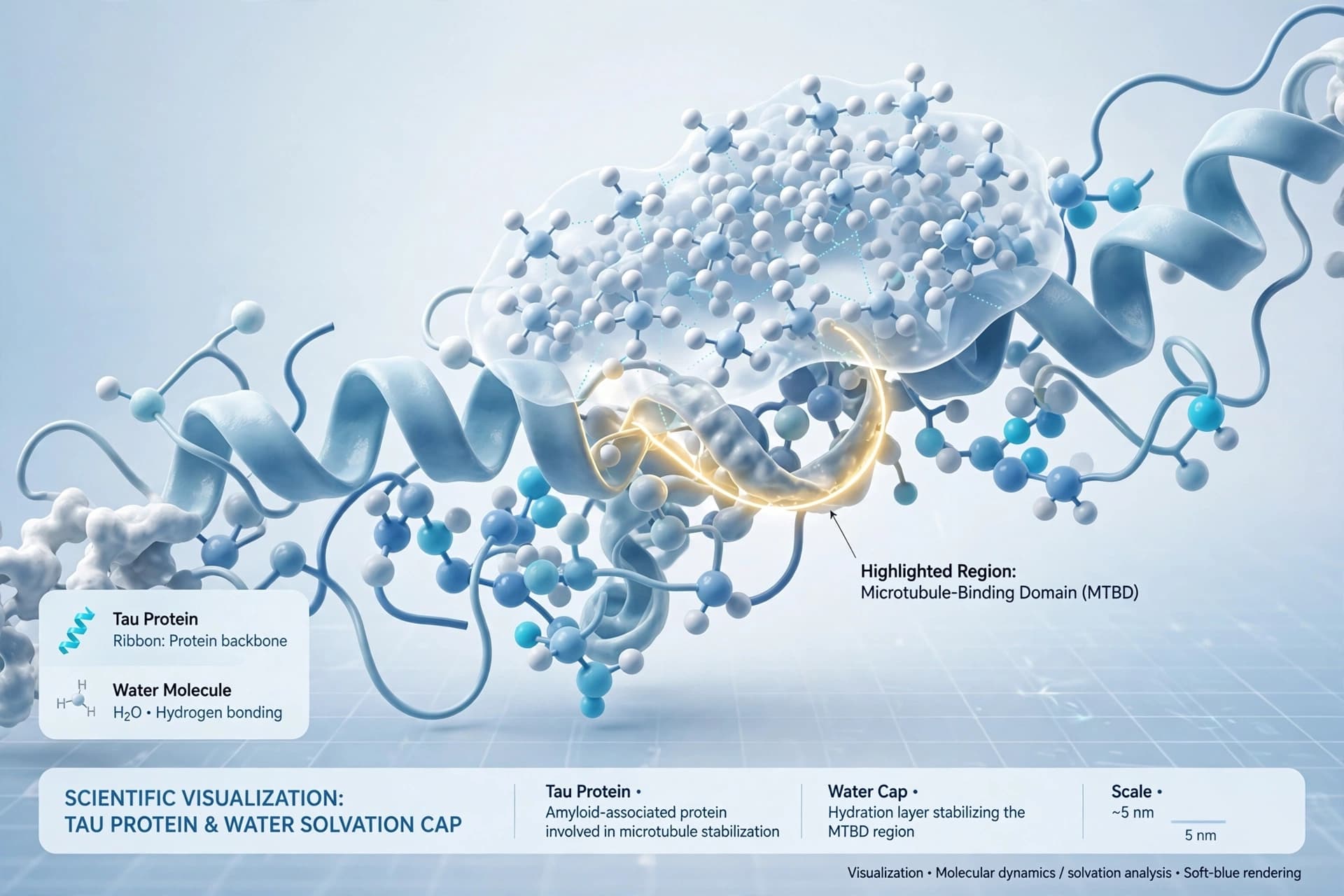
The findings reveal a mechanism that is both elegant and precise. Tau proteins are intrinsically disordered—they lack a fixed shape in their healthy state. Yet when they aggregate, they do so in perfect register, with every molecule adopting the same misfolded conformation. Han and her team discovered that the vulnerable tau carries a specific site where water forms a dynamic, ice-like cap over a hydrophobic patch of the protein . These water caps serve a dual purpose: they protect the hydrophobic region from the surrounding aqueous environment, and they act as markers, showing where two tau molecules will eventually meet .
When two hotspots come together, the capping water is released, and the energy gained by freeing those water molecules is what locks the two proteins together in precisely the right orientation . This ensures that the tau proteins align the same way, every time, allowing the fibril to grow without error. As Han explained, "The proteins have to misfold and neatly stack to fibrils to elongate while propagating the same misfolded shape, and the only way that this process is forever is if the same site of the protein stacks to the same" .
The implications of this discovery are significant. When the researchers capped the hotspot with a chemical tag, the fibrils stopped growing entirely. Capping other sites on the protein had no such effect . This suggests that targeting this single hotspot could potentially block the cascade of misfolding that leads to the devastating tangles found in the brains of dementia patients. "Once you know that aggregation-prone tau proteins always have a hotspot that is first attracted to the same site of tau that is stacked to fibrils, then you know there's always some part of the protein that you can target to neutralize," Han said .
The study, published in the Proceedings of the National Academy of Sciences, offers a new direction for researchers seeking to diagnose and treat tauopathies . It reframes the problem of protein aggregation not as a mysterious process of self-assembly, but as a specific, targetable event driven by the behavior of water at a single molecular location. The water, it turns out, is not merely a passive solvent but an active participant, shaping the course of a disease that affects millions.
For those living with Alzheimer's or frontotemporal dementia, and for the families who care for them, the findings do not offer immediate relief. But they offer something perhaps equally valuable: a clearer understanding of the enemy. In the quiet chemistry of water and proteins, researchers have found a point of leverage, a place where the cascade might be interrupted before it begins. The path from this discovery to a treatment is long and uncertain, but the first step—knowing where to look—has been taken.
AI Image Disclaimer: The images accompanying this article are AI-generated and are intended for illustrative purposes only.
Sources:
· Northwestern University · Proceedings of the National Academy of Sciences · EurekAlert · Scienmag
Published by Banx Network. This article is part of the Banx decentralized media programme, powered by the BXE token on the XRP Ledger.