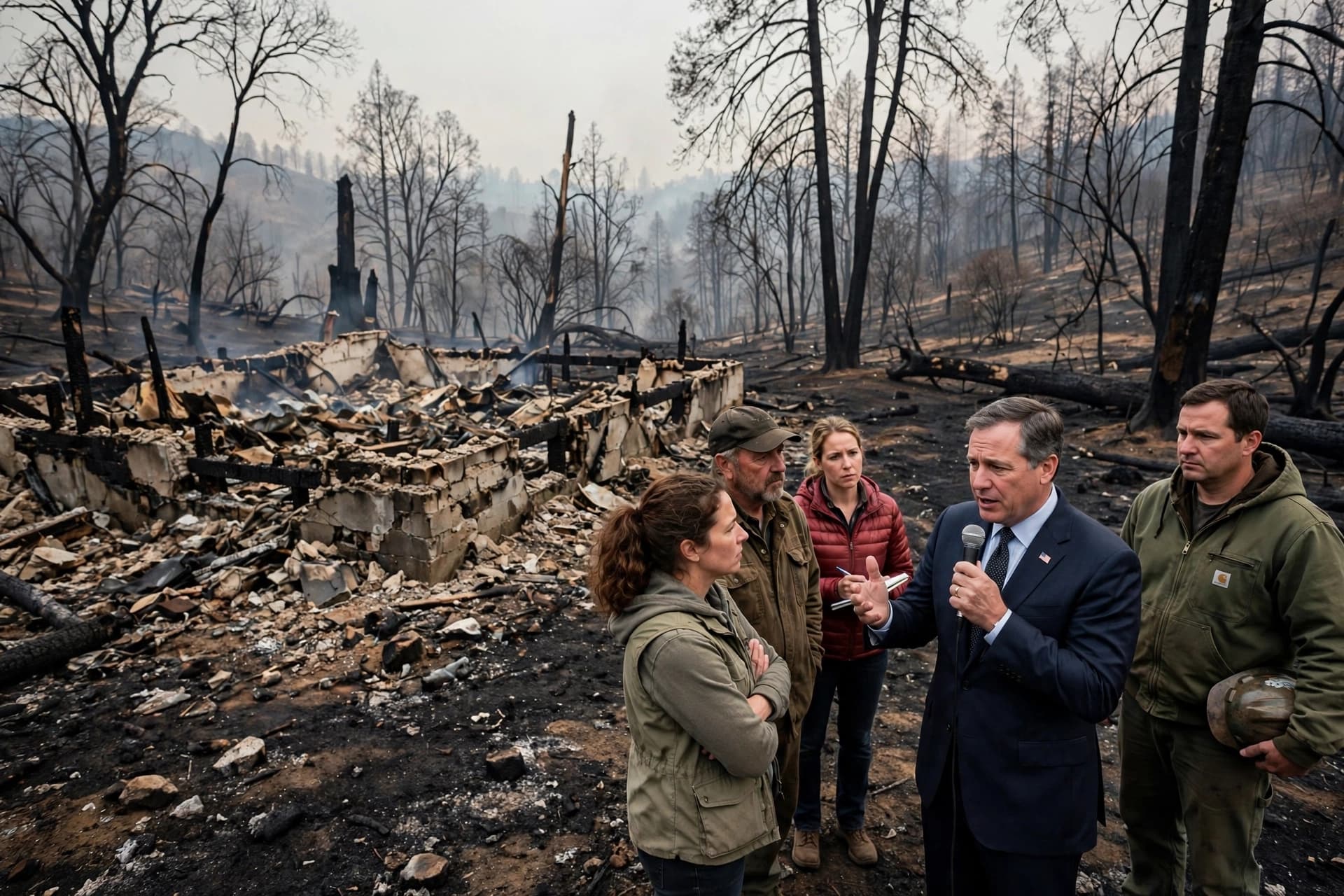
There is a particular poignancy in announcing a wildfire plan from the ashes of a home—a setting that makes the stakes of the policy unmistakable, that transforms a campaign promise into something that feels less like politics and more like a plea. On Friday, British Columbia Conservative interim leader Lorne Doerkson stood in front of the burned-out remains of Joel Patan's family home in Faulder, near Summerland. The Bald Range wildfire had destroyed more than eighty homes in the area in August, forcing thousands to flee. Against that backdrop, Doerkson unveiled a plan he said would prevent such scenes from repeating.
The plan centers on a half-billion-dollar commitment to wildfire response. The largest component is $400 million for a fleet of Crown-owned water bombers, a shift away from what Doerkson described as reliance on short-term rentals and contract services. "We will no longer depend exclusively on short-term leases, and we will no longer have to hope that water bombers are available when our valleys are under threat," he said . An additional $100 million would establish an innovation fund focused on early detection and prevention technologies, including artificial intelligence .
But the plan is not only about planes and technology. Doerkson argued that the province has spent the last decade reacting to wildfires rather than preventing them, and that the costs of that approach have been enormous—more than five billion dollars over the past five years . His proposal includes a stronger partnership with the forestry industry to reduce dangerous fuel loads around communities and infrastructure, an expansion of controlled burns, including cultural burning practices, and a dedicated cabinet committee on wildfires to ensure the province is prepared for next summer .
The announcement was made alongside Tracy St. Claire, the Conservative candidate for Penticton-Summerland, and Joel Patan, whose home provided the backdrop. "Most importantly, we will do everything we can to ensure families like Joel's never again have to flee their homes in the dark with two hours' notice," Doerkson said . When asked how the province would pay for the planes, Doerkson suggested they could be rented out to other jurisdictions when not needed, offsetting some of the cost .
The plan drew immediate questions about feasibility and funding. The timber industry, which Doerkson said would help pay for prevention efforts through revenue from logging in high-risk areas, is itself struggling with tariffs and mill closures . Asked whether taxes would need to increase to cover any shortfall, Doerkson declined to give a specific answer, saying the party would release a full financial platform in the coming weeks .
The timing of the announcement—less than a month before the October 24 provincial election—places wildfire policy at the center of the campaign in the Okanagan, a region that has experienced some of the province's most destructive fires in recent years. The New Democratic Party, which has governed since 2017, has argued that its own investments in wildfire response and prevention have been significant. The election will determine which vision voters find more convincing. For the families who lost homes in Faulder, the debate is not abstract. It is the difference between a policy and a promise, between a plan and a future.
AI Image Disclaimer: All images in this article are AI-generated and are intended for illustrative purposes only.
Sources: Radio-Canada, The Canadian Press, Kelowna Capital News, thecanadianpressnews.ca
Published by Banx Network. This article is part of the Banx decentralized media programme, powered by the BXE token on the XRP Ledger.