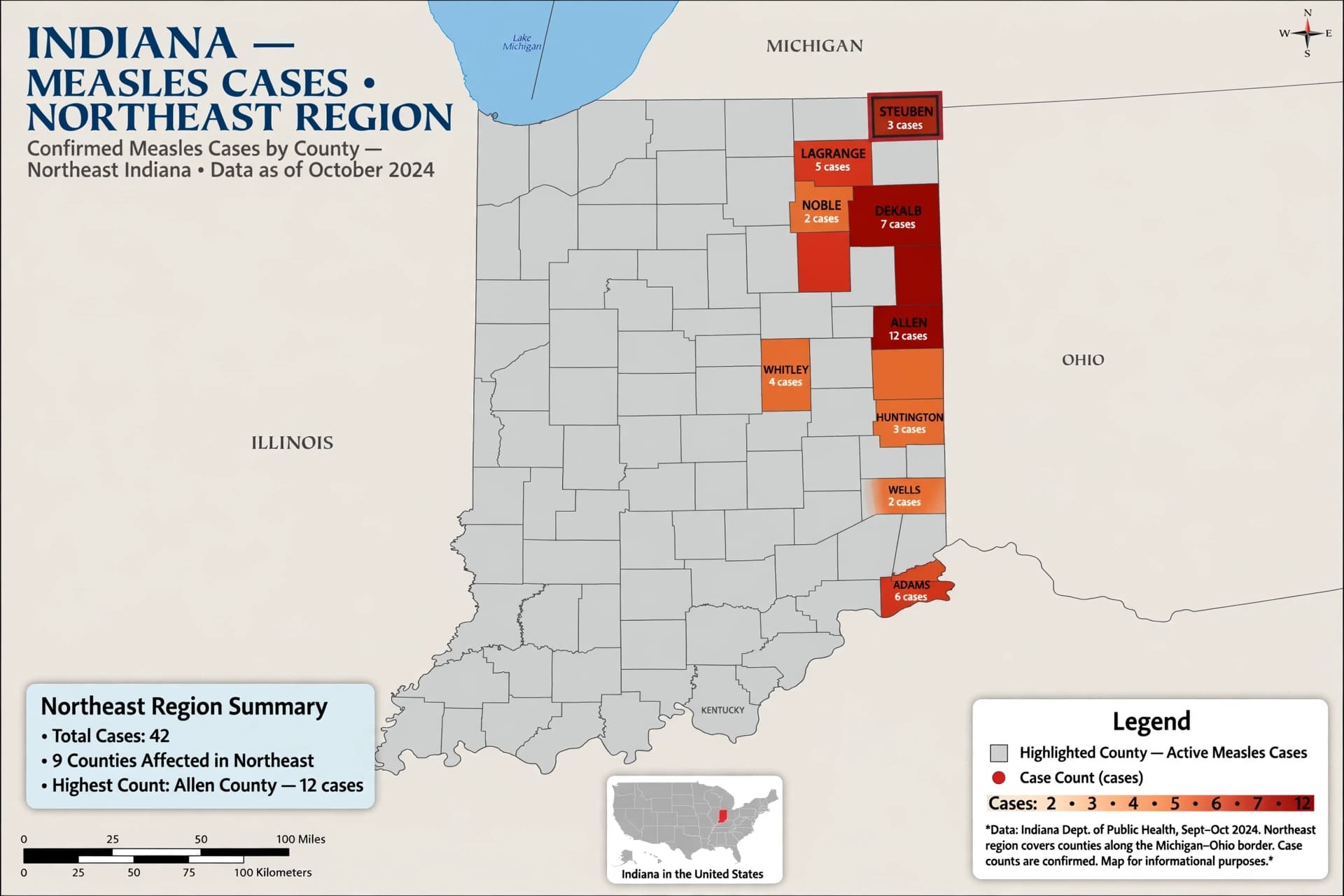
There is a particular stillness that settles over a community when a disease long thought vanquished reappears in its midst—a stillness not of peace but of recognition, of the slow dawning that the protections we once took for granted have begun to thin. In northeast Indiana, that stillness has spread across county lines, from Adams to Allen, and now to DeKalb and LaGrange, as measles cases multiply in a region that had not seen the virus in years. The numbers are small by global standards—six cases in the northeast corner of the state, twenty-four across Indiana—but each one represents a chain of exposure that public health officials are working urgently to trace.
The Indiana Department of Health confirmed this week that DeKalb and LaGrange counties each reported a single measles case as of September 30, joining Adams County with three cases and Allen County with one . The first case in the region appeared in Adams County on September 22, and the spread since then has followed the pattern that makes measles so difficult to contain: it is highly contagious, capable of lingering in the air for up to two hours, and infectious before symptoms appear . Health officials estimate that nine out of ten unvaccinated people who come into close contact with an infected person will themselves become ill.
In Allen County, the health department issued a public warning that anyone who visited the Fort Wayne Zoo on Sunday, September 27, may have been exposed to the virus . That announcement transformed a family outing into a potential transmission event, and officials have urged anyone who was at the zoo that day to monitor for symptoms and check their immunization status. Measles typically begins with fever, cough, runny nose, and red eyes before a rash spreads across the body, and the virus can lead to serious complications, particularly in young children and those with weakened immune systems.
The statewide total of twenty-four cases represents Indiana's highest count in a decade . Nationwide, close to 3,300 measles cases have been diagnosed, a figure that reflects a broader resurgence of a disease that was declared eliminated in the United States in 2000 . The return of measles is not a mystery to epidemiologists; it is the predictable consequence of declining vaccination rates in communities where confidence in immunizations has eroded. The measles-mumps-rubella vaccine, which requires two doses for full protection, is highly effective, but its protection depends on being received.
For the families of northeast Indiana, the practical advice remains unchanged: check vaccination records, monitor for symptoms, and contact a healthcare provider if exposure is suspected. The Allen County Department of Health has been working to notify individuals who may have been in contact with confirmed cases, offering guidance and, where appropriate, post-exposure prophylaxis . The work of containment is slow and meticulous, a process of tracing connections that no one involved would have chosen to make.
The reappearance of measles in a region that had not seen it for years is a reminder that public health is not a destination but a practice—something that must be maintained, not merely achieved. The virus has no agenda, no memory of the decades it was held at bay. It exists only to spread, and it spreads most easily where the barriers against it have been allowed to weaken. In northeast Indiana, those barriers are now being tested, and the outcome will depend on how quickly the community responds.
AI Image Disclaimer: The images accompanying this article were generated by artificial intelligence and are for illustrative purposes only.
Sources: WANE 15, 21Alive, Indiana Department of Health, KBTV
Published by Banx Network. This article is part of the Banx decentralized media programme, powered by the BXE token on the XRP Ledger.