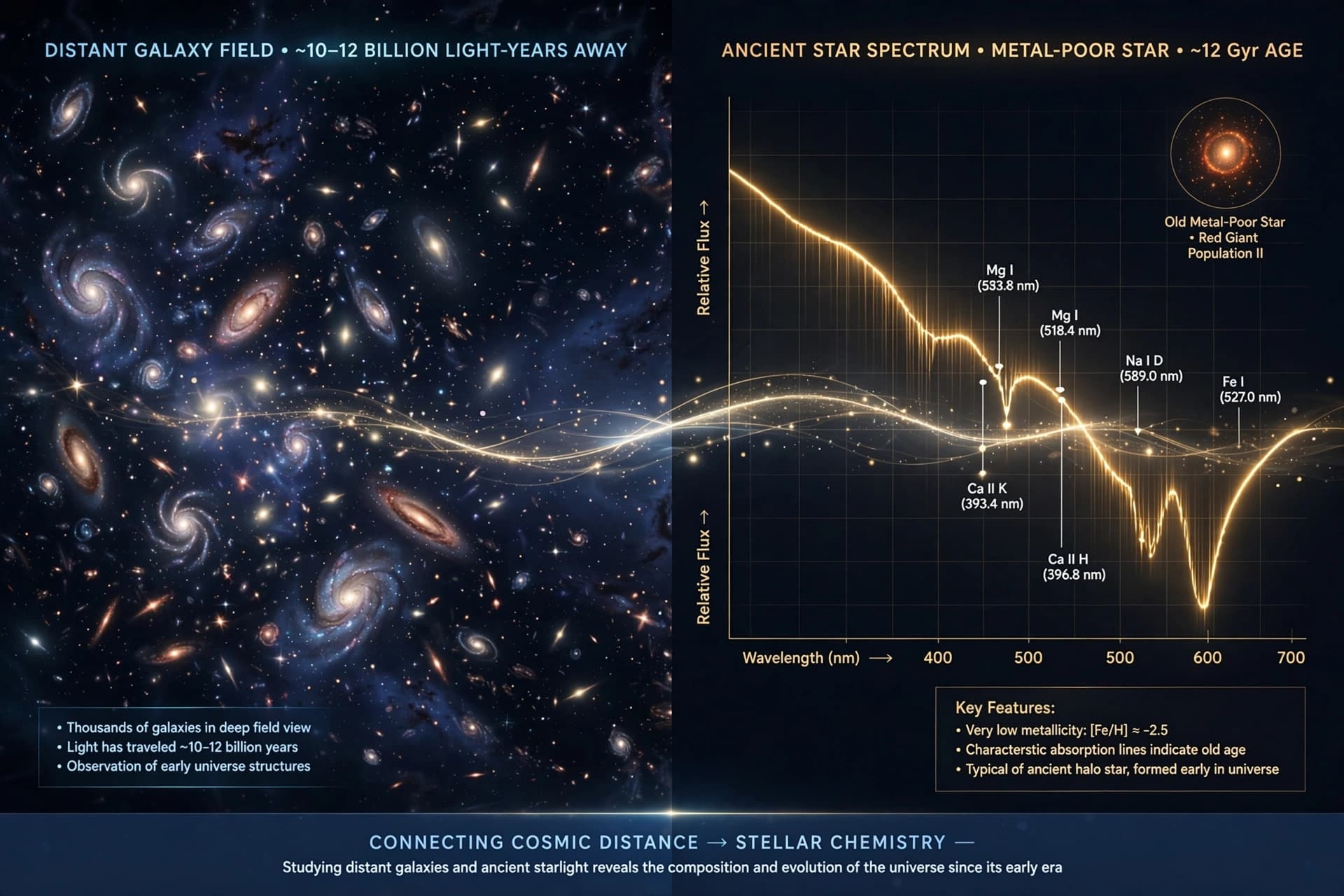
There is a quiet kind of detective work that happens when scientists look up at the night sky. The light arriving at our telescopes today began its journey billions of years ago, carrying with it the faint signatures of a time when the universe was young, dark, and waiting for its first stars to ignite. Understanding those first lights has always been a challenge, not because they are invisible, but because the traces they left behind are scattered across two very different kinds of evidence: the distant galaxies seen by the James Webb Space Telescope and the ancient stars still orbiting quietly in our own Milky Way. Bridging those two views has been an enduring puzzle, one that a project called MEGATRON now seeks to address.
The MEGATRON project, led by researchers at the University of Bath alongside collaborators in the United States and France, has produced a suite of simulations that model the earliest chapters of cosmic history with remarkable detail . Rather than treating the formation of the first stars and the chemical evolution of galaxies as separate problems, the simulations track them together, following how starlight, gas, and newly forged elements interacted over billions of years.
What makes this work noteworthy is how it connects two seemingly unrelated observations. When the James Webb Space Telescope peers into the distant universe, it captures galaxies as they appeared less than a billion years after the Big Bang. When astronomers study the oldest stars in our galactic neighborhood, they find chemical fingerprints—the ratios of heavy elements to lighter ones—that record the conditions in which those stars formed. One view is distant and blurry; the other is nearby and precise. MEGATRON provides a physical framework that links them .
The simulations begin with pristine gas containing no heavy elements, mirroring the conditions shortly after the Big Bang. They then follow the birth of the first stars, the radiation they emitted, the supernova explosions that ended their lives, and the dispersal of elements like carbon, oxygen, and iron into subsequent generations of stars and galaxies . As Dr. Martin Rey of the University of Bath explained, the elements that make our world and life possible were forged by stars, and understanding where those elements came from requires understanding how the first stars formed and enriched their surroundings .
The study suggests that simplified models may underestimate the influence of stellar radiation and complex chemical processes on the gas surrounding early galaxies. By resolving structures that simpler simulations miss, MEGATRON helps refine predictions for both current and future astronomical observations . The project has already been awarded 40 million processor hours on the UK's national supercomputers, resources that will enable even more detailed simulations in the years ahead .
There is something quietly humbling in this work. The same elements that flow through our bodies were once forged in the hearts of stars that lived and died before the Earth existed. MEGATRON does not change that story, but it helps us read it more clearly.
The MEGATRON collaboration began in 2023 and is scheduled to continue through 2030, with further papers expected as the simulations grow more sophisticated .
Note: Images accompanying this article are AI-generated.
Sources: University of Bath, Lifeboat Foundation, Open Journal of Astrophysics, DiRAC
Published by Banx Network. This article is part of the Banx decentralized media programme, powered by the BXE token on the XRP Ledger.