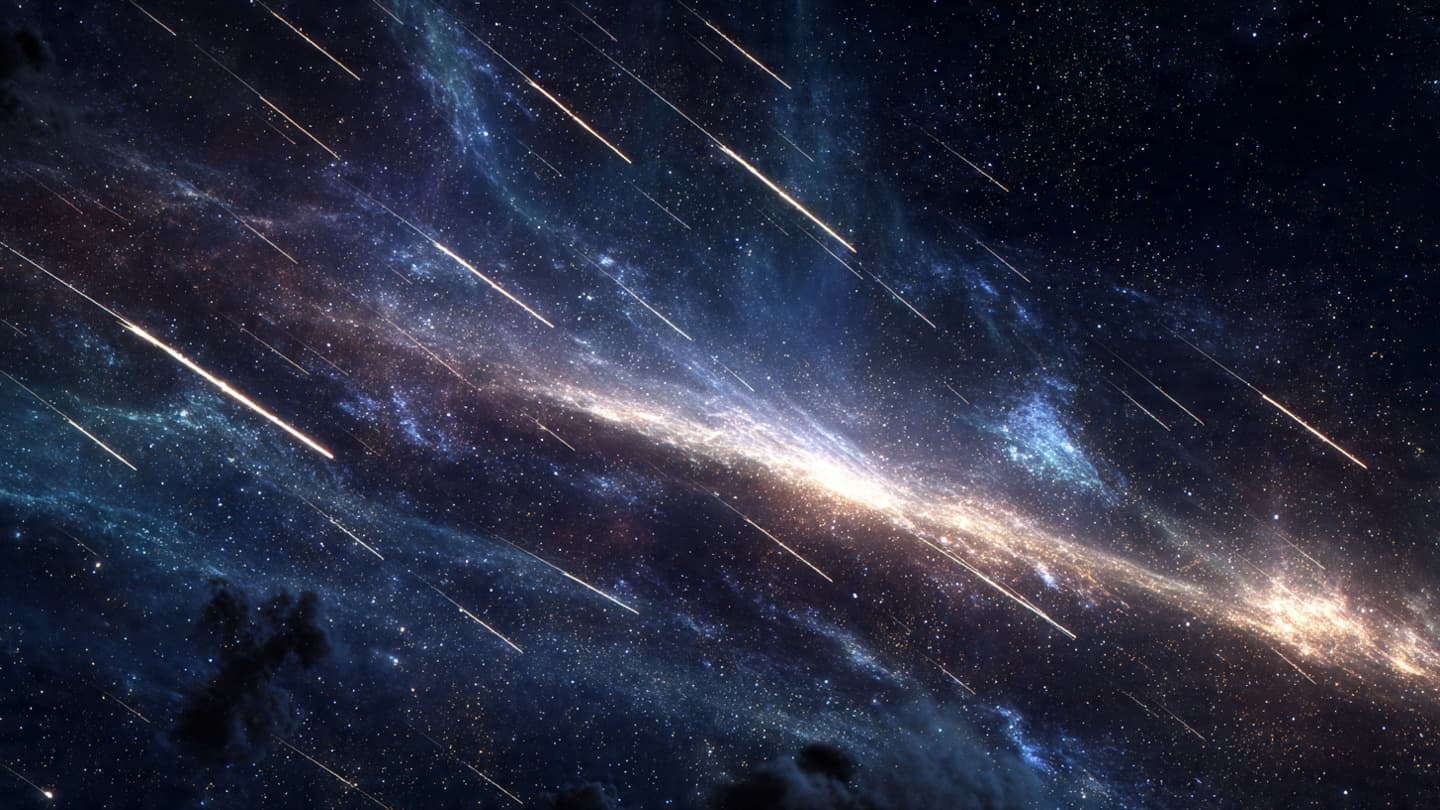
The night sky often appears calm from the surface of Earth, a quiet ceiling of distant lights suspended above ordinary life. Yet beyond that familiar stillness, the universe remains restless. Invisible streams of energy cross enormous distances every second, carrying fragments of ancient explosions, violent collisions, and events so powerful they continue to puzzle modern science. Among them are cosmic rays, particles that arrive at Earth with extraordinary force, like messages traveling through dark cosmic oceans without a clear return address.
Scientists have studied cosmic rays for more than a century, but many questions remain unresolved. These particles, mostly protons and atomic nuclei, move close to the speed of light and constantly strike Earth’s atmosphere. When they collide with atmospheric molecules, they create showers of secondary particles that can be detected by observatories on the ground.
Researchers believe many cosmic rays originate from energetic events inside the Milky Way. Supernova explosions, which occur when massive stars collapse and burst outward, are considered one major source. The shockwaves created during these explosions may accelerate particles across vast regions of space, giving them enough energy to travel enormous distances.
Beyond our galaxy, scientists also investigate more extreme possibilities. Supermassive black holes located at the centers of galaxies may produce cosmic rays through powerful jets of matter and magnetic fields. These regions behave almost like cosmic engines, pushing particles outward with tremendous energy that challenges existing models of physics.
One continuing mystery involves ultra-high-energy cosmic rays, particles carrying energies far beyond what human-made particle accelerators can produce. Their origin remains uncertain because magnetic fields in space bend their paths, making it difficult to trace them back to their exact source. Scientists often compare the challenge to following a drifting leaf backward through a storm.
Large international observatories continue searching for answers. Facilities such as the Pierre Auger Observatory in Argentina and the IceCube Neutrino Observatory in Antarctica monitor particle interactions and related cosmic phenomena. Their findings help researchers build a clearer picture of how energetic processes shape the universe.
Recent studies have also connected cosmic rays to broader questions about the evolution of galaxies, magnetic fields, and interstellar matter. While these particles are tiny, their existence reflects enormous forces operating across billions of years. They remind researchers that space is not empty silence, but a dynamic environment filled with motion and transformation.
The study of cosmic rays continues to evolve as new telescopes, detectors, and computational models improve scientific understanding. Although many uncertainties remain, researchers believe each observation gradually narrows the distance between mystery and explanation.
In the quiet rhythm of everyday life, cosmic rays pass unnoticed through the atmosphere above cities, oceans, and forests. Their journey, shaped by distant stars and violent cosmic events, continues to offer scientists a deeper glimpse into the hidden energy of the universe.
AI Image Disclaimer: Some visual illustrations accompanying this article were created using AI-generated imagery for representational purposes.
Sources: NASA, European Space Agency, Scientific American, Nature, Space.com
Published by Banx Network. This article is part of the Banx decentralized media programme, powered by the BXE token on the XRP Ledger.