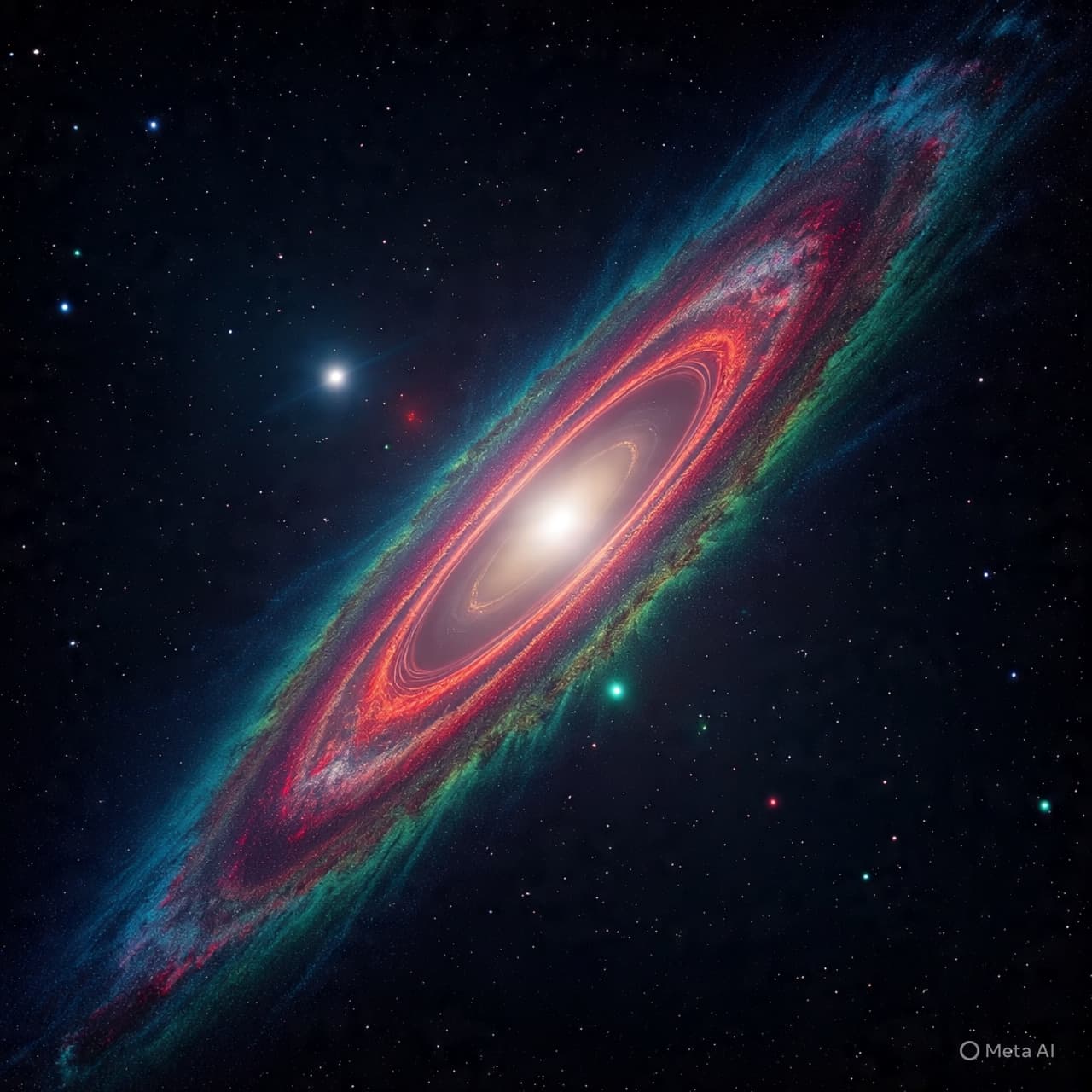
In the vast theater of the night sky, stars often fade like embers at the end of summer quiet, distant, unremarkable. Yet sometimes, even in that gentle fading, there is a scene that catches the observer by surprise, like the last note of a lullaby echoing in a still room. This is the delicate story of a star thought to have settled into silent twilight, only to reveal a radiant disturbance in the fabric of space that surrounds it a colorful shockwave, whispering of motion and mystery beyond expectation.
What astronomers have found, some 730 light-years away in the constellation Auriga, is a white dwarf the hushed remnant of a once-brilliant star carving its path through the interstellar medium with a bow shock that glows in hues of red, green, and blue. The image, captured by the European Southern Observatory’s Very Large Telescope, shows this ethereal wave like the gentle crest before a ship’s prow, the colors borne from hydrogen, nitrogen, and oxygen set aglow as the shock compresses and heats the gas it encounters.
This phenomenon around the star known as RXJ0528+2838 an object expected to be unassuming has stirred a sense of poetic surprise in the scientific community. White dwarfs are common relics of stellar evolution, the dense cores that remain when stars up to eight times the mass of our Sun exhaust their fuel. Typically, when such a star produces a bow shock, it does so from the material swirling in a disk surrounding it. But here, this star appears not to possess such a disk, and yet, the shock remains vivid, persistent, and unexplained by current models.
Astronomers believe the white dwarf’s strong magnetic fields, alongside gas siphoned from a red dwarf companion, may play a role in driving this celestial ripple. Yet even with this insight, there remains an unresolved tension between expectation and observation. The glow has endured for at least a millennium, suggesting a sustained process rather than a fleeting event.
In this way, the shock wave becomes more than a scientific signal. It is a reminder that the cosmos is ever unfolding, offering brushstrokes of color and cadence in places we might assume to be tranquil. Space, often imagined as empty or still, reveals itself here as a dynamic tapestry where even the dying light of a star can stir patterns of beauty and scientific intrigue.
As researchers continue to puzzle over the origins of this vibrant wave, they also find themselves reflecting on the deeper harmonies that govern our universe. It is a whisper from the stars that there are always layers yet unseen, colors yet unsung, waiting just beyond the edge of our understanding.
In the quiet aftermath of discovery, the image of this shockwave stands not as a problem to be solved alone, but as an invitation to wonder a testament to the subtle richness of the night sky’s unfolding story.
AI Image Disclaimer (Rotated Wording) “Visuals are created with AI tools and are not real photographs.”
Source Check (credible media sources)
Reuters European Southern Observatory press/news (covered by Reuters & ESO) Space.com Phys.org Cultured Northeast (science reporting)
Published by Banx Network. This article is part of the Banx decentralized media programme, powered by the BXE token on the XRP Ledger.