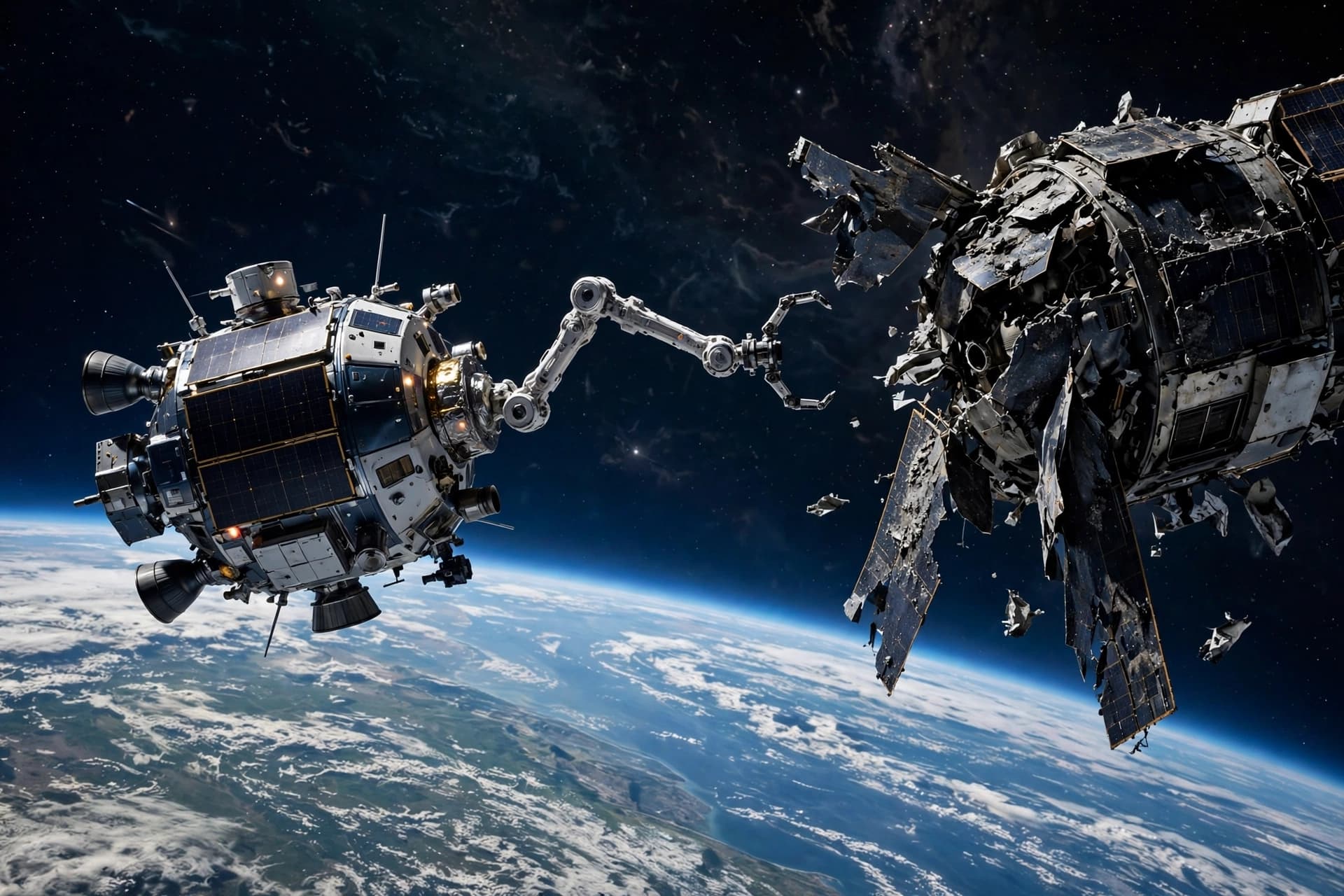
In the growing quiet of low Earth orbit, thousands of satellites circle the planet without a voice. Some are dead, their systems silent. Others are damaged, unable to signal or maneuver. According to the European Space Agency, roughly 19,440 satellites are on orbit, and about 3,540 of them are nonfunctioning or not emitting a signal . To approach one of these sleepwalking machines—to repair it, to refuel it, to remove it—is to approach a patient who cannot respond.
Minduli Wijayatunga, a new aerospace engineering faculty member at the University of Illinois Urbana-Champaign, has spent her recent work on this problem. The challenge is not only technical but temporal. Communication delays between a servicer spacecraft and Earth, combined with limited contact windows, mean that close-range rendezvous with an uncooperative target must be handled autonomously. The spacecraft must make go/no-go decisions without waiting for the ground to decide .
Her framework, called CORTEX, for Convex Optimization for Rendezvous Trajectory Execution, couples a deep-learning perception pipeline with convex-optimization-based trajectory planning and tracking. It includes reference regeneration and abort-to-safe-orbit capabilities for off-nominal conditions . The system was validated in a two-tier campaign: a Monte-Carlo simulation with 500 trials per error regime, and experimental testing on a planar air-bearing hardware testbed with cold-gas thrusters and motion-capture feedback .
The hardware tests were designed to stress the system in ways that matter. The servicer was manually pushed off course. Thrusters were turned off during periods they were supposed to fire. State and thrust errors were artificially increased to simulate unexpected events like solar storms . CORTEX decides whether to replan a new trajectory and reapproach, or to abort, retreat to a passively safe orbit, and retry. "CORTEX was very robust to that," Wijayatunga said .
CORTEX also accounts for eclipses, timing rendezvous when sunlight provides an optimal window to see the target, complete close-proximity operations, and depart . In the software testbed under the strongest error case, the system achieved terminal docking performance of about 26 millimeters in relative position and 0.37 millimeters per second in relative velocity. On the hardware testbed, terminal errors were about 8 millimeters and 2.2 millimeters per second .
The need is not theoretical. More than 8,000 metric tons of debris orbit Earth, none of it cooperative in the sense that it can thrust or send a signal . As more satellites launch, the population of objects requiring servicing or removal will only grow. Autonomous servicing of an uncooperative target has not yet been attempted in space, though close-range approach has been experimentally validated by the ADRAS-J mission .
What Wijayatunga's work offers is a framework for the moment when something goes wrong—the thruster that fails, the perturbation that pushes the servicer off course—and the spacecraft must decide, alone, whether to try again or to wait. In the silence between Earth and orbit, that capacity for judgment is not a luxury. It is the condition of possibility for everything that follows.
The images accompanying this article are AI-generated and are not actual photographs of the spacecraft or testbed described.
Sources: Phys.org, Acta Astronautica, University of Illinois Urbana-Champaign
Published by Banx Network. This article is part of the Banx decentralized media programme, powered by the BXE token on the XRP Ledger.