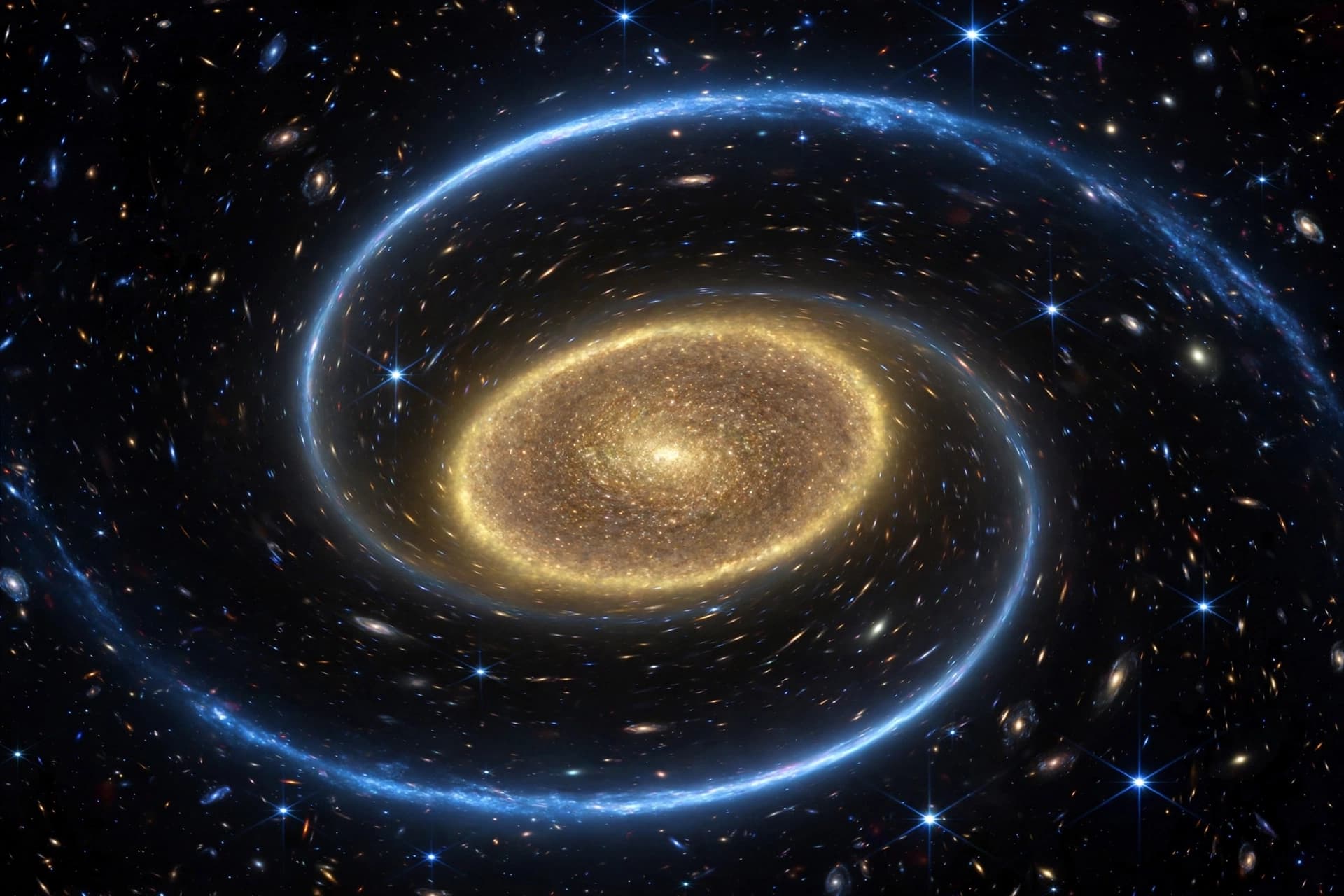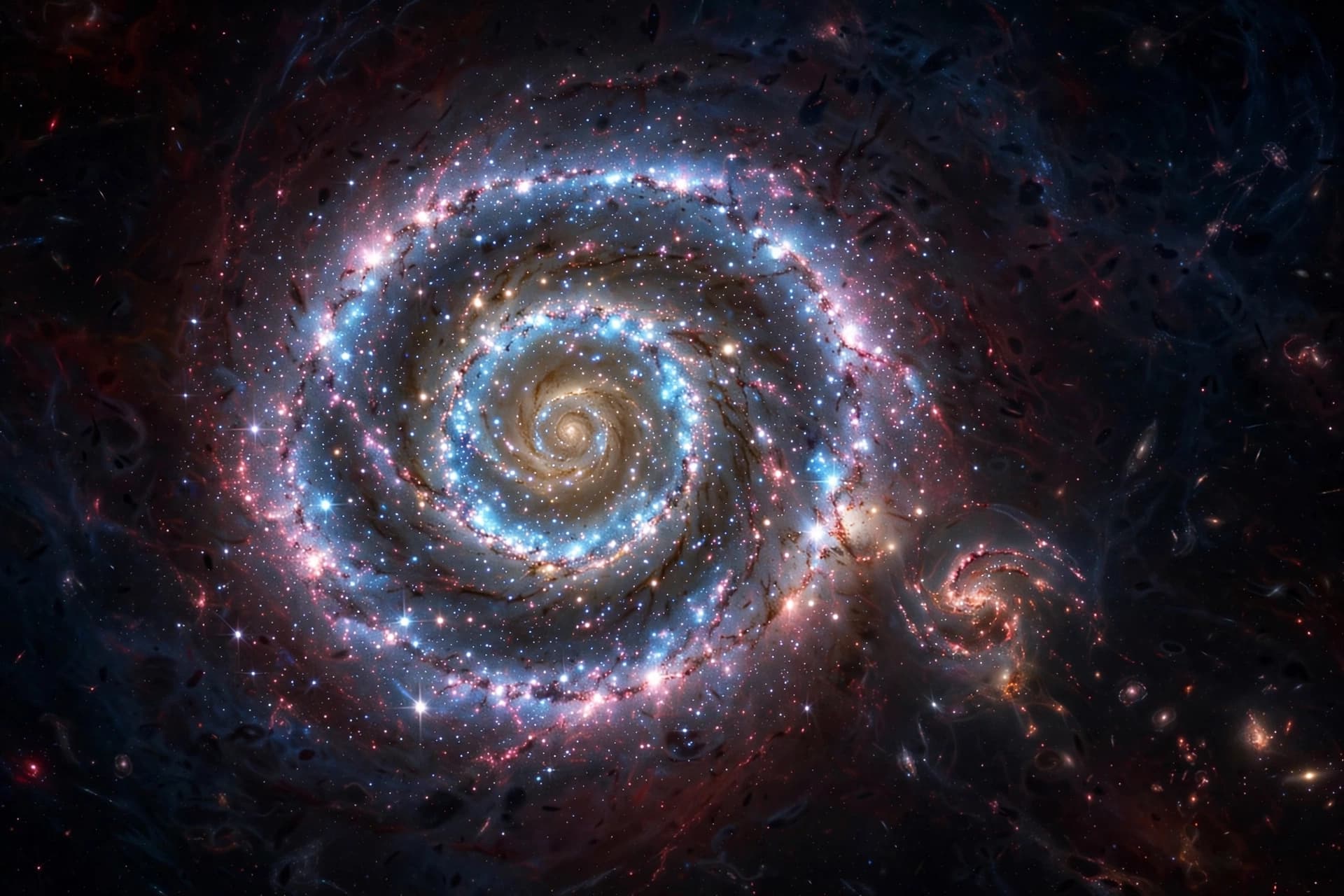
The universe has a way of hiding its most beautiful accidents in the oldest light. A ring galaxy is one of those accidents—a perfect circle of newborn stars, formed when one galaxy plunges through the heart of another, sending a wave of gas and dust outward like a stone dropped into still water. They are rare in the nearby universe. In the distant universe, they are almost ghosts, glimpsed only briefly before the light fades.
The James Webb Space Telescope has now found one. Astronomers using the telescope's Near-Infrared Spectrograph have discovered GS18660, the most distant ring galaxy ever observed. Its light left it approximately 2.1 billion years after the Big Bang, and it may be the remnant of a collision between two galaxies—a head-on impact that sent a wave of star formation rippling outward in a circle . The researchers reported their findings in Astronomy & Astrophysics.
The discovery was, in a sense, an accident of its own. Scientists had selected GS18660 for observation because it looked stretched out in older Hubble Space Telescope images. They did not target it specifically as a ring galaxy. When Webb's more detailed data arrived, the ring structure emerged with startling clarity, allowing the team to investigate the galaxy in three dimensions . What they found was a system still reeling from an impact.
Several pieces of evidence support the collision hypothesis. The researchers identified a small companion galaxy moving away from GS18660 at roughly 264 miles per second. They detected a bridge of gas linking the two, with a change in velocity along it that suggests interaction. The companion's position, roughly along the main galaxy's minor axis, is consistent with where an intruder would appear after plunging through the galaxy's disk . The gas kinematics revealed a rotating disk with an additional radial expansion velocity of about 200 kilometers per second—a propagating collisional wave .
The timing of the impact can be estimated from the companion's speed and distance. The collision likely occurred roughly 17 million to 42 million years before the moment the telescope observed it. Star formation analysis supports this: 10 to 20 percent of the stellar mass in the ring formed in the past few tens of millions of years, suggesting the collision and the burst of new stars were connected . "It is not, by itself, definitive proof of a collision, but together with the bridge and the ring morphology, it strengthens the case for a recent impact," said Michele Perna, the study's first author .
What makes GS18660 significant beyond its distance is what it implies about the early universe. Earlier estimates suggested that collisional rings in the early universe might be as rare as they are today—around 1 in 10,000 galaxies. The new findings hint that head-on collisions that form ring galaxies may have been more common in the early universe than previously thought. "If GS18660 is confirmed as a collisional ring, it would therefore suggest that we need to revisit our estimates of how frequently these systems occur in the distant universe," Perna said .
The team expressed caution. The presence of a recently formed bar and a resonance ring cannot be completely excluded as an alternative explanation . Science moves carefully, even when the image is beautiful. But for now, the ring shines across billions of years, a circle drawn by gravity and chance, visible only because a telescope was built to see what the darkness holds.
The images in this article are AI-generated and are not actual astronomical photographs.
Sources: Yahoo, Live Science, Astronomy & Astrophysics, Semantic Scholar
Published by Banx Network. This article is part of the Banx decentralized media programme, powered by the BXE token on the XRP Ledger.