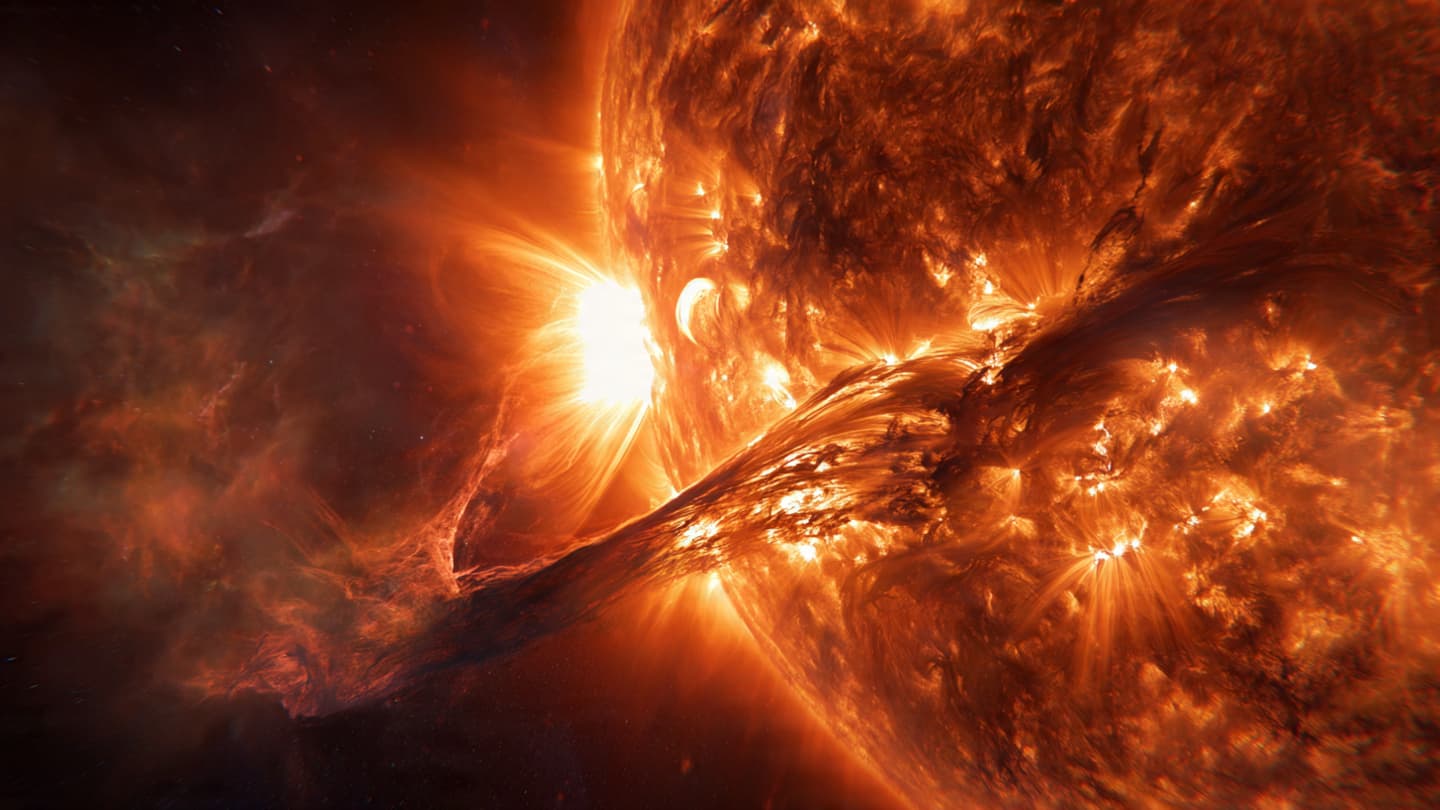
The Sun often appears steady and unchanging from Earth, a familiar presence marking the rhythm of ordinary days. Yet beneath that calm brightness lies a vast sphere of constant motion and explosive energy. This week, scientists observed a powerful solar flare erupting from the Sun’s surface, reminding the world that space weather can influence life far beyond the atmosphere.
According to researchers monitoring solar activity, the eruption released intense bursts of radiation and charged particles into space. Such events, commonly known as solar flares, occur when magnetic energy near sunspots is suddenly released. In stronger cases, these eruptions can interact with Earth’s magnetic field and affect satellites, communications systems, and power infrastructure.
Space agencies and observatories closely tracked the flare as data arrived from solar-monitoring instruments. Scientists explained that while many solar events pass with minimal impact, larger eruptions may create geomagnetic storms capable of disrupting navigation systems, radio communications, and certain satellite operations.
At the same time, solar storms can also produce some of nature’s most beautiful atmospheric displays. Charged particles interacting with Earth’s magnetosphere often generate auroras, commonly known as the northern and southern lights. In recent years, heightened solar activity has allowed auroras to appear farther from polar regions than usual.
Researchers emphasized that modern societies rely heavily on technologies vulnerable to space weather. Satellites support everything from weather forecasting and internet connectivity to aviation systems and emergency communications. Even brief disruptions can create noticeable effects across interconnected global networks.
The current solar cycle has gradually intensified over the past several years. Scientists believe the Sun is approaching a period known as solar maximum, during which magnetic activity becomes more frequent and energetic. During these phases, sunspots and solar flares tend to increase in both number and intensity.
Despite potential risks, scientists view these events as valuable opportunities for research. Studying solar activity helps improve forecasting systems designed to protect critical infrastructure. Advances in solar observation technology have significantly improved humanity’s ability to monitor and predict space weather compared to previous decades.
Public interest in solar storms has also grown through social media and astrophotography communities. Images of vivid auroras often spread rapidly online, blending scientific curiosity with artistic fascination. For many people, such events create rare moments when astronomy feels directly connected to daily experience.
As Earth continues orbiting its restless star, researchers remain watchful but calm. Solar flares are part of the Sun’s natural behavior, and scientists continue working to better understand how these distant eruptions quietly shape the technological world below.
AI Image Disclaimer: Some space visuals in this article were generated using AI-assisted imagery for scientific illustration purposes.
Sources: NASA, Live Science, NOAA, Space.com, European Space Agency
Published by Banx Network. This article is part of the Banx decentralized media programme, powered by the BXE token on the XRP Ledger.