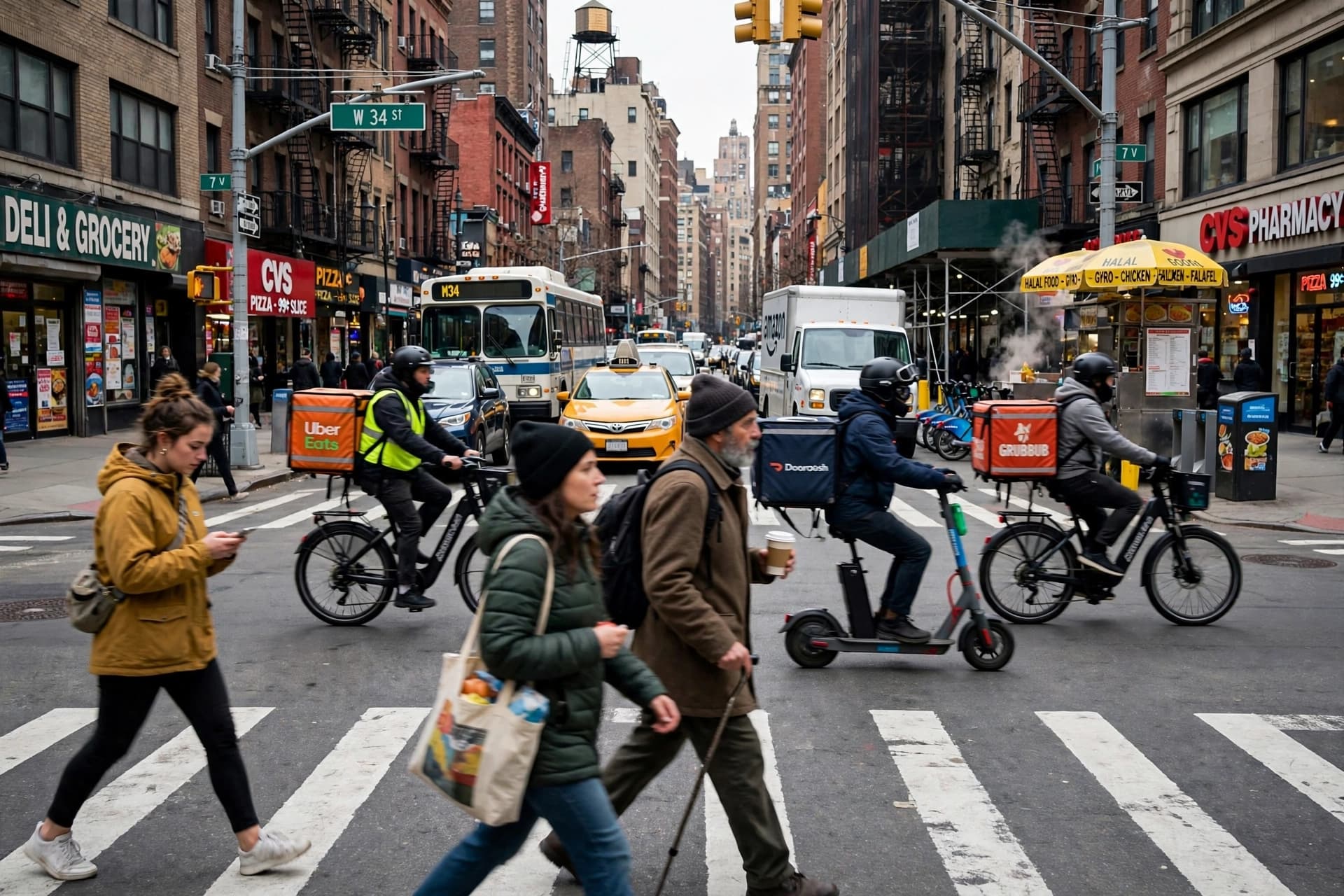
There is a quiet arithmetic being written on the streets of New York, and the numbers do not add up the way they once did. For years, the city measured its progress in Vision Zero statistics—fewer deaths, safer crossings, a slow bending of the curve toward zero. But a new variable has entered the equation, small and fast and largely unregulated. Electric bicycles and scooters have multiplied across the five boroughs, carrying delivery workers and commuters, teenagers and tourists. And as their numbers have grown, so has a particular kind of tragedy that the city’s safety framework was never designed to address.
The figures tell a story of divergence. Through late June 2026, New York recorded 94 traffic fatalities, slightly above the 91 at the same point in 2025. But within that total, something has shifted. Deaths among motor vehicle occupants fell sharply—from 29 in 2024 to 16 this year. Meanwhile, deaths among riders of e-bikes, stand-up scooters, and mopeds rose to 18, up from 16 a year earlier. For the first time, more people died riding small electric vehicles than died inside cars and trucks .
The trend has continued and deepened. By late September, 17 people had been killed while riding e-bikes this year, compared with three on traditional bicycles. Stand-up e-scooter fatalities reached 11, a record. Two weeks before the City Council’s hearing, a 15-year-old girl named Daria Serkov died when her Citi Bike e-bike was struck by a turning truck in Manhattan. Days later, a 50-year-old woman riding an e-bike was killed by a dump truck in Midtown .
What makes this pattern particularly troubling is that it has persisted despite efforts to address it. A citywide 15-mph speed limit on e-bikes and e-scooters took effect in October 2025, yet fatalities have not declined. Several of the vehicles involved in high-profile crashes were not legal under existing laws at all. One 17-year-old was killed riding an e-bike that was illegal for sale and street use in New York City. Two men died on the Queensboro Bridge when an e-scooter capable of 50 mph crashed head-on with a bicycle .
Behind the statistics are people whose lives have been altered in ways that cannot be measured in policy outcomes. At a City Council hearing on Wednesday, survivors and family members testified. A mother described being hit while 20 weeks pregnant, giving birth prematurely, and watching her son spend three months in neonatal intensive care. A cellist lost the ability to play her instrument. A woman struck by an e-bike in Central Park required part of her skull to be removed and remains in the hospital months later. “I do not know the name of the individual who hit me,” one survivor said .
The City Council is now considering 23 bills aimed at regulating e-bikes and scooters, the largest legislative response to a single issue in the city’s recent history . Proposals include licensing and registration requirements, restrictions on high-speed models, and new enforcement mechanisms. The debate reflects a difficult balance: e-bikes have become essential for thousands of delivery workers and offer a low-carbon alternative to cars, but their rapid proliferation has outpaced the rules meant to govern them.
For a city that has spent years trying to make its streets safer, the rise in e-bike fatalities represents an unexpected complication. The solution, if one exists, will need to address not only the vehicles themselves but the infrastructure, the enforcement, and the economic pressures that have made them so ubiquitous. The arithmetic of Vision Zero may yet bend back toward zero, but the equation has grown more complex.
AI Image Disclaimer: The images accompanying this article were generated by artificial intelligence and are intended for conceptual illustration only.
Sources: Automotive Addicts, New York Daily News, amNewYork, New York Post, Infobae, Koreatimes
Published by Banx Network. This article is part of the Banx decentralized media programme, powered by the BXE token on the XRP Ledger.