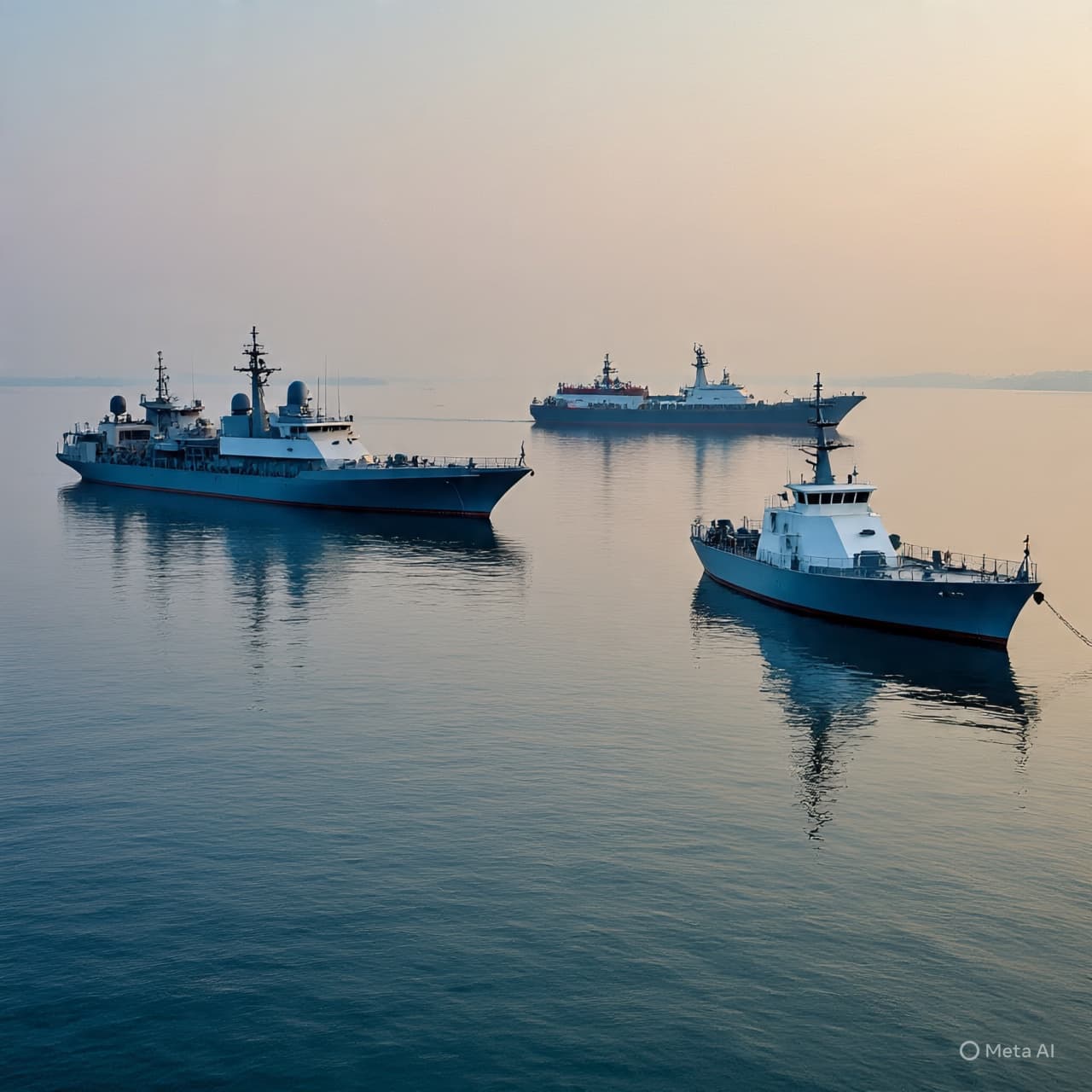
Morning light over the Gulf often arrives without urgency, spreading slowly across the water until ships and shorelines reappear in quiet detail. It is a place where movement rarely stops—tankers advancing along familiar routes, patrol vessels tracing their careful arcs—yet the stillness can feel deceptive, as though the surface conceals a more complicated current beneath.
In recent remarks, Donald Trump suggested that the United States is considering “winding down” its military involvement with Iran, even as a central concern remains unresolved: the status of the Strait of Hormuz. The narrow passage, through which a significant portion of global oil supply flows, has long stood as both lifeline and leverage, its openness tied to stability far beyond the region.
The idea of winding down a conflict without fully securing such a corridor introduces a delicate imbalance. Military drawdowns are often imagined as gradual retreats from intensity, a softening of presence that allows tensions to settle into quieter forms. Yet the Strait of Hormuz resists quiet. Its importance ensures that even the suggestion of disruption can ripple through global markets, altering prices, expectations, and the calculations of states far removed from its shores.
For years, the strait has existed as a focal point of strategic attention, where naval patrols, commercial shipping, and political signaling converge in a narrow band of water. Episodes of heightened tension—seizures, warnings, shadowing vessels—have underscored how quickly routine can shift into uncertainty. In this context, any reduction in U.S. involvement raises questions not only of capacity, but of continuity: who remains, who steps forward, and how the balance is maintained.
The suggestion that other nations might assume a greater role in safeguarding the passage reflects a broader shift in posture. Energy-dependent economies in Europe and Asia have long relied on the steady flow through Hormuz, and many have participated, to varying degrees, in maritime security efforts. Yet a transition from U.S.-led oversight to a more distributed arrangement introduces its own complexities—coordination, commitment, and the subtle dynamics of shared responsibility.
For Iran, the strait carries layered meaning. It is not merely a geographic feature, but a symbol of proximity and influence, a place where national identity intersects with global dependency. The prospect of a reduced American presence, coupled with an unresolved status for the waterway, leaves space for interpretation. It is a moment where restraint and assertion may both appear viable, depending on how the situation evolves.
Meanwhile, the broader conflict continues to resist simple conclusions. The language of “winding down” suggests a desire for de-escalation, yet without a clear resolution to the question of Hormuz, the transition remains incomplete. It is a shift defined less by closure than by adjustment, where one form of engagement gives way to another without fully relinquishing its underlying tensions.
In the end, the waters of the Gulf remain in motion, reflecting both continuity and change. The United States appears to be contemplating a quieter role in its confrontation with Iran, even as the Strait of Hormuz stands unresolved at the center of the equation. And so the moment lingers—between withdrawal and watchfulness, between open passage and uncertain guarantee—carried forward by currents that move slowly, but never without consequence.
AI Image Disclaimer Illustrations were created using AI tools and are not real photographs.
Sources Reuters BBC News Al Jazeera Financial Times Bloomberg
Published by Banx Network. This article is part of the Banx decentralized media programme, powered by the BXE token on the XRP Ledger.