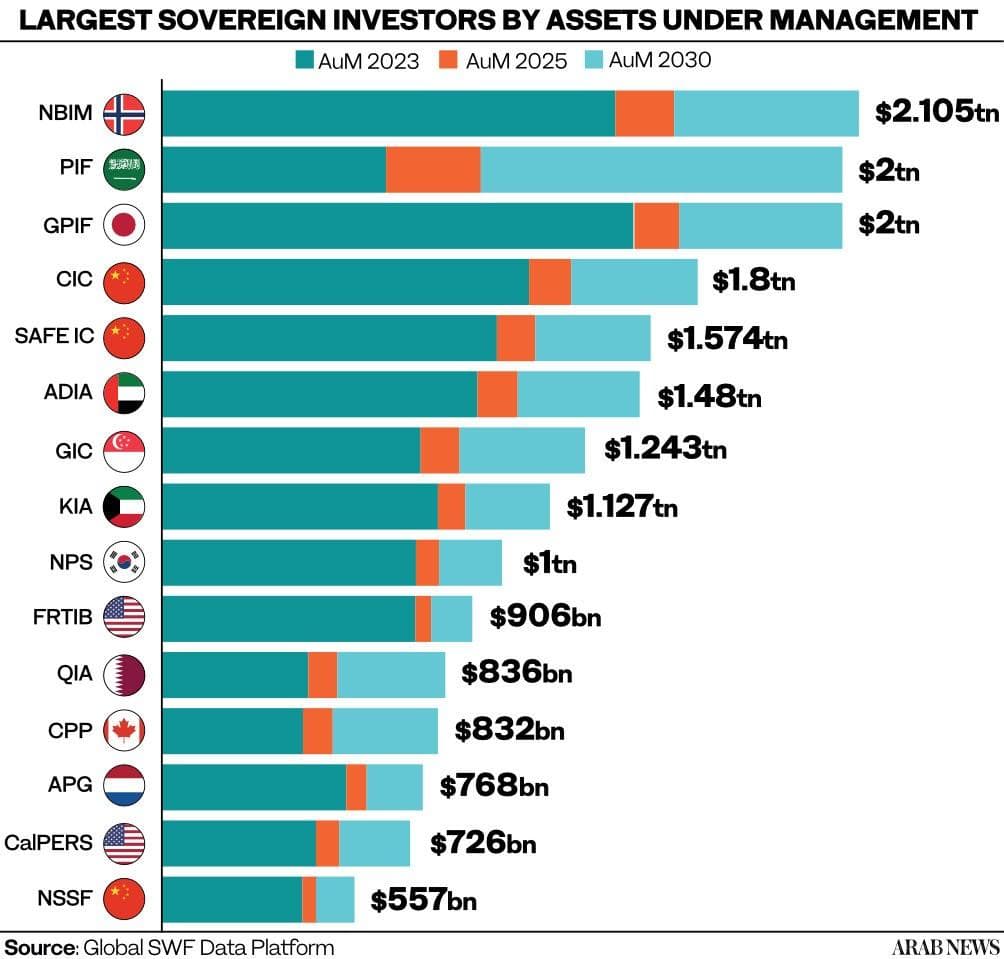
1. The Rise of Government-Owned Investment Giants
When people think about the world's biggest investors, names such as BlackRock, Vanguard and major international banks often come to mind.
However, another group of financial institutions has been steadily increasing its influence: sovereign wealth funds.
These are state-owned investment funds that manage money on behalf of governments and national populations. Their capital can come from oil and gas revenues, foreign exchange reserves, budget surpluses, commodity exports or other state-owned assets.
Unlike ordinary government departments, sovereign wealth funds typically invest in financial markets and businesses with the objective of generating long-term returns or supporting national economic development.
Their portfolios can include:
Shares in publicly traded companies.
Private equity and venture capital.
Commercial property and real estate.
Energy and natural resources.
Infrastructure and transport networks.
Technology companies and artificial intelligence.
Government and corporate bonds.
Their scale is substantial.
According to Global SWF's 2026 reporting, sovereign wealth fund assets reached approximately $15 trillion during 2025. Their investments increased by 35% to around $179.3 billion that year. [1]
This makes them an increasingly important source of capital within the global financial system.
However, sovereign wealth funds are not all identical. Some exist to save resource revenues for future generations, while others are designed to diversify national economies, manage reserves or support strategic industries.
Understanding these differences is essential to understanding their growing influence.
2. Norway: The World's Investment Giant
<escape> </escape>
Norway operates one of the most recognised sovereign wealth funds in the world: the Government Pension Fund Global, commonly known as the Norwegian oil fund.
Established in 1990, the fund was designed to manage the country's petroleum wealth for the long-term benefit of Norwegian society.
Rather than allowing oil and gas revenues to be spent immediately, Norway directs much of its petroleum wealth into a diversified international investment portfolio.
The fund invests across global financial markets, holding shares in companies, bonds, property and renewable energy infrastructure.
Its scale is enormous.
By June 2026, the fund's market value had reached approximately NOK 22.7 trillion, equivalent to more than $2 trillion depending on the exchange rate. [2]
One of its defining characteristics is its global investment strategy.
Instead of concentrating its capital primarily within Norway, the fund invests internationally across thousands of companies and financial instruments.
This allows Norway to benefit from economic growth around the world while reducing its dependence on its domestic economy.
The fund also has an influential approach to corporate governance. It regularly votes at shareholder meetings and publishes expectations concerning issues such as climate risk, executive remuneration and corporate transparency.
This means its influence extends beyond simply providing capital. As a major shareholder, it can participate in decisions affecting some of the world's largest businesses.
Norway's model demonstrates how natural resource wealth can be transformed into a long-term financial asset rather than being consumed entirely through government spending.
3. Saudi Arabia: The Public Investment Fund's Global Ambitions
Saudi Arabia has developed one of the most ambitious sovereign investment strategies in the world through its Public Investment Fund (PIF).
The fund is a central component of Saudi Arabia's Vision 2030 economic transformation programme, which aims to diversify the country's economy and reduce its dependence on oil revenues.
Its investment strategy combines international investments with major domestic development projects.
According to its 2025 annual report, PIF managed more than $900 billion in assets. Revenue increased by 9% to $120 billion, while net profit more than doubled to $17 billion. [3]
Between 2021 and 2025, the fund invested more than $199 billion domestically and contributed over $342 billion cumulatively to Saudi Arabia's real non-oil GDP.
Its investments span several industries:
Artificial intelligence and digital technology.
Tourism and hospitality.
Renewable energy.
Advanced manufacturing.
Sports and entertainment.
Infrastructure and construction.
Financial services.
One of its most significant strategic initiatives has been the development of large-scale domestic projects intended to transform Saudi Arabia's economic landscape.
However, PIF's strategy is evolving.
Its 2026–2030 strategy places greater emphasis on maximising returns, developing competitive domestic ecosystems and unlocking value from existing investments.
The fund is also seeking to expand international partnerships and investment opportunities.
This is important because Saudi Arabia is not simply attempting to accumulate foreign assets. It is using state-backed capital to develop industries, attract international businesses and establish new sources of economic activity.
The challenge will be ensuring that ambitious investments generate sustainable financial returns rather than creating long-term financial commitments without sufficient commercial demand.
4. The United Arab Emirates: Multiple Investment Powerhouses
The United Arab Emirates has developed a particularly extensive sovereign investment ecosystem.
Rather than relying on a single national investment fund, the country has several major institutions operating across different emirates and investment strategies.
Among the most significant are:
Abu Dhabi Investment Authority (ADIA)
Established in 1976, ADIA manages capital on behalf of the Government of Abu Dhabi.
It invests internationally across equities, fixed income, property, infrastructure, private equity and other asset classes.
Mubadala Investment Company
Mubadala focuses on strategic investments that support economic diversification while generating financial returns.
Its portfolio includes technology, healthcare, energy, aerospace, manufacturing and infrastructure.
ADQ
ADQ invests in businesses and industries considered important to Abu Dhabi's economic development, including transport, food, healthcare, energy and financial services.
Together, these institutions give the UAE a substantial presence in global investment markets.
Estimates published in September 2026 placed ADIA's assets at approximately $1.1 trillion, although the fund does not publish a fully transparent, frequently updated market-value figure. [4]
Mubadala also reported significant growth in its investment portfolio, with assets under management reaching AED 1.4 trillion at the end of 2025. [5]
The UAE's approach illustrates how a relatively small country can become a major international investment centre by combining resource wealth, financial expertise and strategic capital allocation.
5. China and Singapore: Competing Through Global Capital
Sovereign investment is not limited to countries with large oil and gas reserves.
China and Singapore have also developed major state-backed investment institutions.
China Investment Corporation (CIC)
Established in 2007, CIC was created to manage part of China's foreign exchange reserves and generate long-term investment returns.
Its portfolio includes international financial assets and investments across multiple industries.
China also operates other state investment institutions, meaning its overall government-controlled investment presence is considerably broader than CIC alone.
Singapore's GIC
GIC manages Singapore's foreign reserves with a long-term investment horizon.
Its portfolio spans public equities, fixed income, real estate, private equity and infrastructure.
Unlike a fund focused on developing a domestic industrial base, GIC's principal mandate is to preserve and enhance the international purchasing power of Singapore's reserves.
Temasek
Temasek is another major Singaporean investment company, but it has a different structure and mandate from GIC.
It is an investment company owned by the Singapore government and holds a portfolio of companies and financial investments.
These institutions demonstrate how governments can use different investment structures to manage national wealth and participate in global economic growth.
They also highlight an important distinction: not every state-owned investment institution is technically a sovereign wealth fund, even if it performs a similar economic role.
6. The New Investment Target: Artificial Intelligence and Data Centres
One of the most significant changes in sovereign investment strategies is the growing interest in artificial intelligence and digital infrastructure.
The rapid expansion of AI is creating demand for enormous quantities of computing capacity, electricity, semiconductor technology, data centres and telecommunications infrastructure.
This has attracted the attention of major government-backed investors.
State Street Investment Management's March 2026 research found that private markets represented approximately 29% of sovereign wealth fund allocations in its research sample at the end of 2025, compared with 25% in 2020.
The report identified digital infrastructure, data centres and AI technologies among the important drivers behind the increase. [6]
This is significant because sovereign wealth funds have several characteristics that make them suitable investors in these industries.
They can often invest over much longer periods than traditional investment funds. They also have access to substantial amounts of capital, allowing them to participate in projects requiring billions of dollars.
Potential investment opportunities include:
AI infrastructure and computing facilities.
Semiconductor manufacturing.
Cloud computing platforms.
Electricity generation and transmission.
Data centre construction.
Advanced robotics.
Cybersecurity.
Digital communications networks.
These investments could become increasingly important as countries compete to secure access to advanced technology.
For sovereign wealth funds, the opportunity is not just financial. Supporting strategic technology infrastructure can also strengthen national economic competitiveness.
7. Governments Are Investing in Energy and Critical Infrastructure
Artificial intelligence is only one part of the wider investment shift.
Sovereign wealth funds are also increasing their involvement in energy, transport, logistics and critical infrastructure.
These industries are essential to economic development and can provide long-term investment opportunities.
Energy investment is particularly important.
Countries are facing rising electricity demand, ageing infrastructure and the need to modernise power networks.
This creates opportunities in:
Renewable energy projects.
Nuclear power.
Electricity transmission networks.
Battery storage.
Natural gas infrastructure.
Hydrogen technology.
Industrial energy systems.
Infrastructure investments can also generate long-term income through regulated returns, service agreements and commercial contracts.
However, they often require substantial initial capital and can take years to become profitable.
This is one reason sovereign wealth funds are increasingly attractive partners for infrastructure developers and private investment firms.
They can provide capital that might otherwise be difficult to secure through shorter-term financing arrangements.
8. Sovereign Wealth Funds Are Becoming Major Private Market Investors
Another important development is the growing allocation of sovereign wealth towards private markets.
Traditional investment portfolios have historically contained substantial holdings of publicly traded shares and government bonds.
However, sovereign wealth funds are increasingly investing in private equity, infrastructure, real estate and other assets that are not traded on public exchanges.
State Street's 2026 research estimated that sovereign wealth fund investments in private markets reached approximately $3.5 trillion at the end of 2025 within its research sample. [6]
Private investments can provide access to businesses and infrastructure projects that are not available through ordinary stock markets.
They can also allow funds to negotiate direct ownership stakes and participate in long-term business development.
For example, a sovereign fund might invest in a private technology company before it becomes publicly listed, or acquire a stake in a logistics business operating across several countries.
However, private markets introduce different risks.
Investments can be difficult to value, selling assets may take considerable time, and returns are not guaranteed.
They also require specialist investment teams capable of assessing businesses, negotiating deals and managing complex ownership structures.
For the largest sovereign funds, these capabilities are becoming increasingly important.
9. The United States Is Attracting Enormous State Investment
One of the most interesting trends in global sovereign investment is the concentration of capital flowing into the United States.
According to Global SWF figures reported by Reuters, state-owned investors directed approximately $132 billion into the US during 2025, representing around half of their investments that year.
Digital infrastructure, data centres and artificial intelligence were among the attractions. [1]
This demonstrates that sovereign wealth funds are not necessarily investing according to traditional geographical boundaries.
Instead, they are targeting markets where they believe long-term economic and technological opportunities exist.
The United States offers access to some of the world's largest technology companies, financial markets, private investment opportunities and infrastructure businesses.
For international sovereign investors, it represents an opportunity to participate in industries that could shape global economic growth.
However, the concentration of foreign state-backed investment in strategically important American industries also raises questions about national security, foreign ownership and political influence.
Governments may welcome international capital while remaining cautious about foreign ownership of sensitive technologies and infrastructure.
This tension is likely to become increasingly important as sovereign funds expand their international activities.
10. Are Sovereign Wealth Funds Becoming Geopolitical Weapons?
The growing financial power of sovereign wealth funds raises an important question: can investment capital become a tool of geopolitical influence?
Unlike private investment firms, sovereign wealth funds ultimately belong to governments.
Their investment decisions may therefore reflect a combination of commercial objectives and national strategic priorities.
For example, a government may want to secure access to critical minerals, establish partnerships with technology companies or strengthen relationships with important trading partners.
Investing in these industries can create economic benefits while also supporting broader national interests.
This does not mean every sovereign investment is politically motivated.
Many funds operate with clear financial mandates and invest internationally to diversify risk.
Nevertheless, their government ownership creates a relationship between finance and foreign policy that ordinary private investment firms do not have in the same way.
This can create tensions.
Countries receiving sovereign investment may benefit from additional capital, employment and infrastructure development. At the same time, they may worry about strategic dependence or foreign influence over important industries.
As sovereign funds become more involved in technology, energy and infrastructure, these concerns are likely to attract greater attention from regulators.
11. The Risks of Governments Becoming Major Investors
Despite their enormous financial resources, sovereign wealth funds are not immune to investment losses.
Their size does not guarantee that every investment will succeed.
There are several important risks.
Poor investment decisions
Large government-backed projects can become financially unsuccessful if costs rise, demand is overestimated or commercial conditions change.
Political interference
Investment decisions may become influenced by political objectives rather than financial performance.
Concentration risk
A fund investing heavily in a particular industry, country or asset class may suffer significant losses if that market experiences a downturn.
Lack of transparency
Some sovereign funds publish detailed annual reports, while others disclose relatively little about their holdings and investment performance.
This can make it difficult for citizens and external investors to assess how public wealth is being managed.
Liquidity challenges
Private equity, property and infrastructure investments can take years to sell. Funds may struggle to access cash quickly if financial or government needs change.
Commodity dependence
Funds financed heavily through oil and gas revenues may face pressure if commodity prices decline or government revenues weaken.
These risks demonstrate why governance, transparency and independent investment oversight are essential.
A sovereign wealth fund is ultimately managing resources that belong to a country and, in many cases, future generations.
12. What Could the Sovereign Investment Landscape Look Like by 2030?
The next few years could see sovereign wealth funds become even more influential in international markets.
Several developments are likely to shape the industry.
First, artificial intelligence and digital infrastructure could attract a growing share of long-term investment.
Second, competition for critical minerals and energy resources may encourage governments to secure strategic ownership stakes in international projects.
Third, private market investment could continue expanding as large funds seek access to businesses and infrastructure that are unavailable through public exchanges.
Fourth, emerging economies may establish new sovereign investment institutions as they attempt to diversify their economies and manage national assets.
Finally, geopolitical competition could influence where sovereign funds choose to invest and which international partnerships they develop.
However, the industry will also face challenges.
Higher borrowing costs, market volatility, political uncertainty and the difficulty of valuing private assets could affect investment returns.
The most successful funds will need to balance national objectives with financial discipline.
Conclusion: The World's Governments Are Becoming Financial Superpowers
Sovereign wealth funds have evolved from relatively specialised government investment institutions into some of the most influential participants in international finance.
Norway has demonstrated how resource wealth can be transformed into a global investment portfolio. Saudi Arabia is using state-backed capital to support economic diversification. The UAE has developed a network of investment institutions with international ambitions, while Singapore and China continue to manage substantial portfolios of global assets.
Their growing interest in artificial intelligence, energy, infrastructure, technology and private markets demonstrates that governments are increasingly participating directly in industries that will shape the future economy.
But their influence extends beyond financial returns.
Through ownership stakes, investment partnerships and strategic capital allocation, sovereign wealth funds can influence where businesses expand, which industries receive funding and how international investment flows develop.
The challenge is ensuring that these enormous pools of public capital are managed responsibly, transparently and with sustainable returns in mind.
As global competition intensifies, sovereign wealth funds are likely to become increasingly important to the relationship between governments, businesses and financial markets.
The world's biggest investors are no longer exclusively private financial institutions.
Increasingly, they are governments investing on behalf of their nations and future generations.
Sources
Reuters – US Draws Bulk of State-Owned Investment in 2025 as Assets Hit Record $60 Trillion (1 January 2026)
SovereignWealthFunds.com – Largest Sovereign Wealth Funds: Norway's Government Pension Fund Global
Saudi Arabia's Public Investment Fund – 2025 Annual Results and Financial Performance (17 August 2026)
SovereignWealthFunds.com – Global Sovereign Wealth Fund Rankings and Abu Dhabi Investment Authority
Mubadala – Annual Reports and Financial Information
State Street Investment Management – Investment Trends Among Sovereign Wealth Funds (March 2026)
Norway's Government Pension Fund Global – Official Investment Strategy and Results
International Forum of Sovereign Wealth Funds – Santiago Principles and Governance Framework
China Investment Corporation – Official Annual Reports
GIC Singapore – Annual Reports and Investment Approach
Published by Banx Network. This article is part of the Banx decentralized media programme, powered by the BXE token on the XRP Ledger.