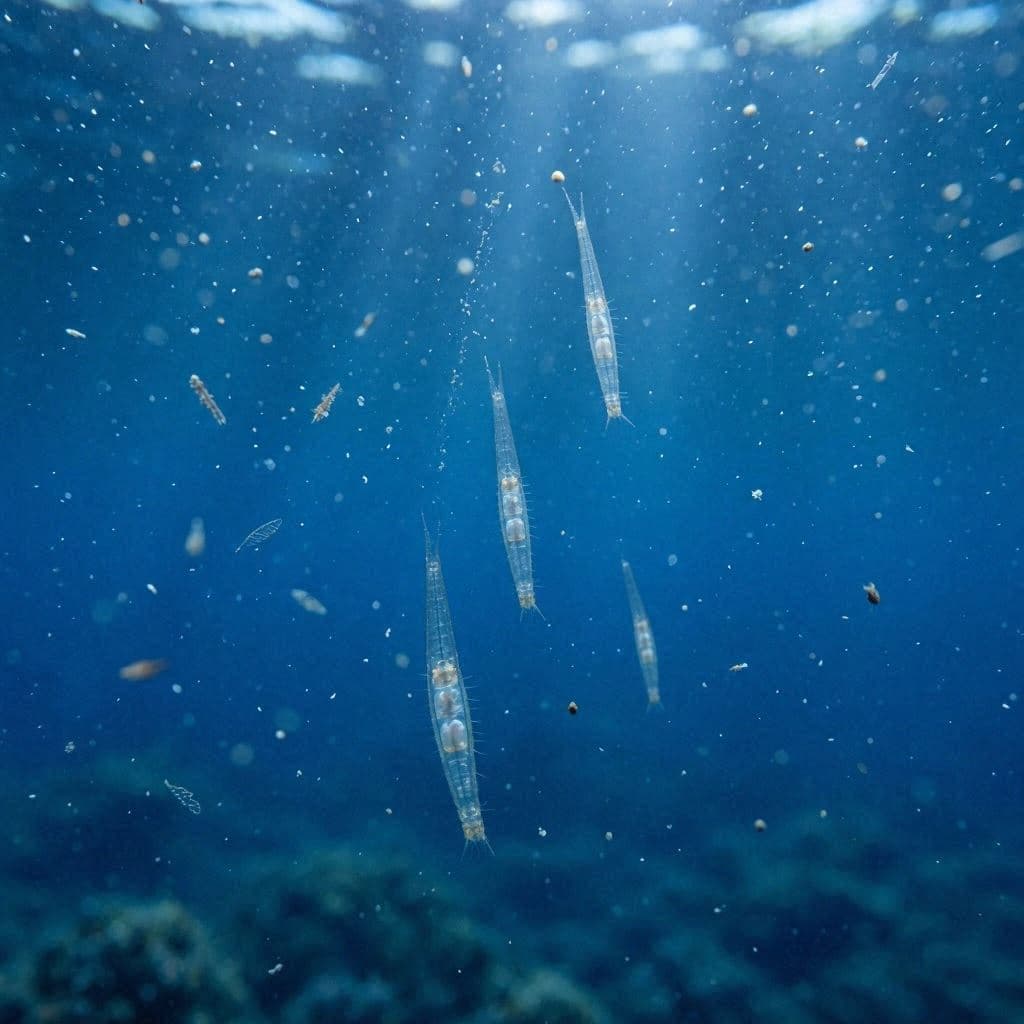
Some of nature's greatest discoveries begin with its smallest inhabitants. Hidden beneath the surface of Africa's Lake Malawi, billions of tiny insect larvae perform a daily journey through dark, oxygen-poor waters. Their movements are nearly invisible to the human eye, yet they have prompted scientists to reconsider a scientific idea that has endured for decades about why insects never established themselves in the open ocean.
Researchers from the University of British Columbia investigated the lake fly larva Chaoborus edulis, an aquatic insect that migrates vertically each day. During daylight hours, the larvae descend more than 200 meters beneath the lake's surface to avoid fish predators before returning to shallower waters at night to feed. These repeated dives expose the insects to pressures far greater than previously believed survivable for animals with air-filled respiratory structures.
For many years, scientists proposed that insects failed to colonize the open ocean because their tracheal breathing system, which contains air-filled tubes and sacs, would collapse under intense hydrostatic pressure. That explanation appeared consistent with the observation that, although insects thrive in freshwater habitats, virtually none inhabit the deep pelagic ocean. The new study, however, suggests that pressure alone may not fully explain this long-standing evolutionary puzzle.
Detailed examinations revealed that the larvae possess modified air sacs functioning much like miniature ballast tanks. Their walls contain resilin, a highly elastic protein that changes its mechanical properties as the larvae adjust the pH within the tissue. This remarkable adaptation enables the air sacs to expand and contract while resisting collapse under extreme pressure, allowing the insects to maintain buoyancy during deep dives. Laboratory testing showed that the largest larvae could withstand pressures equivalent to depths exceeding 500 meters.
The findings indicate that the insects' respiratory structures are considerably more resilient than scientists had assumed. Rather than imploding under pressure, the reinforced air sacs remain functional throughout the larvae's daily migrations. This discovery challenges a central physiological argument explaining the absence of insects from the open ocean, although it does not eliminate other ecological or evolutionary factors that may still prevent marine colonization.
Researchers emphasize that the study does not suggest insects will soon occupy the world's oceans. Marine environments present numerous additional challenges, including salinity, competition with established marine animals, reproductive constraints, and food-web dynamics. The research instead narrows the list of possible explanations by demonstrating that extreme underwater pressure is not necessarily an insurmountable barrier for all insects.
Beyond evolutionary biology, the discovery may influence engineering and materials science. Understanding how tiny biological structures withstand repeated compression could inspire new buoyancy-control technologies or pressure-resistant materials for underwater robotics. Such applications illustrate how observations from even the smallest organisms can contribute to advances far beyond their natural habitats.
The lake fly larvae of Lake Malawi remind scientists that long-accepted ideas often evolve alongside new evidence. Rather than overturning decades of research, the discovery refines our understanding of insect evolution and highlights the importance of testing even the most familiar hypotheses against careful observation. In the quiet depths of an African lake, these tiny divers have opened a broader conversation about life's remarkable capacity to adapt.
AI Image Disclaimer: The accompanying illustrations are AI-generated visual interpretations based on published scientific research and are intended solely to represent the biological concepts described in this article.
Sources (Verified):
Science University of British Columbia (UBC) EurekAlert! Popular Science
Published by Banx Network. This article is part of the Banx decentralized media programme, powered by the BXE token on the XRP Ledger.