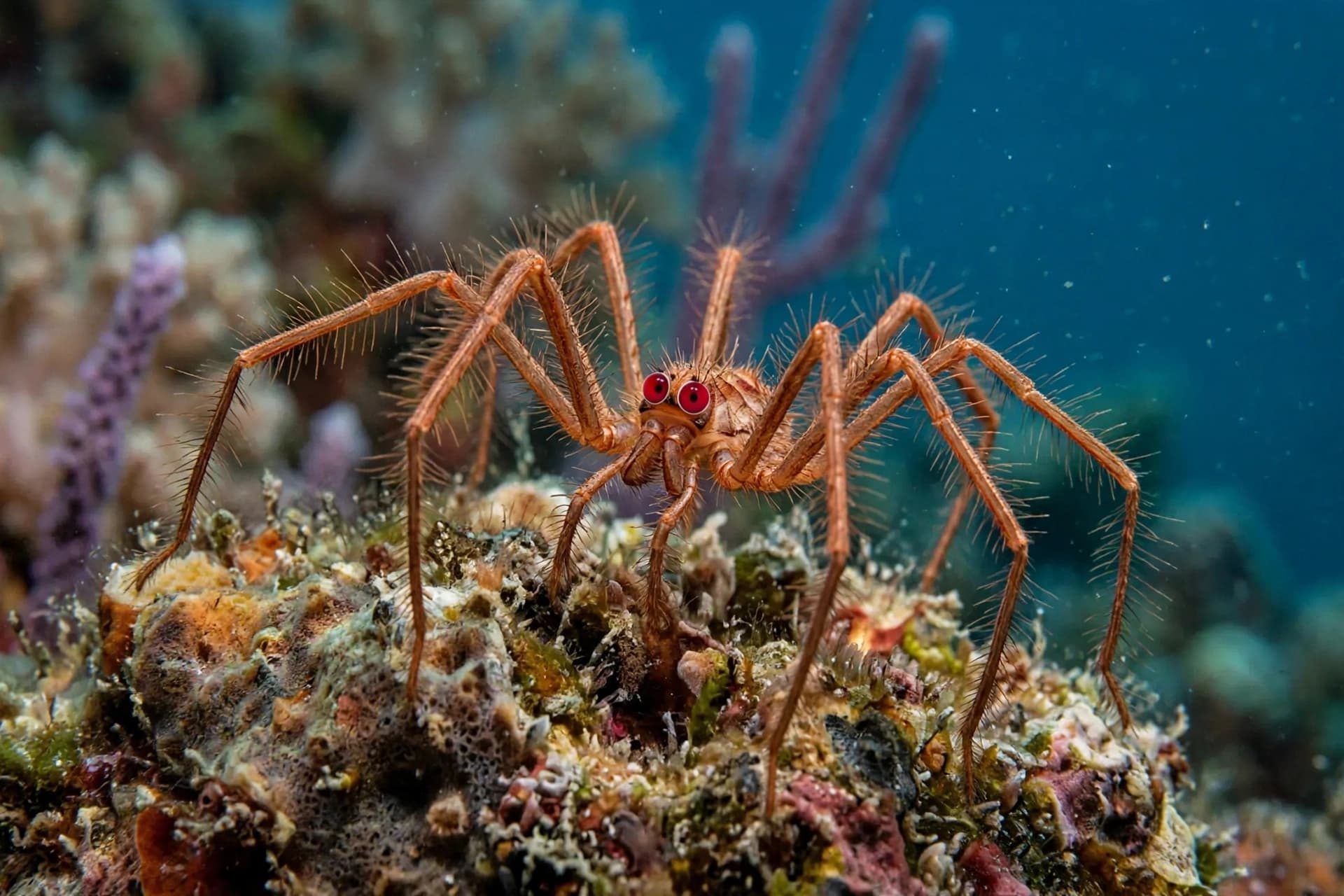
In the cold, dark depths of the Salish Sea, a creature of unusual appearance has emerged from the shadows of scientific obscurity. With legs covered in fine hairs, eyes that glow a striking red, and a body structure that seems to defy conventional aesthetics, the newly discovered sea spider, Callipallene pilosuspedes, has captured the imagination of researchers and the public alike. While some may find its features unsettling, others see a marvel of evolutionary adaptation in one of the ocean’s most enigmatic inhabitants.
Researchers from the University of British Columbia identified the species during a survey of marine biodiversity in the Pacific Northwest. The name pilosuspedes derives from Latin, meaning "hairy feet," a direct reference to the spines covering its lower legs. This distinctive feature, along with its three-lipped proboscis, sets it apart from other known sea spiders, marking it as a unique addition to the region’s ecological tapestry.
Sea spiders, or pycnogonids, are marine arthropods that have existed for hundreds of millions of years. They are characterized by their long, slender legs and small bodies, often appearing almost all-legs. Despite their spider-like appearance, they are not true spiders and belong to a separate class of arthropods. Their peculiar anatomy allows them to navigate the complex environments of the seafloor, feeding on soft-bodied invertebrates.
The discovery of Callipallene pilosuspedes is significant because it is one of the first new sea spider species described from the Salish Sea in nearly a century. This highlights the extent to which even well-studied regions can still hold secrets. The Salish Sea, a complex estuarine system, supports a rich diversity of life, much of which remains undocumented.
The "red-eyed" feature of the species adds to its distinctiveness. In the dim light of the ocean floor, these eyes may play a role in detecting prey or avoiding predators. The combination of sensory adaptations and physical structures illustrates the intricate ways in which organisms evolve to survive in their specific niches. It is a reminder that beauty in nature is often defined by function rather than form.
Public reaction to the discovery has been mixed, with some describing the creature as "nightmare fuel." However, scientists emphasize the importance of looking beyond initial impressions. Each species, no matter how unusual, plays a role in its ecosystem. Understanding these roles is crucial for conservation efforts and for appreciating the complexity of marine life.
The research team used advanced imaging techniques to document the species, ensuring that its features were accurately recorded. These images serve as a valuable resource for future studies, allowing other scientists to identify the species and compare it with related organisms. The detailed documentation reflects the rigorous standards of modern taxonomic work.
As climate change and human activity impact marine environments, discoveries like this underscore the urgency of biodiversity research. Knowing what lives in our oceans is the first step toward protecting it. The hairy-legged sea spider may be small, but its existence contributes to the larger story of life in the Salish Sea.
The identification of Callipallene pilosuspedes is a testament to the enduring mystery of the natural world. It invites us to look closer at the creatures that share our planet, finding wonder in the unexpected and value in the unfamiliar. In the deep, dark waters, there is still much to learn.
AI Image Disclaimer: The images accompanying this text are AI-generated artistic interpretations of the sea spider and its habitat, not actual photographs of the specimen.
Sources: CNN University of British Columbia News Discover Wildlife EurekAlert! Nature World News
Published by Banx Network. This article is part of the Banx decentralized media programme, powered by the BXE token on the XRP Ledger.